


SBI PO 4-Week Study Plan is the perfect roadmap for candidates who want to complete the Prelims syllabus in one month with smart preparation. With the SBI PO notification 2026 released for 1500 vacancies and prelims is expected to be held in August 2026, every day becomes valuable. Following a structured weekly plan helps you cover the complete syllabus, improve speed, and revise effectively. If you study for 6–8 hours daily, practise mock tests regularly, and analyse your mistakes, you can maximise your chances of clearing the SBI PO Prelims on your first attempt.
SBI PO 4-Week Study Plan 2026: Overview
Preparing for SBI PO in just four weeks becomes much easier when you divide the syllabus into weekly goals. The SBI PO study plan focuses on learning concepts first, then improving speed, followed by revision and mock tests.

| Particular | Details |
| Exam | SBI PO 2026 |
| Stage | Preliminary Examination |
| Duration of Study Plan | 4 Weeks |
| Daily Study Hours | 6–8 Hours |
| Mock Tests | 1 Full-Length Mock Daily (Final Week) |
| Focus Areas | Quantitative Aptitude, Reasoning Ability, English Language, General Awareness |
| Difficulty Level | Moderate to High |
Before You Start: Know the Exam Pattern
The SBI PO Prelims exam pattern consists of 3 sections. Each section gets exactly 20 minutes. Once the timer ends, the section locks. You cannot go back.

- English Language — 30 questions, 30 marks, 20 minutes
- Quantitative Aptitude — 35 questions, 35 marks, 20 minutes
- Reasoning Ability — 35 questions, 35 marks, 20 minutes
There is 0.25 negative marking per wrong answer. There is no sectional cut-off — only an overall qualifying score.
For the General category, target 70+ marks to stay comfortably above the expected cut-off. The 2025 cut-off was 66.75, so don’t aim to just scrape through.
Want to know where you stand right now? Take a free SBI PO Mock Test on PracticeMock before starting Week 1. Your score will tell you exactly which section to prioritise.
Also Read: SBI PO Salary 2026
Week 1: Build Your Core Concepts
The first week of the SBI PO 4-Week Study Plan should focus on building a strong foundation. Avoid solving very difficult questions during this phase. Instead, understand concepts, learn formulas, and practise basic questions from every topic.
Quantitative Aptitude: Start with topics that appear regularly in the SBI PO exam and strengthen your calculation speed. During this week, revise multiplication tables, squares up to 30, cubes up to 20, percentage conversions, and fraction values. Fast calculations save valuable time during the examination.
Focus on:
- Number Series
- Quadratic Equations
- Simplification & Approximation
- Percentages
- Ratio & Proportion
- Profit & Loss
Reasoning Ability: Reasoning contains several scoring topics that can be mastered with practice. These topics require less time in the actual exam and help you secure quick marks.
Focus on:
- Inequalities
- Syllogism
- Coding-Decoding
- Direction Sense
- Blood Relations
- Alphanumeric Series
English Language: Instead of memorising grammar rules only, improve your reading habit from Day 1. Regular reading improves Reading Comprehension, vocabulary, and sentence correction simultaneously.
Focus on:
- Reading one newspaper editorial (30 minutes)
- Learning 15–20 new vocabulary words
- Revising grammar concepts:
- Subject-Verb Agreement
- Articles
- Tenses
- Prepositions
- Error Spotting basics
General Awareness: General Awareness preparation should begin from the very first day because it cannot be completed overnight. A small daily revision is much easier than trying to study everything during the last week.
Focus on:
- Reading Daily Current Affairs.
- Start covering the last three months of Banking & Financial Awareness.
- Make short notes for revision.
Week 1 Goals: By the end of Week 1, you should be able to:
- Complete the basic Quantitative Aptitude topics.
- Solve Number Series and Quadratic Equation questions confidently.
- Understand all major Reasoning concepts.
- Build a daily newspaper-reading habit.
- Cover one month of Current Affairs.
- Attempt one sectional mock test for each subject.
Week 2: Increase Your Speed and Accuracy
The second week of the SBI PO 4-Week Study Plan should focus on improving speed. Since the SBI PO Prelims is a time-bound exam, solving questions quickly is just as important as solving them correctly.
Quantitative Aptitude: Move from basic concepts to application-based questions. While solving calculations, use mental math wherever possible. Break larger calculations into smaller parts instead of solving everything traditionally. Practice at least 2–3 DI sets every day.
Focus on:
- Data Interpretation (Table, Bar Graph, Pie Chart)
- Missing Number DI
- Caselet DI
- Simplification Revision
Reasoning Ability: It is the right time to begin puzzle practice. Initially, don’t worry about speed. Focus on understanding how clues connect with each other. Regular practice improves pattern recognition much faster.
Focus on:
- Linear Seating Arrangement
- Circular Seating Arrangement
- Floor-based Puzzles
- Box-based Puzzles
Once comfortable, solve:
- 2–3 puzzles every day
- One puzzle within 6–8 minutes
English Language: Move towards comprehension-based questions. Continue reading newspaper editorials daily for at least 30 minutes. This habit naturally improves reading comprehension.
Focus on:
- Reading Comprehension
- Para Jumbles
- Error Spotting
- Cloze Test
While reading:
- Identify the main idea.
- Understand the author’s tone.
- Learn new vocabulary.
- Try summarising the article in two or three sentences.
General Awareness: Continue current affairs preparation alongside static topics. Revise every weekend instead of waiting until the last week.
Focus on:
- Monthly Current Affairs PDFs
- Banking Awareness
- Static GK
- Important Government Schemes
- RBI Updates
Week 2 Goals: By the end of Week 2, you should be able to:
- Solve basic DI sets comfortably.
- Complete easy puzzles within the expected time.
- Improve calculation speed.
- Attempt Reading Comprehension with better understanding.
- Complete five to six months of Current Affairs.
- Attempt two full-length sectional tests.
Daily Practice Targets (Week 2)
Following these daily targets will help you stay consistent with your SBI PO 4-Week Study Plan. Regular practice improves speed, accuracy, and confidence while ensuring you complete the syllabus on time.
| Subject | Daily Target |
| Quantitative Aptitude | 40–50 Questions + 2 DI Sets |
| Reasoning Ability | 25–30 Questions + 2–3 Puzzles |
| English Language | 2 RC Passages + Grammar Practice |
| General Awareness | 1 Daily CA Quiz + Monthly Revision |
| Revision | 30 Minutes |
Week 3: Master the High-Level Topics
Now, the focus of your SBI PO 4-Week Study Plan shifts towards difficult topics that require more practice and logical thinking. This week also prepares you for questions that are slightly above the Prelims level, making the actual exam feel easier.
Quantitative Aptitude: Concentrate on important arithmetic topics that frequently appear in the SBI PO exam. Don’t rush to learn new shortcuts. Instead, improve your question selection and calculation speed.
Focus on:
- Time and Work
- Time, Speed and Distance
- Simple & Compound Interest
- Partnership
- Mixture and Alligation
- Data Interpretation Revision
Solve at least:
- 2 Arithmetic topics daily
- 2–3 DI sets
- One sectional Quant test every alternate day
Reasoning Ability: It is the time to practise advanced reasoning topics. These questions may look lengthy, but they become easier with regular practice. This gradually builds confidence without making the preparation overwhelming. A good strategy is to solve one easy, moderate, and difficult puzzle everyday.
Focus on:
- Input-Output
- Logical Reasoning
- Advanced Seating Arrangement
- Double Line-up Puzzles
- Month & Date-based Puzzles
- Mixed Variable Puzzles
English Language: Continue strengthening your English section by practising exam-level questions.
Focus on:
- Cloze Test
- Sentence Rearrangement
- Reading Comprehension
- Vocabulary Revision
- Phrase Replacement
While solving Reading Comprehension, don’t read only to answer questions. This habit improves both speed and understanding. Instead, ask yourself:
- What is the passage mainly about?
- What is the author’s opinion?
- Which words are new?
General Awareness: Most of your current affairs preparation should already be completed. Spend at least 45–60 minutes daily revising Current Affairs notes.
Focus on:
- Banking Awareness
- RBI Updates
- Important Reports & Indices
- Government Schemes
- Budget Highlights
- Static Banking GK
Descriptive Paper Preparation
Although the descriptive paper is conducted after the Preliminary stage, spending a little time every week helps you prepare without pressure. Keep your writing simple, organised, and within the word limit.
Practise:
- One Essay every week
- One Formal Letter every week
Follow a Simple Daily Routine
A consistent daily schedule helps you complete the syllabus without feeling stressed. Studying for 6–8 focused hours every day is enough if you remain consistent.
| Time | Activity |
| Morning (2 Hours) | Learn New Concepts |
| Mid-Morning (2 Hours) | Topic-wise Practice Questions |
| Afternoon (1.5 Hours) | English + General Awareness |
| Evening (1.5 Hours) | Mock Test or Sectional Test |
| Night (30–45 Minutes) | Revision & Error Notebook |
End of Week 3 Targets: By the end of Week 3, you should aim to:
- Complete the entire SBI PO Prelims syllabus.
- Solve Arithmetic questions more confidently.
- Complete advanced puzzles within the expected time.
- Improve Reading Comprehension accuracy.
- Revise Current Affairs of the last six months.
- Attempt at least 3–4 full-length mock tests.
Week 4: Mock Tests, Revision & Final Preparation
The final week of your SBI PO 4-Week Study Plan should focus entirely on revision, mock tests, and improving accuracy. Strengthen what you have already learned and build confidence for the exam day. The main goal of Week 4 is to simulate the actual exam environment, identify mistakes, and avoid repeating them.
Take One Full-Length Mock Test Every Day: Mock tests are the most important part of the final week. They help you improve speed, accuracy, and time management while giving you a clear idea of your preparation level.
Focus on:
- Solving it in a distraction-free environment.
- Following the exact exam timing.
- Don’t pause the test midway.
Analyse Every Mock Test: Taking mock tests alone is not enough. Analysing your performance is equally important. Spend 1–1.5 hours reviewing every mock test. This analysis helps you improve with every mock instead of repeating the same mistakes.
While analysing, ask yourself:
- Which questions did I answer incorrectly?
- Was the mistake due to concept, calculation, or time pressure?
- Did I spend too much time on any question?
- Which section needs more revision?
Revise Important Topics Daily: Spend 45–60 minutes every day revising important concepts. Daily revision improves retention and keeps concepts fresh until the exam.
Your revision should include:
- Quant formulas
- Squares, cubes, and percentage conversions
- Puzzle approaches
- Grammar rules
- Vocabulary notes
- Banking Awareness
- Current Affairs
Attempt Sectional Tests: Along with full-length mocks, attempt one sectional test every day. Sectional tests improve both speed and confidence.
Quantitative Aptitude
- Simplification
- Number Series
- Quadratic Equations
- Data Interpretation
Reasoning Ability
- Inequalities
- Syllogism
- Coding-Decoding
- Puzzles
English Language
- Error Spotting
- Cloze Test
- Reading Comprehension
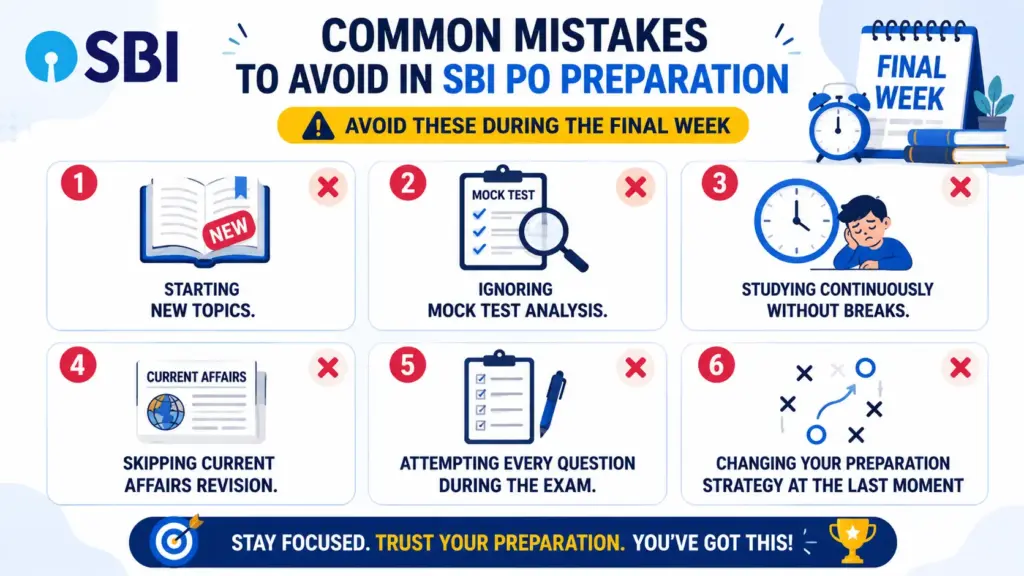
Common Mistakes to Avoid in SBI PO Preparation 2026
Many candidates lose marks because of avoidable mistakes rather than lack of preparation. Stay consistent with the plan you have followed over the last three weeks.
Why Follow a 4-Week SBI PO Study Plan 2026?
Many candidates lose marks because of small mistakes. Follow this SBI PO 4-Week Study Plan, stick to your routine, revise daily, and avoid changing your strategy in the final week. Following a proper study plan helps you:
- Complete the entire SBI PO Prelims syllabus on time.
- Improve speed and accuracy through daily practice.
- Revise important topics regularly.
- Build confidence before the examination.
- Identify weak areas through mock test analysis.
SBI PO Daily Study Time Distribution (6–8 Hours)
To complete the syllabus within four weeks, divide your study hours across all four sections. This ensures balanced preparation without ignoring any subject. The SBI PO 4-Week Study Plan helps you improve conceptual understanding while giving enough time for revision and practice.
| Subject | Daily Time |
| Quantitative Aptitude | 2 Hours |
| Reasoning Ability | 2 Hours |
| English Language | 1.5 Hours |
| General Awareness | 1.5 Hours |
| Revision & Mock Analysis | 1 Hour (Flexible) |
Final Thoughts
Following a well-planned SBI PO 4-Week Study Plan can help you complete the Prelims syllabus without feeling overwhelmed. Focus on learning concepts during the first week, improving speed in the second week, practising difficult topics in the third week, and revising through mock tests in the final week. Stay consistent, analyse your mistakes, and revise regularly. With disciplined preparation and daily practice, you can significantly improve your chances of clearing the SBI PO 2026 Preliminary examination.
Related Blogs
FAQs
1. Is a 4-week study plan enough to crack SBI PO Prelims?
Yes. If you already know the basics and study consistently for 6–8 hours daily, a structured SBI PO 4-Week Study Plan can help you complete the syllabus, revise effectively, and perform well in the Prelims exam.
2. How many hours should I study daily for SBI PO?
You should study for around 6–8 focused hours every day. Divide your time among Quantitative Aptitude, Reasoning Ability, English Language, General Awareness, revision, and mock tests.
3. How many mock tests should I take during the final week?
During the last week, it is recommended to take one full-length mock test every day and spend enough time analysing your mistakes after each test.
4. Which topics should I complete first?
Begin with high-scoring topics such as Simplification, Number Series, Quadratic Equations, Inequalities, Syllogism, Coding-Decoding, Error Spotting, and Reading Comprehension before moving to advanced topics.
5. Should I study General Awareness every day?
Yes. Reading daily current affairs and revising Banking Awareness regularly helps you prepare for the Mains examination while building a strong knowledge base.
6. Is mock test analysis really important?
Absolutely. Analysing your mock tests helps identify weak areas, improves time management, and reduces repeated mistakes, making it one of the most important parts of SBI PO preparation.
7. Can beginners follow this SBI PO 4-Week Study Plan?
Yes. Beginners can follow this study plan by focusing on understanding concepts first, practising daily, and gradually increasing their speed through sectional and full-length mock tests.
8. What should I avoid during the final week?
Avoid learning new topics, changing your preparation strategy, skipping revision, and ignoring mock test analysis. Focus only on revision, practice, and improving accuracy during the final week.
- Sign Up on Practicemock for Updated Current Affairs, Topic Tests and Mini Mocks
- Sign Up Here to Download Free Study Material
Free Mock Tests for the Upcoming Exams
- IBPS PO Free Mock Test
- RBI Grade B Free Mock Test
- IBPS SO Free Mock Test
- NABARD Grade A Free Mock Test
- SSC CGL Free Mock Test
- IBPS Clerk Free Mock Test
- IBPS RRB PO Free Mock Test
- IBPS RRB Clerk Free Mock Test
- RRB NTPC Free Mock Test
- SSC MTS Free Mock Test
- SSC Stenographer Free Mock Test
- GATE Mechanical Free Mock Test
- GATE Civil Free Mock Test
- RRB ALP Free Mock Test
- SSC CPO Free Mock Test
- AFCAT Free Mock Test
- SEBI Grade A Free Mock Test
- IFSCA Grade A Free Mock Test
- RRB JE Free Mock Test
- Free Banking Live Test
- Free SSC Live Test