



Blood Relations is an important part of the Reasoning Ability section in the RBI Grade B Phase 1 exam. It tests the candidates’ ability to understand and process relationships based on the given data. This topic is common in most Reasoning sections and is very scoring. But only if you can solve it quickly and correctly. Many students confuse themselves with words like maternal uncle or daughter-in-law. Especially when complicated family trees are involved. This blog will guide you with smart and effective tips to solve Blood Relations questions fast and accurately. You’ll also find some sample questions with solutions to help you strengthen your preparation and boost your speed in this key topic.
RBI Tests Blood Relations
Blood Relations questions in RBI exams test logical reasoning and analytical ability. PracticeMock provides a wide range of RBI-level Blood Relation questions based on actual exam patterns. These include direct, coded, and puzzle-based problems like: “Pointing to a girl, Raj said, ‘She is the daughter of the only sister of my father.’ How is the girl related to Raj?” Such questions demand a clear understanding of family hierarchies and relationship chains. Practicing regularly with these mock tests improves speed and accuracy. Detailed solutions and tricks provided by PracticeMock help candidates master even the most complex relation-based problems effectively.

Tips to Solve Blood Relations Questions Quickly
Before we dive into the sample questions, let’s take a look at the best tips to master Blood Relations questions:
1. Always Start by Drawing a Family Tree
Don’t try to solve these questions in your head. It’s easy to get lost. Use symbols or letters to represent family members and link them logically.
Here are some tips:
- Use M for Male and F for Female.
- Use arrows or lines to show relationships (→ for child, ↑ for parent).
- Keep generations clearly separated.
- Avoid rewriting the entire question—just map it out.
- It saves time and reduces confusion.
2. Pay Close Attention to Gender Clues
Many questions hinge on gender-specific roles like brother, sister, aunt, etc. To answer such questions, never assume gender and find keywords.
Here’s how to do it:
- Look for pronouns like he, she, his, her.
- Confirm gender with context.
- If gender isn’t given, keep it open while solving.
- Incorrect gender assumptions cause errors.
- Highlight gender clues while reading the question.
3. Use Reverse Logic When Required
Sometimes, it’s easier to start from the end of the statement. So, try solving it backwards if the forward way seems confusing.
Let’s break it down:
- Start with the last part of the statement.
- Work backward to the starting point.
- It clears the picture in complex, nested statements.
- This trick works especially well with “How is A related to B?” type questions.
- Reverse solving helps in eliminating options faster too.
4. Practice Different Patterns Regularly
Blood Relations questions come in multiple formats. Hence, you need to practice all common types to increase confidence and accuracy.
Use this simple process:
- Statement-based questions.
- Puzzle-style or coded relationships.
- Mixed with directions or seating arrangement.
- Solve previous year questions regularly.
- Track new patterns in recent exams.
5. Time Yourself During Practice
Speed matters a lot in the RBI Grade B exam. So, cultivate a habit of solving each question in under 1 minute.
Here’s the way to go about it:
- Use a timer while solving practice sets.
- Bit by bit, increase your solving speed with tougher questions.
- Note your mistakes and revisit confusing types.
- Try sectional tests focused only on Blood Relations.
- Recreate real exam conditions during practice.
Mistakes to Avoid while Solving Blood Relation Questions
Now that you’ve understood the concept and tricks to solve blood relation questions, you must refer to the sample questions below and start practising. You must practice at least 50 questions to get a good understanding of this topic and to get a smooth flow when solving the questions. It’s imperative that when solving blood relations questions, you will make some mistakes. To avoid this situation, we are providing you with a list of ‘mistakes to avoid’. Knowing and avoiding these mistakes will definitely save you a lot of time, effort and marks. Have a look:
Misinterpreting Speaker’s Perspective
Sometimes a question has a narrator who describes their situation: “The sister of my father’s uncle…”. In this kind of situation, always assume the narrator as yourself and proceed with solving the question. If you go by the narrator’s perspective, it may take some time to draw the family-tree whereas when you assume yourself the narrator, you can visualize your own family, check the relations and answer the question in less time.
Assuming Gender from Name
Who is Golu? Male or female? What about Lucky or Kiran? These names can create confusion in an aspirant’s mind, as they may be biased towards some names being male or female. Never assume any gender because of names and keep all the options open.
‘Only Son’ or ‘Only Child’ Confusion
If the info ‘only son’ is provided it means that parents don’t have any other son but they may have a number of daughters. Keep this in mind.
Mixing up Maternal and Parental Sides
In a complex question, you may get confused about maternal and parental relationships. The best policy in this case is to draw a family tree where you have clearly branched out the relatives of both sides.
Ignoring Keywords
You need to pay special attention to keywords such as ‘only’, ‘not’, ‘either’ and ‘neither’. Usage of these words carry a lot of weightage and even a little bit of misinterpreation can change the answer of the question.
Sample Blood Relations Test Questions for Practice
Directions [1-2]: Answer the questions based on the information given below:
In a certain language,
‘A $ B’ means ‘B is wife to A’,
‘A # B’ means ‘A is daughter of B’,
‘A @ B’ means ‘B is son of A’,
‘A % B’ means ‘A is mother of B’,
‘A & B’ means ‘B is sister of A’,
‘A © B’ means ‘A is husband of B’.
Question 1: If “P $ Q & R # S © T & U @ O © L % N” is definitely true, then how is R related to N’s father’s mother?
A) Aunt
B) Mother-in-law
C) Niece
D) Daughter-in-law
E) Cannot be determined
Solution:
Given code: P $ Q & R # S © T & U @ O © L % N
After decoding the code, we get
P is husband of Q, who is sister of R. S is father of R and husband of T. U is sister of T. O is son of U. L is wife of O, who is father of N.
We draw the following family tree:
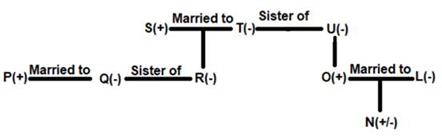
Here, N’s father’s mother is U.
R is the niece of U.
Hence, option c.
Question 2: If “C © E @ G & D % F # H @ J $ K” is definitely true, then how is J’s spouse related to C’s only daughter?
A) Granddaughter
B) Grandson
C) Daughter-in-law
D) Nephew
E) Cannot be determined
Solution:
Given code:
After decoding the code, we get
C is husband of E. G and D are children of E. D is wife to H. H is father of F and J. J is husband of K.
We draw the following family tree:
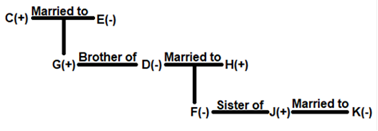
J’s spouse is K and C’s only daughter is D.
K is daughter-in-law of D.
Hence, option c.
Directions [3-5]: Answer the questions based on the information given below:
A % B means A is married to B
A # B means A is father of B
A & B means A is sister of B
A $ B means A is son of B
A β B means A is daughter-in-law of B
A ≤ B means A is father-in-law of B
A π B means A is maternal uncle of B
A ≠ B means A is mother of B
A µ B means A is niece of B
H % K, K $ L, L β P, P π V, G & V, N # V, F ≤ H, N % X
Common solution:
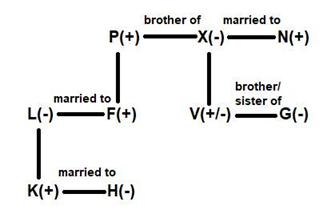
After decoding the codes, we get:
H % K means H is married to K.
K $ L means K is son of L.
L β P means L is daughter-in-law of P
P π V means P is maternal uncle of V
G & V means G is sister of V
N # V means N is father of V
F ≤ H means F is father-in-law of H
N % X means N is married to X.
The blood relation tree we can draw using the above information is:
Question 3: If ‘V µ Q & P’, the how many female members are there in the family (including Q)?
A) Three
B) Five
C) Four
D) Six
E) Either ‘b’ or ‘d’
Solution:
There are six female members in the family (including Q).
Hence, option d.
Question 4: Which of the following statement/statements are definitely true?
I. G is daughter-in-law of N.
II. K is grandson of P.
III. Gender of H and G is same.
A) Only I
B) Only II and III
C) Only I and III
D) Only III
E) All I, II and III
Solution:
Statements:
I. G is daughter-in-law of N – False (G is daughter of N)
II. K is grandson of P – True
III. Gender of H and G is same – True
Only II and III are true.
Hence, option b.
Question 5: If ‘V ≠ E & L $ J’, then how is how is G related to L?
A) Mother-in-law
B) Paternal aunt
C) Maternal aunt
D) Grandmother
E) None of the above
Solution:
After decoding the codes, we get:
V ≠ E means V is mother of E
E & L means E is sister of L
L $ J means L is son of J
Therefore, the family tree we get after adding the above information:
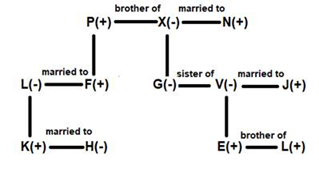
So, G is maternal aunt of L.
Hence, option c.

Takeaway
Blood Relations may look confusing at first, but once you practice regularly with the right strategies, it becomes one of the most scoring topics in Reasoning. Build your basics, stay consistent, and keep testing yourself. Want to improve your accuracy and speed? Start your journey with PracticeMock’s Free RBI Grade B Mock Test and explore our online courses crafted to multiply your preparation 10x.
RBI Blood Relation Test: FAQs
Use a family tree to visualize the relationships clearly.
Try to solve each one in under 1 minute.
Yes, they are common in the Reasoning section of Phase 1.
Practice regularly and break statements into smaller parts.
Yes, but combine mock tests with theory and revision for the best results.
Join our unique Telegram group immediately to skyrocket your preparation for Regulatory exams via expert guidance, top tips, perfect feedback, and much more!
[ Click Here to join the PracticeMock Telegram Group! ]
[ Click Here to join the PracticeMock Telegram Discussion Group Link! ]
Also, go through the 60 days Study Plan for the RBI Grade B Exam 2025
Related Posts:
- Sign Up on Practicemock for Updated Current Affairs, Topic Tests and Mini Mocks
- Sign Up Here to Download Free Study Material
Free Mock Tests for the Upcoming Exams
- IBPS PO Free Mock Test
- RBI Grade B Free Mock Test
- IBPS SO Free Mock Test
- NABARD Grade A Free Mock Test
- SSC CGL Free Mock Test
- IBPS Clerk Free Mock Test
- IBPS RRB PO Free Mock Test
- IBPS RRB Clerk Free Mock Test
- RRB NTPC Free Mock Test
- SSC MTS Free Mock Test
- SSC Stenographer Free Mock Test
- GATE Mechanical Free Mock Test
- GATE Civil Free Mock Test
- RRB ALP Free Mock Test
- SSC CPO Free Mock Test
- AFCAT Free Mock Test
- SEBI Grade A Free Mock Test
- IFSCA Grade A Free Mock Test
- RRB JE Free Mock Test
- Free Banking Live Test
- Free SSC Live Test