


Updated on 19 June 2026 as per latest official notification.
The Bank exam tests your calculation skills on multiple quantitative aptitude topics. Some questions are also based on percentages. These questions play an important part in maximizing the overall quantitative aptitude score. This topic features questions related to profit and loss, data interpretation, discount calculations, etc. You will also face questions on the Percentage to Fraction conversion. As there are time constraints of the exam, mastering the conversions is essential for handling both simple and complicated question topics quickly and accurately. Read on to check out the essential points required for solving difficult or time-consuming questions based on percentages and lengthy calculations. Also, get a free Percentage to Fraction table PDF.
Why Percentage Questions Matter in Bank Exams
Percentage questions in bank exams do make it tough for the candidates to think analytically to solve every problem regarding fraction and decimal conversion. Candidates, who practice sufficiently succeed in converting and applying these percentages quickly. They are habituated to solving numerous time-consuming problems quickly. This understanding and practice are very much needed in day-to-day banking. Therefore, it is essential to master the art of converting Percentages to Fractions, and vice-versa.

Percentage to Fraction Table
Understanding percentage-to-fraction conversions can greatly help quick calculations. Here is a quick conversion table to make fraction and decimal equivalents easy to memorize.
| Fraction | Decimal | Percent |
| 1/32 | 0.03125 | 3.125% |
| 1/16 | 0.0625 | 6.25% |
| 1/12 | 0.08333… | 8.333…% |
| 1/10 | 0.1 | 10% |
| 1/9 | 0.111… | 11.111…% |
| 1/8 | 0.125 | 12.5% |
| 1/6 | 0.1666… | 16.666…% |
| 1/5 | 0.2 | 20% |
| 2/9 | 0.222… | 22.222…% |
| 1/4 | 0.25 | 25% |
| 3/8 | 0.375 | 37.5% |
| 2/5 | 0.4 | 40% |
| 4/9 | 0.444… | 44.444…% |
| 1/2 | 0.5 | 50% |
| 5/9 | 0.555… | 55.555…% |
| 3/5 | 0.6 | 60% |
| 5/8 | 0.625 | 62.5% |
| 2/3 | 0.666… | 66.666…% |
| 3/4 | 0.75 | 75% |
| 7/9 | 0.777… | 77.777…% |
| 4/5 | 0.8 | 80% |
| 5/6 | 0.8333… | 83.333…% |
| 7/8 | 0.875 | 87.5% |
| 8/9 | 0.888… | 88.888…% |
Key Calculation Tips
- When handling increases or decreases in percentages, knowing the formulae for percentage change and percentage difference is essential.
- For questions involving population growth or similar trends, understanding the formula for compounded percentage change over time can be particularly helpful.
Practical Application
Questions about changes in values over time, such as profit or commodity price shifts, are common and rely on quick percentage calculations. It is absolutely important to understand how such concepts need to be applied to banking, which is why advanced knowledge of their usage is crucial.
Bank Exams Fraction to Percentage Table 1 to 100 and Chart
Fraction to Percentage conversion table for numbers 1 to 100, which is useful for bank exams, has been provided below.
Fraction to Percentage Table (1 to 100)
| Fraction | Percentage | Fraction | Percentage | Fraction | Percentage |
|---|---|---|---|---|---|
| 1/1 | 100% | 1/2 | 50% | 1/3 | 33.33% |
| 1/4 | 25% | 1/5 | 20% | 1/6 | 16.67% |
| 1/7 | 14.29% | 1/8 | 12.5% | 1/9 | 11.11% |
| 1/10 | 10% | 1/11 | 9.09% | 1/12 | 8.33% |
| 1/13 | 7.69% | 1/14 | 7.14% | 1/15 | 6.67% |
| 1/16 | 6.25% | 1/17 | 5.88% | 1/18 | 5.56% |
| 1/19 | 5.26% | 1/20 | 5% | 1/25 | 4% |
| 1/30 | 3.33% | 1/33 | 3.03% | 1/40 | 2.5% |
| 1/50 | 2% | 1/60 | 1.67% | 1/75 | 1.33% |
| 1/80 | 1.25% | 1/90 | 1.11% | 1/100 | 1% |
Percentage to Fraction Usage in Solving Arithmetic Question
Try to solve it by using the conversion tricks provided to you.
Question
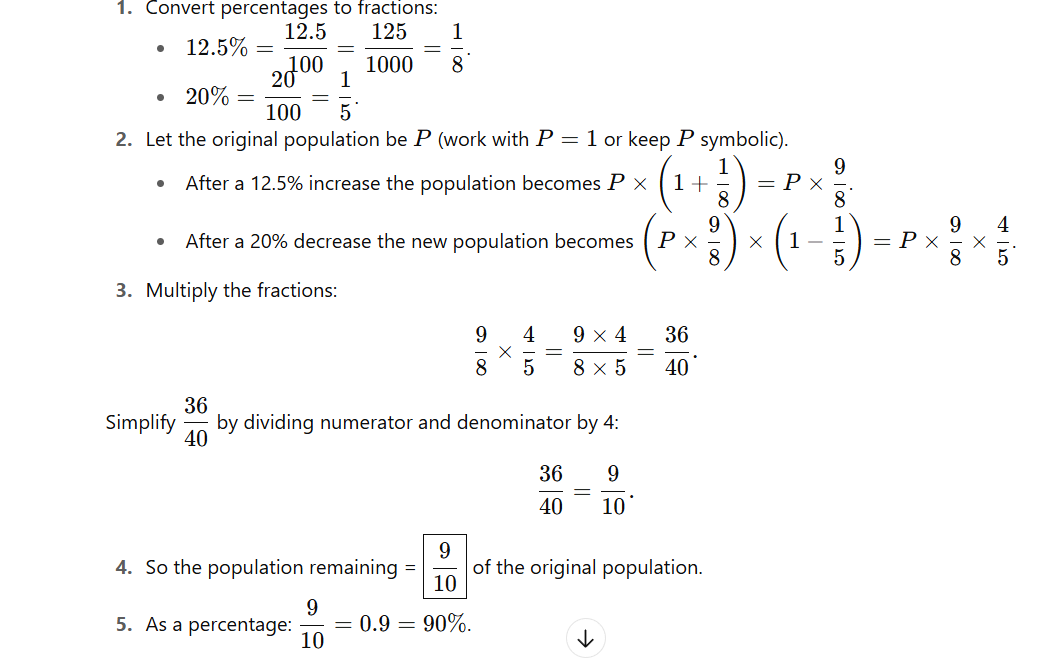
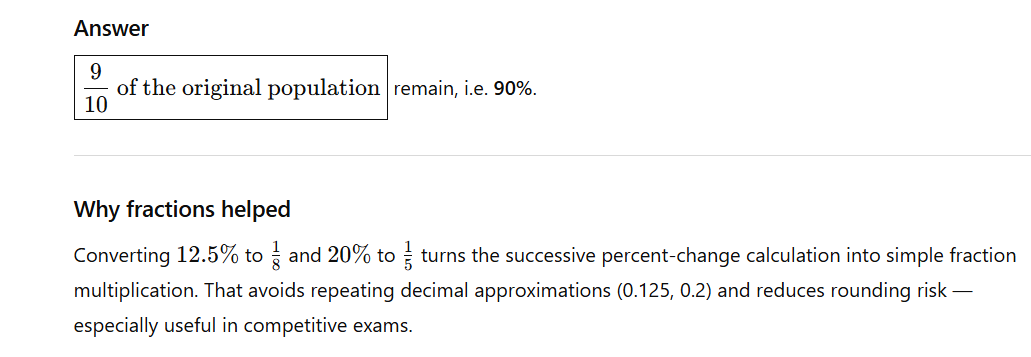
A town’s population first increases by 12.5% in one year and then decreases by 20% the next year. What fraction of the original population remains after these two years? Also give the answer as a percentage.
Solution
Conclusion
A good practice of Percentage questions will increase the problem-solving speed and accuracy, which an exam like the bank and insurance exam demands. A mastery of the rules above can prove advantageous. It can help you successfully deal with percentage questions quickly and thereby raise your overall score.
To improve your exam preparation, try PracticeMock free mock test designed for SSC, Banking, Railways, Regulatory, and other major government exams.
Also Read: Best Online Coaching for Banking Exams India 2026
Also Read: SBI PO Online Coaching 2026
| Attempt a Banking Mock Test Today | ||
| IBPS Clerk Mock Test | SBI PO Mock Test | IBPS RRB PO Mock Test |
| IBPS PO Mock Test | SBI Clerk Mock Test | IBPS RRB Clerk Mock Test |
Percentage to Fraction Table FAQs
The Percentage questions play an important role in maximizing the overall quantitative aptitude score.
It enables candidates to solve both simple and complicated problems accurately and efficiently under time constraints.
The blog provides a conversion table with common fractions, decimals, and their percentage equivalents.
Understanding percentage change formulas and their real-world applications, like profit or price shifts, is important.
Yes, regular practice boosts speed and accuracy. It enables candidates to handle tricky percentage problems quickly.
SBI PO in-hand salary ranges from Rs 80,000 to Rs 82,000
- Sign Up on Practicemock for Updated Current Affairs, Topic Tests and Mini Mocks
- Sign Up Here to Download Free Study Material
Free Mock Tests for the Upcoming Exams
- IBPS PO Free Mock Test
- RBI Grade B Free Mock Test
- IBPS SO Free Mock Test
- NABARD Grade A Free Mock Test
- SSC CGL Free Mock Test
- IBPS Clerk Free Mock Test
- IBPS RRB PO Free Mock Test
- IBPS RRB Clerk Free Mock Test
- RRB NTPC Free Mock Test
- SSC MTS Free Mock Test
- SSC Stenographer Free Mock Test
- GATE Mechanical Free Mock Test
- GATE Civil Free Mock Test
- RRB ALP Free Mock Test
- SSC CPO Free Mock Test
- AFCAT Free Mock Test
- SEBI Grade A Free Mock Test
- IFSCA Grade A Free Mock Test
- RRB JE Free Mock Test
- Free Banking Live Test
- Free SSC Live Test