


What is a CIBIL Score? It is one of the most important concepts in Banking Awareness and Personal Finance. Understanding the CIBIL Score helps banking aspirants answer exam questions and build financial awareness. A good credit score also improves your chances of getting loans and credit cards in the future.
In this article, you will learn everything about the CIBIL credit score, how it is calculated, why it matters, and why every banking aspirant should understand it. AScore is often called your financial report card because it shows banks how responsibly you manage loans and credit card payments.

What is a CIBIL Score: Quick Highlights
A CIBIL Score is a three-digit number ranging from 300 to 900 that represents an individual’s creditworthiness. It is issued by TransUnion CIBIL based on your credit history, repayment behaviour, credit utilisation, and borrowing habits. Banks and financial institutions use this score to assess whether they should approve a loan or credit card application. Generally, a score above 750 is considered good and improves your chances of faster loan approval and better interest rates.
- The Score ranges from 300 to 900
- Calculated by TransUnion CIBIL
- Reflects your credit behaviour
- Higher score improves loan eligibility
- Frequently asked topic in Banking Awareness exams
Who Calculates the CIBIL Score?
The CIBIL credit score is calculated by TransUnion CIBIL, one of India’s leading credit bureaus. Although each bureau may calculate scores slightly differently, they all analyse your credit history, repayment habits, outstanding loans, and borrowing behaviour. Apart from TransUnion CIBIL, other authorised credit bureaus include:
- Experian
- Equifax
- CRIF High Mark
How to Check Your CIBIL Score?
Checking your CIBIL Score is quick, easy, and completely safe. Regularly reviewing your score also helps you track your credit health, identify errors in your credit report, and take timely steps to improve your financial profile. You can check your score online through:
- Visit the official TransUnion CIBIL website, www.cibil.com.
- Check through other authorised credit bureaus like Experian, Equifax, and CRIF High Mark.
- Many banks and UPI apps also allow users to check their credit score for free.
- You are generally entitled to one free score and credit report every calendar year.
How is a CIBIL Score Calculated?
Your credit score is calculated using several important factors from your financial history. Understanding these factors also helps you improve your score over time.
1. Payment History
This is the most important factor. Banks check whether you have paid your EMIs and credit card bills on time.
- Timely payments improve your score.
- Missed or delayed payments reduce your score.
2. Credit Utilisation Ratio
This refers to how much credit you use compared to your available credit limit. Your credit utilisation ratio is 25%, which is considered healthy. Experts generally recommend keeping your utilisation below 30%.
For example:
- Credit Card Limit: ₹1,00,000
- Amount Used: ₹25,000
3. Length of Credit History
The longer you maintain a healthy credit history, the better your credit profile becomes. Older accounts with regular repayments build trust among lenders.
4. Credit Mix
Banks also evaluate whether you have experience managing different types of credit. Managing different types of credit responsibly strengthens your credit assessment. A balanced mix may include:
- Home Loan
- Personal Loan
- Vehicle Loan
- Education Loan
- Credit Card
5. New Credit Applications
Applying for several loans or credit cards within a short period creates multiple hard enquiries. Too many enquiries may indicate financial stress and can lower your CIBIL Score. Therefore, avoid applying for unnecessary loans frequently.
Why Should You Maintain a Good CIBIL Score?
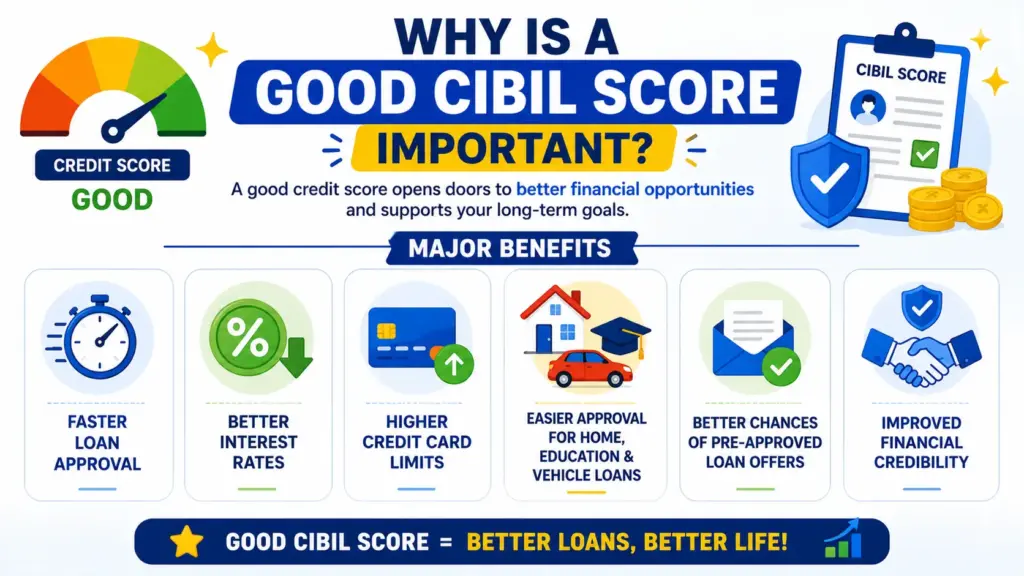
Why is a CIBIL Score Important for Banking Aspirants?
Although there is no minimum score required to appear for banking exams, understanding this topic is important for several reasons. Candidates should understand how banks assess loan applications and evaluate borrowers. Some banks, especially for loan-processing or credit-related roles, may consider an applicant’s financial background during recruitment.
Questions related to CIBIL Score, credit report, and financial awareness are frequently asked in Banking Awareness sections of exams like:
- SBI PO
- IBPS PO
- IBPS Clerk
- RBI Grade B
- NABARD
- SBI Clerk
For complete Banking Awareness preparation, also read:
- Banking Awareness Notes for SBI PO
- Important Banking & Financial Terms- Download PDF
- 50 Most Expected Banking Awareness Questions 2026 | Free Pdf Inside
What Does the CIBIL Score Range Mean?
Understanding the score range helps you know how banks view your creditworthiness. Generally, banks prefer applicants with a credit score above 750 because it reflects strong repayment behaviour.
| CIBIL Score | Meaning |
| 750–900 | Excellent credit profile |
| 700–749 | Good credit score with high approval chances |
| 650–699 | Fair credit profile |
| 600–649 | Poor credit score |
| Below 600 | Very poor; loan approval becomes difficult |
| NH/NA | No credit history available |
Tip for Banking Aspirants: While there is no minimum score required to appear for banking exams, maintaining a score above 700 is considered a good financial practice, especially if you later apply for banking jobs or loans.
CIBIL vs Credit Score: What’s the Difference?
Many candidates use these terms interchangeably, but there is a small difference. Every CIBIL Score is a credit score, but not every credit score is a CIBIL Score.
| Credit Score | CIBIL Score |
| Generic term for a credit rating | Credit score issued specifically by TransUnion CIBIL |
| Can be generated by different credit bureaus | Issued only by TransUnion CIBIL |
| Includes Experian, Equifax and CRIF High Mark scores | Exclusive to TransUnion CIBIL |
How to Improve Your CIBIL Score?
If your score is low, don’t worry. A few good financial habits can gradually improve it. Following these simple habits helps improve your credit score, credit profile, and overall financial health over time.
Pay EMIs and Credit Card Bills on Time
Payment history has the biggest impact on your score. Always pay before the due date.
Keep Credit Utilisation Low
Try to use less than 30% of your available credit limit whenever possible.
Avoid Applying for Too Many Loans
Multiple loan applications within a short period create several hard enquiries, which may lower your score.
Maintain Old Credit Accounts
Older credit accounts with a good repayment record improve your credit history.
Check Your Credit Report Regularly
Review your report for mistakes or unauthorised loans and report any errors immediately.
Common Mistakes That Reduce Your CIBIL Score
Many people unknowingly reduce their credit score because of poor financial habits. Even small improvements in these areas can significantly strengthen your credit profile. Avoid these common mistakes:
- Missing EMI or credit card payments.
- Using almost the entire credit limit.
- Closing old credit accounts without reason.
- Applying for multiple loans together.
- Ignoring errors in the credit report.
- Defaulting on loans.
What is CIBIL Score in Banking?
A CIBIL score in banking offers employees special benefits such as home loans, vehicle loans, and personal loans at lower interest rates. Before approving these staff loans, banks may review the employee’s score to assess their repayment behaviour. A healthy credit score can improve the chances of getting these benefits quickly and at better terms.
Simple Tips to Build a Good Score
- Pay all EMIs and credit card bills on time.
- Keep your credit utilisation below 30% of your available limit.
- Avoid applying for multiple loans or credit cards within a short period.
- Check your credit report regularly and correct any errors.
Final Thoughts on the CIBIL Score
Understanding about the CIBIL Score is important not only for managing your personal finances but also for succeeding in banking exams. It reflects your creditworthiness and helps lenders decide whether to approve your loan or credit card application. Although it is not mandatory for appearing in SBI, IBPS, RBI, or NABARD exams, it remains an important Banking Awareness topic. Learning how the score is calculated, its ideal range, and ways to improve it will strengthen both your exam preparation and financial knowledge.
Related Blogs on Banking
Continue your Banking Awareness preparation with:
FAQs
What is a CIBIL Score?
A CIBIL Score is a three-digit number between 300 and 900 that represents a person’s creditworthiness based on their credit history and repayment behaviour.
What is considered a good CIBIL Score?
A score of 750 or above is generally considered good and improves your chances of getting loans and credit cards approved.
Is it important for banking exams?
Yes. Although it is not required for exam eligibility, it is an important Banking Awareness topic for exams like SBI PO, IBPS PO, RBI Grade B, and NABARD.
Is CIBIL Score and Credit Score the same?
Not exactly. A credit score is a general term, while the CIBIL Score is the credit score issued specifically by TransUnion CIBIL.
Can I check my score for free?
Yes. You can check your score through the official CIBIL website or other authorised financial platforms. One free report is generally available every year.
Does checking my own CIBIL Score reduce it?
No. Checking your own score is a soft enquiry and does not affect your score.
What factors affect a CIBIL Score?
Payment history, credit utilisation, credit history length, credit mix, and new credit enquiries are the major factors that influence your score.
- Sign Up on Practicemock for Updated Current Affairs, Topic Tests and Mini Mocks
- Sign Up Here to Download Free Study Material
Free Mock Tests for the Upcoming Exams
- IBPS PO Free Mock Test
- RBI Grade B Free Mock Test
- IBPS SO Free Mock Test
- NABARD Grade A Free Mock Test
- SSC CGL Free Mock Test
- IBPS Clerk Free Mock Test
- IBPS RRB PO Free Mock Test
- IBPS RRB Clerk Free Mock Test
- RRB NTPC Free Mock Test
- SSC MTS Free Mock Test
- SSC Stenographer Free Mock Test
- GATE Mechanical Free Mock Test
- GATE Civil Free Mock Test
- RRB ALP Free Mock Test
- SSC CPO Free Mock Test
- AFCAT Free Mock Test
- SEBI Grade A Free Mock Test
- IFSCA Grade A Free Mock Test
- RRB JE Free Mock Test
- Free Banking Live Test
- Free SSC Live Test