


For policymakers tracking India’s welfare backbone, the Iran war review is more than a headline about schemes. Yes, the Finance Ministry’s note mentions Mudra, Vishwakarma, and Svanidhi, but the deeper story lies in structural vulnerability — India’s dependence on uninterrupted credit pipelines, the digital rails of Jan Dhan and DBT, and the fiscal credibility of guarantees when global liquidity tightens. What looks like a welfare “review” is in fact a sovereign stress test, with 328 million MSME workers, remittance flows, and India’s digital welfare spine all exposed. In this Vishleshan, we decode the war shock, track MSME resilience, and assess whether India’s welfare architecture can withstand a conflict‑driven credit freeze.
Will Iran war shake India’s flagship welfare schemes? The finance ministry wants to find out
Context: On April 29, 2026, the Finance Ministry convened a high-level review — chaired by Financial Services Secretary M. Nagaraju — to assess whether India’s flagship welfare schemes can withstand the economic shockwaves of the Iran War. This article covers what is being reviewed, why the Iran War is the trigger, what the schemes’ real vulnerabilities are, and what needs to change urgently.
Link to the Article: Mint
Background: What These Schemes Actually Are
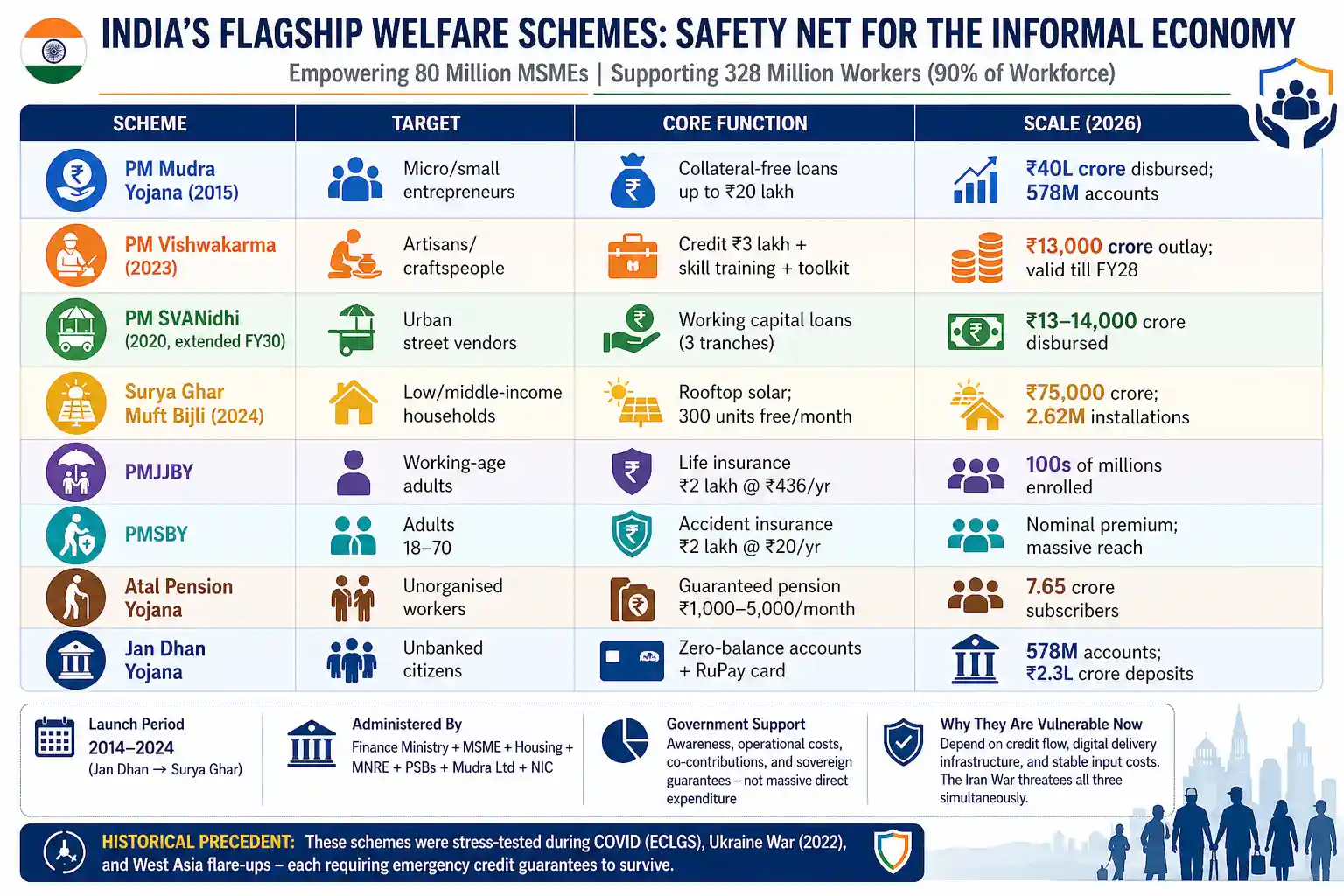
- India’s flagship welfare schemes act as the main support system for the informal economy, which includes nearly 74.7 million (economic survey data) MSMEs employing around 328 million workers, or about 90% of the workforce. These schemes are not primarily cash transfer programmes; instead, they focus on expanding access to credit, insurance, and essential infrastructure so that the formal financial system can better serve unorganised workers and small businesses.
- Launched between 2014 and 2024, from Jan Dhan to PM Surya Ghar, they are implemented through multiple institutions including the Finance Ministry, MSME Ministry, Housing Ministry, MNRE, public sector banks, Mudra Ltd, and digital platforms.
- Their scale is substantial, with around ₹40 lakh crore in Mudra loans, 578 million Jan Dhan accounts, and a ₹75,000 crore outlay for Surya Ghar. Government spending is generally limited to guarantees, operational support, co-contributions, and awareness measures rather than large direct subsidies.
- These schemes remain vulnerable because their success depends on steady credit flows, reliable digital delivery systems, and stable input costs.
- External shocks such as the Iran conflict can disrupt all three at the same time. Similar stress was seen during COVID-19, the Ukraine conflict, and earlier West Asia disruptions, when emergency credit guarantees became necessary to sustain these programmes.
Schemes Under Review — What They Control
Article Decoding: Three Layers Beyond the Headline
Layer 1 — This Is a Credit Delivery Stress Test, Not a Scheme Review
- The article calls this a “review.” In reality, it is a pre-emptive stress test of the government’s credit pipelines.
- Every scheme under review — Mudra, Vishwakarma, and Svanidhi — serves as a credit delivery mechanism for India’s informal economy.
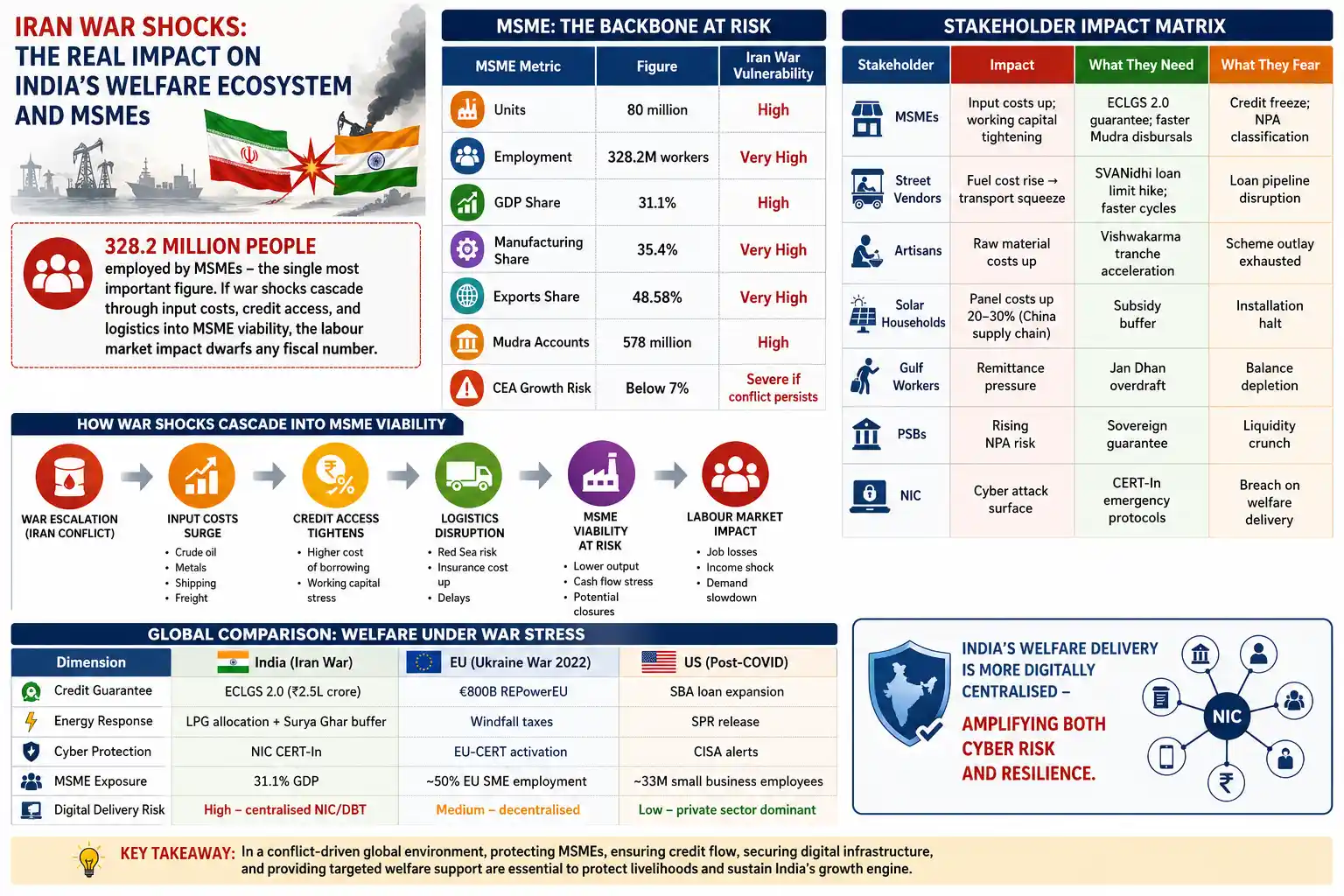
- The Iran War has already triggered four simultaneous shocks: energy prices are rising, logistics costs are climbing, Gulf remittances face pressure, and global liquidity is tightening. Each of these hits MSMEs harder than any other sector.
- The government is not evaluating scheme performance. It is mapping which credit pipelines will jam first under sustained stress. This review is not about the schemes — it is about keeping credit flowing to 328 million MSME workers when everything else is tightening.
Layer 2 — MSMEs Are the Real Pressure Point
- The article mentions MSMEs once. The numbers deserve more attention. India’s 74.7 million MSME units contribute 31.1% of GDP, 35.4% of manufacturing output, and 48.58% of exports.
- Since 2020, they have absorbed COVID, the Ukraine War, recurring West Asia flare-ups, and Trump-era tariffs. Each crisis required an ECLGS-type emergency credit guarantee.
- Now the government has readied a ₹2.5 lakh crore sovereign credit guarantee scheme — modelled directly on ECLGS — to prevent a credit freeze.
- Mudra and Svanidhi are the delivery vehicles for that guarantee. If their pipelines clog under war stress, fiscal intervention has no channel to reach beneficiaries. The welfare scheme review is really a credit delivery stress test for the informal economy.
Layer 3 — Cyber Risk Is the Silent Killer
- Energy prices and supply chains dominate headlines. The cyber risk mention deserves its own section. NIC runs the digital backbone of DBT, Jan Dhan, Mudra, and welfare portals — all high-value targets for Iran-linked retaliatory cyber operations.
- The Mythos report (April 23, 2026) flagged AI-assisted zero-day attacks on open-source infrastructure as an active threat. A breach on Jan Dhan payment rails or Aadhaar authentication does not just affect data — it stops welfare transfers to 578 million accounts in real time.
- India’s welfare delivery is more digitally centralised than comparable economies — making cyber risk its most acute vulnerability.
- The Iran War’s most dangerous threat to India’s welfare schemes is not energy prices — it is a state-sponsored cyber attack on the digital plumbing that delivers them.
The Big Number: 328.2 Million
328.2 million — the number of people employed by MSMEs — is the single most important figure. If war shocks cascade through input costs, credit access, and logistics into MSME viability, the labour market impact dwarfs any fiscal number:
Action Agenda: Four Reforms India Cannot Delay
Reform 1 — Restart the Credit Lifeline for MSMEs
The Problem: The Emergency Credit Line Guarantee Scheme (ECLGS) has lapsed at exactly the wrong time. Between February and March 2026 alone, more than 5.27 lakhguarantees were issued — a clear signal that MSME credit demand is already under stress. Without a live guarantee cover, Public Sector Banks will stall disbursals, leaving small businesses cash-starved just as input costs are climbing.
What Must Happen: The government must immediately activate ECLGS 2.0 — a ₹2.5 lakh crore credit guarantee facility offering 90% cover on loans up to ₹1 crore. Speed of rollout is more important than scheme design at this stage.
Why It Cannot Wait: Banks do not lend generously into uncertainty. Without the guarantee backstop, the credit pipeline dries up — and MSMEs, which employ 328.2 million people, begin collapsing quietly before any official data captures the damage.
Reform 2 — Protect the Digital Spine of Welfare Delivery
The Problem: India’s welfare architecture runs almost entirely on NIC-hosted platforms — DBT transfers, Jan Dhan accounts, Mudra disbursals. This centralisation, while efficient, has created a high-value cyber target. In a conflict environment, Iran-linked threat actors have a documented history of retaliatory cyberattacks on critical financial infrastructure.
What Must Happen: CERT-In must activate emergency response protocols immediately — with AI-assisted vulnerability scanning deployed across all NIC nodes and DBT rails. Redundancy systems need to be stress-tested now, not after an incident.
Why It Cannot Wait: A successful cyberattack on NIC does not just disrupt a government portal. It stops 578 million welfare transfers instantly — wages, pensions, subsidies, food support — all frozen in a single breach event.
Reform 3 — Secure the Solar Supply Chain Before Installations Stall
The Problem: 70% of solar panels used under the PM Surya Ghar scheme are sourced from China. The Iran War has disrupted shipping lanes and triggered 20–30% panel cost escalation. At current trajectory, new installations become financially unviable and existing commitments face delivery delays.
What Must Happen: The government must move on two tracks simultaneously — pre-purchase strategic panel inventory to buffer against further price shocks, and fast-track PLI (Production Linked Incentive) disbursals to domestic manufacturers to accelerate import substitution.
Why It Cannot Wait: 2.62 million households already have live Surya Ghar installations. They represent real fiscal commitments and real voter expectations. A supply chain freeze does not just hurt future targets — it puts subsidy promises already made at risk.
Reform 4 — Build a Financial Safety Net for Gulf Workers
The Problem: Gulf employment is under severe stress due to the Iran conflict. This affects a population of Indian workers who send home remittances that are invisible in formal welfare data — but deeply visible in rural household consumption, loan repayment, and local business activity. India’s $137–140 billion (SBI Research (Apr 2026)) in FY26 remittance inflow is the world’s largest and is now directly exposed.
What Must Happen: Jan Dhan overdraft limits must be temporarily raised for Gulf worker-linked accounts, and insurance premium grace periods must be extended so that workers who miss payments due to employment disruption do not lose their policy coverage.
Why It Cannot Wait: Remittance pressure does not announce itself loudly. It shows up quietly — in welfare uptake data, in rural NPA figures, in SVANidhi loan defaults. By the time formal indicators catch up, the damage to household balance sheets is already done.
What to Watch
The Finance Ministry’s review meeting has happened. That is a positive first step. But in policy, a meeting without a documented output is just a conversation. The immediate priority is a published, scheme-by-scheme stress report from this review — one that acknowledges vulnerabilities openly and assigns accountability for each. Verbal assurances, however well-intentioned, do not release credit, protect digital infrastructure, or stabilise supply chains.
- Sign Up on Practicemock for Updated Current Affairs, Topic Tests and Mini Mocks
- Sign Up Here to Download Free Study Material
Free Mock Tests for the Upcoming Exams
- IBPS PO Free Mock Test
- RBI Grade B Free Mock Test
- IBPS SO Free Mock Test
- NABARD Grade A Free Mock Test
- SSC CGL Free Mock Test
- IBPS Clerk Free Mock Test
- IBPS RRB PO Free Mock Test
- IBPS RRB Clerk Free Mock Test
- RRB NTPC Free Mock Test
- SSC MTS Free Mock Test
- SSC Stenographer Free Mock Test
- GATE Mechanical Free Mock Test
- GATE Civil Free Mock Test
- RRB ALP Free Mock Test
- SSC CPO Free Mock Test
- AFCAT Free Mock Test
- SEBI Grade A Free Mock Test
- IFSCA Grade A Free Mock Test
- RRB JE Free Mock Test
- Free Banking Live Test
- Free SSC Live Test