


The debate on AI in classrooms is framed as a values dilemma — speed versus thoughtfulness. Cognitive science suggests the choice is narrower: friction is not incidental to learning, it is essential. Yet AI collapses that friction, removing desirable difficulty and bypassing generative processing. The article’s most telling observation is buried — that AI has entered the homework ecosystem through parents first, not children. In this Vishleshan, we decode why improvised household rules, absent institutional policy, and collapsing cognitive effort together risk widening inequality and undermining foundational learning.
AI and children: How parents, teachers and schools are navigating the use of chatbots as learning aids
Context: A Mint columnist writes about the dilemma parents and teachers face as AI becomes embedded in children’s learning environments — using his eight-year-old’s homework experience as the frame. The article is warm, honest, and reflective. It identifies the right tensions: AI as shortcut vs. AI as tool, the collapse of the line between search and AI, the improvised and inconsistent rules families are inventing in the absence of institutional guidance. The article tells us what the problem feels like. This analysis asks what the evidence actually says, and what a credible institutional response would require.
Link to the Article: Mint
Background
The Cognitive Science of Learning — Why Friction Matters
The article quotes Brilliant’s co-founder saying AI should be “a tool for thinking, not a replacement for it.” This is an intuition. There is now a growing body of evidence behind it. Cognitive scientists distinguish between two types of mental effort in learning:
| Concept | What It Means | Why It Matters for AI |
| Desirable Difficulty | Struggling with material — re-reading, self-testing, spaced retrieval — produces stronger long-term retention than fluent, frictionless learning | AI removes desirable difficulty by generating answers instantly |
| Cognitive Load Theory | Working memory has limits; learning happens when material is processed at the right level of challenge — not too easy, not overwhelming | AI collapses challenge to near-zero for low-effort tasks |
| Generative Processing | Writing in your own words, drawing diagrams, explaining to someone else — these encoding acts build durable memory | AI-generated summaries bypass generative processing entirely |
| Transfer Learning | The ability to apply knowledge in novel contexts — the defining goal of education | Dependent on having processed foundational concepts yourself; AI-assisted shortcuts may undermine transfer |
Decoding the Article: Analysis
1. The Article Frames a Values Dilemma — But the Underlying Question Is Empirical, and the Evidence Is Already Pointing in a Direction
- The article’s central question — “Do we want children to be fast, or thoughtful?” — treats this as a values choice, as though reasonable people could pick either answer based on preference. This is understandable in a personal essay. It understates how much the empirical literature has already narrowed the range of defensible positions.
- Cognitive science research on desirable difficulty — developed by Robert Bjork at UCLA and extensively replicated — establishes that effortful processing is not incidental to learning; it is constitutive of it. The article correctly observes that a child using AI to summarise a chapter “may miss the friction that builds comprehension.” The word “may” is doing considerable work. A more precise formulation: the conditions under which AI-assisted shortcutting produces equivalent long-term learning outcomes to effortful processing have not been demonstrated for primary school children.
- The OECD Digital Education Outlook 2026 is direct on this point — generative AI “can support learning when guided by clear teaching principles” but produces adverse outcomes when used without that guidance. Guided AI use in a structured classroom is a different intervention from a child typing a question into a chatbot at home. The article conflates the two.
- The evidence is not merely that AI might undermine foundational learning. It is that the conditions under which it reliably does not are narrow, well-defined, and not currently present in most Indian homes or classrooms.
2. The “AI Literacy Is the Next Step” Conclusion Assumes an Institutional Capacity That Does Not Yet Exist in India
- The article’s forward-looking argument is that avoidance is not a strategy, that AI literacy will become part of the curriculum, and that “we taught children how to use the internet; we’ll have to teach them how to use AI.” This analogy is reasonable in structure but optimistic about pace and preconditions. Teaching children to use the internet required — and still largely failed to require — a parallel investment in digital literacy curricula, teacher training, and age-appropriate pedagogical frameworks. The results of that transition in India are mixed at best.
- AI literacy as a curricular goal is more demanding than internet literacy in at least three ways. First, it requires teachers to understand not just how to use AI tools, but when their use is pedagogically appropriate — a distinction that requires domain knowledge, pedagogical training, and comfort with the technology simultaneously.
- Second, it requires curriculum redesign around the principle that if AI can produce an output, the educational value must shift to the process that precedes the output — which means reimagining what homework, assessments, and in-class activities are actually for.
- Third, it requires an institutional consensus on age-appropriate AI use that India’s school system — governed by CBSE, ICSE, state boards, and thousands of autonomous private schools — does not currently have and has not been directed to develop.
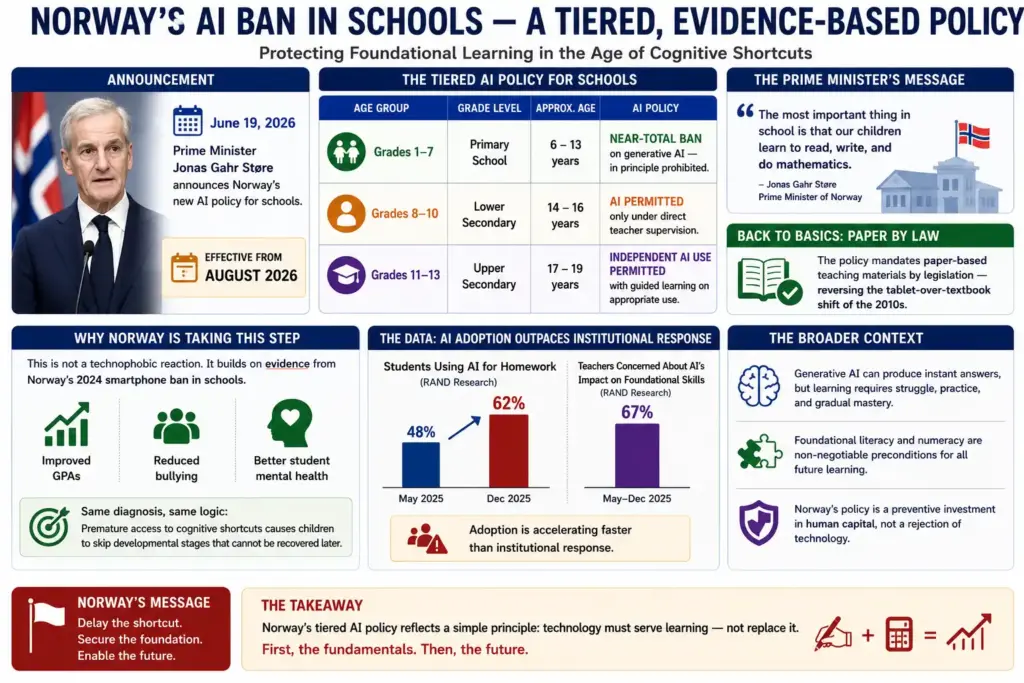
- Norway’s tiered policy took a national curriculum authority, a prime ministerial press conference, and binding legislation to implement. India has produced no equivalent institutional signal. The article’s conclusion — that schools need to “define categories and set age-appropriate rules” — is correct. The article does not examine whether the Indian school system is structurally positioned to do this, or what it would take.
3. The Article’s Most Important Observation Is Buried — That AI Has Entered the Homework Ecosystem Through Parents, Not Children
- The article’s most analytically significant line is almost thrown away: “AI has entered the homework ecosystem through parents first, not the children.” The author observes that parents use AI to brainstorm ideas, simplify instructions, generate quiz questions — and notes, almost in passing, that the class teacher’s slide deck carried Gemini watermarks. It is the central structural problem.
- The standard framing of the AI-in-education debate positions children as the risk subjects and adults — parents, teachers, policymakers — as the responsible gatekeepers. The article’s observation inverts this: adults are the primary AI users in the homework ecosystem, children are being asked to abstain, and the adults setting the rules are not abstaining themselves.
- This creates an asymmetry that is not merely hypocritical — it is pedagogically incoherent. A child who watches their parent use AI to prepare quiz questions, and whose teacher uses AI to prepare the holiday homework slide deck, is receiving a clear signal about AI’s role in intellectual work.
- Telling that child that AI is off-limits for their own homework is not a rule — it is a contradiction that the child will resolve in the most pragmatic direction available.
- The article names this observation. It does not follow it to its structural conclusion: that any credible framework for AI use by children must first establish consistent norms for AI use by the adults in their educational environment.
Fine Print — What the Article Quietly Skipped
The digital divide makes the “improvised rules” landscape far more unequal than the article acknowledges. The article describes parents inventing their own AI rules — “no AI for homework but AI for revision,” “AI for brainstorming but not for writing.” This improvisation is presented as a universal parent experience. It is not. The children of parents who are themselves AI-literate, professionally engaged with technology, and capable of drawing nuanced distinctions between AI use cases will navigate this transition very differently from children whose parents have no AI familiarity at all. The latter group is significantly larger in India. An improvised-rules landscape does not produce thoughtful AI use across the board — it produces a new axis of educational inequality, where AI fluency becomes a proxy for parental socioeconomic status in the same way that tutoring and extracurriculars already are.
The article treats the “no AI” directive as a temporary stopgap — but does not examine whether it is effective even as a stopgap. The RAND data shows that 62% of students were using AI for homework by December 2025. A teacher saying “don’t use AI” in passing, without enforcement mechanisms, curriculum redesign, or assessment changes that make AI use detectable, is not a policy — it is a preference statement. Homework submitted digitally can be AI-generated without any visible marker. The only reliable way to make AI irrelevant to homework is to redesign what homework asks for — oral explanations, handwritten drafts, process documentation, in-class demonstrations. The article gestures at this (“teachers want to see a child’s own handwriting and mistakes”) without drawing the institutional implication: that AI-proofing education requires assessment redesign, not just prohibitions.
The article cites Brilliant’s Koji as an example of AI tutors designed for children, but does not distinguish between AI tutoring and AI homework assistance — which are pedagogically very different. An AI tutor that adapts to a child’s pace, identifies misconceptions, and generates practice problems at the right difficulty level is functioning as a Socratic interlocutor — it is increasing cognitive engagement, not reducing it. A chatbot that writes a paragraph on the water cycle for a child to copy is doing the opposite. The article conflates these two use cases under the category of “AI for learning,” which makes the policy question appear more ambiguous than it is. The evidence from intelligent tutoring systems in K-12 education shows measurable learning gains in structured settings. The question is not whether AI can help children learn — it demonstrably can, in the right configuration. The question is whether the configurations that help are the ones children are actually using at home.
Norway’s policy is the one concrete institutional response available for comparison, and the article gives it one sentence. The Norwegian ban is the most significant education policy development on this topic in 2026, grounded in declining PISA scores, a successful prior smartphone ban, and a tiered age-based framework developed in consultation with educators. India, which has its own concerns about learning outcome declines documented in ASER reports, has produced no equivalent policy signal. The article’s single-line mention of Norway — presented as a data point about declining test scores — misses the policy architecture behind the decision and the precedent it sets for how democratic governments can respond institutionally to this dilemma.
The dilemma the article describes — how to let children grow up with AI without letting AI substitute for growth — is real, and it will not resolve itself through parental improvisation or passing classroom instructions. The cognitive science points in one direction: foundational skills require effortful, friction-laden processing that AI, by design, eliminates. The policy evidence from Norway points in the same direction: that protecting developmental stages requires institutional commitment, not individual discretion. What India needs is not a national conversation about values — it already has that, in every school WhatsApp group in the country. What it needs is a curricular authority willing to do what Norway’s government did: name the developmental stages that AI must not be allowed to skip, define the age boundaries at which AI assistance becomes appropriate, and redesign assessments so that what is being evaluated cannot be outsourced. Until then, the rules will remain improvised, the inequality will widen, and the eight-year-olds doing homework the old-fashioned way will owe that outcome to their teacher’s preference rather than their nation’s policy.
- Sign Up on Practicemock for Updated Current Affairs, Topic Tests and Mini Mocks
- Sign Up Here to Download Free Study Material
Free Mock Tests for the Upcoming Exams
- IBPS PO Free Mock Test
- RBI Grade B Free Mock Test
- IBPS SO Free Mock Test
- NABARD Grade A Free Mock Test
- SSC CGL Free Mock Test
- IBPS Clerk Free Mock Test
- IBPS RRB PO Free Mock Test
- IBPS RRB Clerk Free Mock Test
- RRB NTPC Free Mock Test
- SSC MTS Free Mock Test
- SSC Stenographer Free Mock Test
- GATE Mechanical Free Mock Test
- GATE Civil Free Mock Test
- RRB ALP Free Mock Test
- SSC CPO Free Mock Test
- AFCAT Free Mock Test
- SEBI Grade A Free Mock Test
- IFSCA Grade A Free Mock Test
- RRB JE Free Mock Test
- Free Banking Live Test
- Free SSC Live Test