


Banking aspirants often face confusion when it comes to IDBI’s Junior Assistant Manager (JAM) recruitment, especially between the PGDBF route and the Grade O direct recruitment. Both pathways lead to the same designation, yet the journey, financial implications, and career trajectory differ significantly. As an expert guiding you through this maze, let’s break down every aspect, ownership, training, salary, career growth, and exam strategy, so you can make an informed choice.
JAM PGDBF – Post Graduate Diploma in Banking & Finance
The PGDBF route offers structured training before absorption. Aspirants undergo classroom learning and internships, making this pathway ideal for those who prefer academic exposure before entering full-time banking service.

- Structure:
- Candidates undergo 1-year training (classroom + internship).
- Training is conducted at IDBI’s partner institutes.
- On successful completion, candidates are absorbed as Junior Assistant Manager (Grade O).
- Financial Aspect:
- Aspirants pay a course fee (approx. ₹3–4 lakhs, subject to bank updates).
- Stipend is provided during internship, but classroom phase is largely self-funded.
- Advantages:
- Structured academic exposure to banking concepts.
- Internship ensures practical learning before joining.
- Candidates enter with strong fundamentals.
- Challenges:
- Financial burden of course fee.
- No guarantee of refund if candidate exits early.
- Delayed entry into full-time service (after 1 year).
JAM Grade O – Direct Recruitment
The Grade O route is straightforward. Candidates clear the exam and interview, then join directly as Junior Assistant Managers. This option suits aspirants who want immediate employment without financial investment.
- Structure:
- Candidates clear the exam + interview.
- Direct appointment as Junior Assistant Manager (Grade O).
- On-the-job training is provided post-joining.
- Financial Aspect:
- No course fee.
- Salary starts immediately after joining.
- Advantages:
- Faster entry into service.
- No financial burden.
- Direct exposure to banking operations.
- Challenges:
- Learning curve is steeper—candidates must adapt quickly.
- Less structured academic training compared to PGDBF.
Salary & Benefits, PGDBF vs Grade O
Salary and perks remain identical for both routes. The only difference lies in when earnings begin—PGDBF candidates start after training, while Grade O recruits earn from day one.
- Salary: Approx. ₹6–6.5 LPA (CTC) at entry level.
- Perks: Medical, insurance, allowances, and retirement benefits.
- Difference: PGDBF candidates start earning only after training, while Grade O recruits earn from day one.
Career Growth
Career progression is identical for both PGDBF and Grade O recruits. Promotions follow the same ladder, ensuring equal opportunities for long-term growth regardless of entry route.
- Designation Path: JAM → Assistant Manager → Manager → Senior Manager → Chief Manager → AGM → DGM → GM.
- Growth Rate: Comparable for both PGDBF and Grade O, since both merge into the same cadre.
- Long-Term Impact: No difference in promotions or career ceiling.
Exam Pattern & Preparation Strategy
Both exams follow similar structures. Success depends on mastering reasoning, quant, English, and awareness sections. Mock tests remain the most effective way to simulate exam conditions and improve performance.
- Sections:
- Logical Reasoning
- Quantitative Aptitude / Data Analysis
- English Language
- General / Banking / Economy Awareness
- Strategy:
- Mocks are essential—simulate exam conditions.
- Focus on speed + accuracy.
- Dedicate daily time to current affairs & banking awareness.
- Analyze mistakes after every test.
Key Differences – Snapshot Table
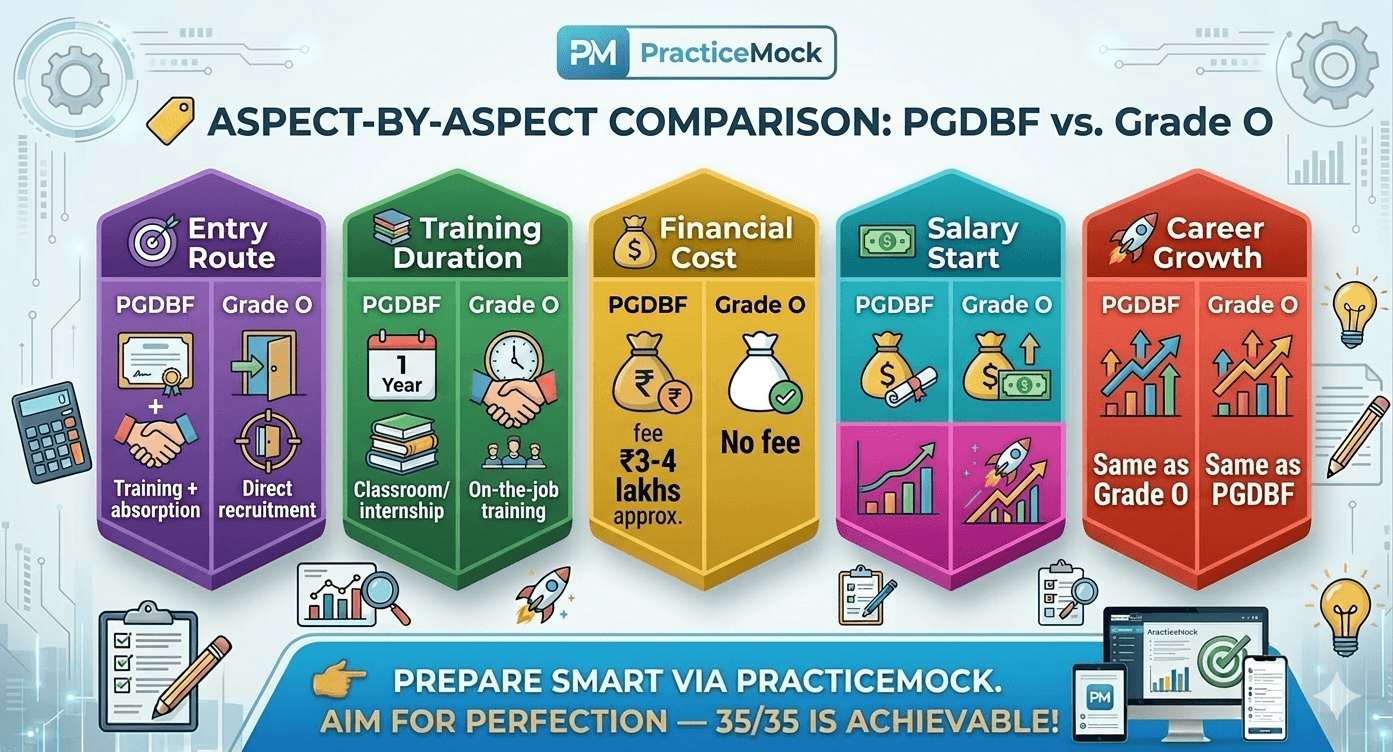
This table highlights the most important differences between PGDBF and Grade O. The only nuance is that PGDBF involves a paid training year, while Grade O is direct entry.
| Aspect | JAM PGDBF | JAM Grade O |
| Entry Route | Training + absorption | Direct recruitment |
| Training Duration | 1 year (classroom + internship) | On-the-job training post joining |
| Financial Cost | Course fee (₹3–4 lakhs approx.) | No fee |
| Salary Start | After training completion | Immediately after joining |
| Learning Curve | Structured, gradual | Steep, practical |
| Career Growth | Same as Grade O | Same as PGDBF |
Which Route Should You Choose?
Choosing between PGDBF and Grade O depends on your financial readiness and learning preference. Both lead to the same designation, salary, and career growth opportunities.
- Choose PGDBF if:
- You prefer structured academic learning.
- You can manage the financial investment.
- You want a gradual entry into banking.
- Choose Grade O if:
- You want immediate employment and salary.
- You prefer learning directly on the job.
- You want to avoid financial burden.
Expert Guidance for Aspirants
Aspirants should focus less on the route and more on preparation. Both pathways demand strong fundamentals, consistent practice, and confidence. The choice is personal, but success depends on discipline.
- Don’t confuse ownership: IDBI is private sector, but opportunities are equally rewarding.
- Focus on preparation: Whether PGDBF or Grade O, exam pattern demands strong fundamentals.
- Mock tests are non-negotiable: They bridge the gap between theory and exam reality.
- Confidence matters: Both routes lead to the same designation—your choice depends on personal preference and financial readiness.
Final Word
The JAM PGDBF vs JAM Grade O debate is less about career growth and more about entry style and financial planning. Both culminate in the same designation, salary, and promotion ladder.
Remember: The only nuance is that PGDBF involves a paid training year, while Grade O is direct entry. If you’re financially comfortable and prefer structured training, PGDBF is a solid choice. If you want immediate employment without extra cost, Grade O is ideal. Either way, success depends on how well you prepare for the exam and how consistently you practice mock tests.
FAQs
The only nuance is that PGDBF involves a paid training year, while Grade O is direct entry. Both lead to the same designation, salary, and career growth.
Neither is superior. PGDBF suits aspirants who prefer structured training and can afford the fee. Grade O suits those who want immediate employment without financial burden.
Yes, successful completion of the PGDBF program leads to absorption as Junior Assistant Manager (Grade O).
Both PGDBF and Grade O recruits earn approx. ₹6–6.5 LPA (CTC) with allowances and benefits. The difference is only in when salary starts.
No. Both merge into the same cadre and follow identical promotion ladders within IDBI Bank.
- Sign Up on Practicemock for Updated Current Affairs, Topic Tests and Mini Mocks
- Sign Up Here to Download Free Study Material
Free Mock Tests for the Upcoming Exams
- IBPS PO Free Mock Test
- RBI Grade B Free Mock Test
- IBPS SO Free Mock Test
- NABARD Grade A Free Mock Test
- SSC CGL Free Mock Test
- IBPS Clerk Free Mock Test
- IBPS RRB PO Free Mock Test
- IBPS RRB Clerk Free Mock Test
- RRB NTPC Free Mock Test
- SSC MTS Free Mock Test
- SSC Stenographer Free Mock Test
- GATE Mechanical Free Mock Test
- GATE Civil Free Mock Test
- RRB ALP Free Mock Test
- SSC CPO Free Mock Test
- AFCAT Free Mock Test
- SEBI Grade A Free Mock Test
- IFSCA Grade A Free Mock Test
- RRB JE Free Mock Test
- Free Banking Live Test
- Free SSC Live Test