


The IBPS PO Interview Preparation process can be managed by yourself with a structured study plan, regular practice and a clear understanding of banking fundamentals. Candidates do not necessarily need coaching to perform well in the interview. They should focus on banking knowledge, economic and financial awareness, current affairs, personal-profile questions, graduation subjects and the responsibilities of a Probationary Officer. The interview panel also evaluates communication skills, confidence, decision-making ability and professional attitude.
For the IBPS PO 2026 recruitment cycle (CRP PO/MT-XVI), candidates shortlisted after the Main Examination must appear for the prescribed Personality Test before the interview. The Personality Test is mandatory but non-qualifying in nature. The interview carries 100 marks, and the final merit calculation follows an 80:20 weightage between the Main Examination and the interview.

The IBPS PO Interview Preparation plan should cover both knowledge and personality development. Candidates must understand important banking concepts, stay updated with financial developments, prepare answers based on their personal profiles and practise speaking confidently. To help you prepare independently, this guide explains the important preparation areas, strategies to study each section and a 15-day self-preparation timetable that you can customise according to your interview schedule.
Core Areas to Focus On for IBPS PO Interview Preparation
Your IBPS PO Interview Preparation should cover banking fundamentals, current affairs, economic awareness and your personal profile. Candidates should not restrict their preparation to banking definitions because the interview panel may ask questions based on their educational qualifications, hometown, hobbies, work experience and understanding of the PO role.
The following six areas should be included in your self-preparation strategy.
1. Banking Knowledge
Banking knowledge is one of the most important areas to prepare for the IBPS PO interview. Candidates should understand basic banking operations, financial products, RBI functions, banking regulations and recent developments in the banking sector.
Start with fundamental concepts before moving towards advanced topics. Prepare the meaning, purpose and practical application of important banking terms such as:
- Reserve Bank of India and its functions
- Monetary Policy and Monetary Policy Committee
- Repo Rate, Standing Deposit Facility (SDF), MSF, Bank Rate, CRR and SLR
- Types of bank accounts and deposit products
- Non-Performing Assets (NPA) and their classification
- Priority Sector Lending (PSL)
- CASA Ratio, NIM and Capital Adequacy Ratio
- KYC and Anti-Money Laundering (AML)
- Basel III norms
- SARFAESI Act and Insolvency and Bankruptcy Code
- Financial Inclusion and Financial Literacy
- NEFT, RTGS, IMPS and UPI
- Small Finance Banks and Payments Banks
- Digital Banking and Cybersecurity
Do not simply memorise the full forms of banking terms. Understand how they influence banking operations and customers. For example, while preparing NPA, also understand its impact on a bank’s profitability, lending capacity and asset quality.
2. Economic and Financial Awareness
Economic and financial awareness helps the interview panel understand whether candidates can connect banking operations with the broader economy. A Probationary Officer should be aware of important economic developments, financial policies and government initiatives.
Prepare the following topics:
- Gross Domestic Product (GDP) and economic growth
- Inflation and its impact on purchasing power
- Consumer Price Index (CPI) and Wholesale Price Index (WPI)
- Monetary Policy and Fiscal Policy
- Fiscal Deficit and Revenue Deficit
- Balance of Payments and Current Account Deficit
- Foreign Direct Investment (FDI) and Foreign Portfolio Investment (FPI)
- Government Securities and Treasury Bills
- Union Budget and Economic Survey
- Financial Markets and Banking Reforms
- Financial Inclusion and Digital Economy
- Foreign Exchange Reserves
Along with definitions, prepare the practical implications of these concepts. For instance, understand how changes in monetary policy can influence interest rates, borrowing costs, savings and credit demand.
Also revise important government schemes related to banking, finance, insurance, agriculture, MSMEs and social security.
3. General Awareness and Current Affairs
Current affairs are an important part of the interview because candidates may be asked about recent national, international, economic and banking developments.
Cover approximately the last 4–6 months of current affairs, giving greater attention to banking and financial developments. Also revise important updates released shortly before your interview.
Focus on the following areas:
- Recent RBI announcements and monetary policy decisions
- Banking sector developments and regulatory changes
- Important government schemes and initiatives
- Union Budget and Economic Survey highlights
- Important national and international events
- Banking and financial sector appointments
- Reports, indices and rankings
- Important awards and sports events
- Major economic developments
- Digital banking, fintech and cybersecurity
- Important developments related to financial institutions
Candidates should also understand the role of IBPS and the participating banks in the recruitment process.
Self-preparation tip: Make a separate notebook for current affairs. For every important news item, write down what happened, why it matters and how it may affect banking or the economy. This will help you answer follow-up questions instead of just recalling isolated facts.
4. Personal Information and Resume Deep Dive
Your personal profile can become an important source of interview questions. The panel may ask questions based on the details mentioned in your application form, educational background, work experience, hobbies and hometown.
Prepare answers related to:
- Your name and hometown
- Family background
- Educational qualifications
- Graduation subjects and favourite subjects
- Academic achievements
- Work experience and previous employment
- Gap years in education or employment
- Hobbies and personal interests
- Strengths and weaknesses
- Career goals
- Reasons for choosing the banking sector
Read your submitted application form carefully. Every detail mentioned in it should be familiar to you because the panel may ask follow-up questions.
For example, if you mention reading as a hobby, prepare information about the books you have recently read, their authors and what you learned from them. Similarly, if you have work experience, be ready to explain your responsibilities, achievements and reason for choosing banking.
Candidates should also prepare questions related to their hometown and state, including important industries, agricultural products, historical places, geographical features and famous products.
5. Situational and Behavioural Questions
Situational and behavioural questions help the interview panel assess your problem-solving skills, decision-making ability, patience and professional attitude.
A Probationary Officer may face different situations while handling customers, coordinating with staff, managing branch operations and following banking regulations. Therefore, candidates should practise explaining how they would respond to practical situations.
Prepare questions such as:
- How will you handle an angry customer?
- What will you do if a customer reports a fraudulent transaction?
- How will you handle pressure at the workplace?
- What will you do if your senior asks you to perform an unethical activity?
- How will you manage a disagreement between two employees?
- What will you do if your branch is unable to achieve its targets?
- How will you handle a customer who is not eligible for a loan?
- Are you willing to work in a rural or remote area?
While answering, focus on patience, honesty, customer service, regulatory compliance and practical decision-making. Avoid giving unrealistic answers or suggesting actions that violate banking rules.
6. Role-Specific Knowledge (The PO Mandate)
Candidates should have a clear understanding of the responsibilities of a Probationary Officer. The panel may ask why you want to become a PO and how your skills can contribute to banking operations.
Important responsibilities to understand include:
- Managing day-to-day banking operations
- Handling customer queries and service-related issues
- Understanding deposit and loan products
- Assisting with credit-related activities
- Ensuring KYC and regulatory compliance
- Supporting financial inclusion initiatives
- Promoting digital banking services
- Monitoring loan accounts and assisting with recovery-related activities
- Coordinating with bank employees
- Supporting branch business and administrative activities
Prepare answers to questions such as why you want to join banking, why you prefer the PO role, how you can contribute to customer service and why you are suitable for a managerial position.
You should also understand the basic functions of IBPS, the participating banks and the difference between a Probationary Officer and a bank clerk.
How to Prepare Each Area Effectively for IBPS PO Interview?
Success depends on disciplined and targeted study. Reading banking books or current affairs alone is not sufficient. Candidates must also practise explaining concepts, preparing personal answers and handling follow-up questions.
To make your IBPS PO Interview Preparation more effective, follow these strategies to study each domain systematically.
1. Preparing Banking and Economic Knowledge
Begin with basic banking concepts and gradually move towards regulatory and financial developments.
- Revise important banking terms such as SLR, CRR, NPA, CASA, Repo Rate and Priority Sector Lending. Prepare short notes or flashcards for quick revision.
- Understand the functions of the RBI, monetary policy and the role of the banking system in the economy.
- Study the differences between important concepts, such as Repo Rate and CRR, NEFT and RTGS, and Payments Banks and Small Finance Banks.
- Prepare the practical applications of banking concepts so that you can explain them in simple language.
- Revise important government schemes related to financial inclusion, agriculture, MSMEs and social security.
- Check the latest RBI circulars and major banking developments from official sources.
- Practise answering banking-related questions aloud without referring to your notes.
A useful approach is to prepare every topic in four parts: definition, purpose, practical example and latest relevant development. This will help you answer both direct questions and follow-up questions.
2. Preparing General Awareness and Current Affairs
Candidates should follow current affairs regularly instead of trying to cover everything in the last few days.
- Read newspapers and reliable financial news sources to stay updated on national, international and economic developments.
- Give special attention to banking news, RBI announcements, changes in financial regulations and important government schemes.
- Prepare short notes on important appointments, reports, indices, awards and economic developments.
- Revise monthly and weekly current affairs to improve retention.
- Understand the purpose and impact of major government policies instead of memorising only their launch dates.
- Follow official sources such as the RBI, PIB, Ministry of Finance and Department of Financial Services for important updates.
You can also use monthly current affairs PDFs and banking awareness material to revise important events. Keep the focus on understanding the news because the interview panel may ask why a particular announcement is important.
3. Preparing Your Personal Narrative (Resume and Behaviour)
Your personal information should be one of the first things you prepare during self-study. Write down all the details from your application form and create possible interview questions based on them.
- Prepare a natural self-introduction covering your name, hometown, educational qualification, achievements and interest in banking.
- Revise your graduation subjects, especially the basic concepts of your favourite and final-year subjects.
- Prepare logical answers about your academic or career choices.
- Be ready to explain any gaps in your education or employment honestly.
- Prepare examples from your academic life, projects, work experience or extracurricular activities that demonstrate leadership and teamwork.
- Research your hometown, district and state, including important industries, local products and economic activities.
- Prepare genuine answers about your strengths, weaknesses, hobbies and career goals.
How to prepare your self-introduction?
A self-introduction is often used to begin the interview. Keep it natural and around 45–90 seconds. Include only relevant details rather than narrating your complete life history.
A useful structure is:
- Your name and hometown.
- Your educational qualifications.
- Relevant achievements or work experience.
- Skills or interests connected with the PO role.
- Your reason for choosing banking.
Do not memorise a fixed script. Practise the structure so that you can introduce yourself confidently and answer follow-up questions naturally.
4. Refining Communication and Presence
Communication skills and professional behaviour are important parts of interview performance. Candidates must practise speaking clearly, listening carefully and explaining their thoughts in a structured manner.
- Practise mock interviews with friends, mentors or experienced professionals.
- Record your answers on your phone and review your tone, speed, clarity and confidence.
- Practise speaking in front of a mirror to observe your facial expressions and body language.
- Keep answers relevant and avoid unnecessary explanations.
- Maintain natural eye contact and listen to the complete question before responding.
- Practise answering questions in the language you are comfortable using, while keeping your communication clear and professional.
- Learn to admit politely when you do not know an answer instead of guessing.
- Wear formal attire during mock practice occasionally so that you become comfortable with a professional interview environment.
Try to attempt around 4–5 mock interviews, depending on the time available. After every mock, identify weak areas and revise them before attempting the next one.
How to Prepare for the IBPS PO Interview Without Coaching?
Independent IBPS PO Interview Preparation is possible with a practical routine, reliable study material and consistent speaking practice. Coaching is not compulsory, but candidates must ensure that they receive some form of feedback on their communication and performance.
Follow these steps to organise your self-preparation.
Step 1: Create a Personal Interview Notebook: Maintain one notebook for your personal information, educational background, hometown, work experience, hobbies and career goals. Write down possible questions and prepare your own answers.
Step 2: Make a Banking Awareness Question Bank: Prepare a list of important banking terms, RBI functions, monetary policy concepts, banking products, digital payment systems and government schemes. Write short answers in your own words.
Step 3: Prepare Current Affairs Notes: Maintain a separate section for banking and economic current affairs. Revise important developments from the last 4–6 months and check the latest updates before your interview.
Step 4: Practise Speaking Every Day: Select 5–10 questions daily and answer them aloud without reading. Record your responses and check whether your answers are clear, relevant and concise.
Step 5: Take Mock Interviews: Ask a friend or mentor to conduct mock interviews. Share your profile with them so that they can ask questions about your education, hometown, hobbies and work experience.
Step 6: Review Your Performance: After every practice session, write down the questions you could not answer, the topics you need to revise and the communication mistakes you noticed. Work on these areas before your next mock.
Step 7: Revise Instead of Learning Everything Again: During the final few days, focus on revising your personal answers, banking concepts and recent developments. Avoid starting too many new topics just before the interview.
Self-Preparation Plan for IBPS PO Interview
A structured timetable helps candidates divide their preparation into manageable sections. The following 15-day IBPS PO Interview Preparation plan can be customised according to your existing knowledge and interview schedule.
| Day | Focus Area | Activity |
| Day 1 | Personal Profile | Prepare self-introduction, educational details, family background, strengths and weaknesses. |
| Day 2 | Hometown and Graduation | Revise hometown facts, state awareness, graduation subjects and academic achievements. |
| Day 3 | Banking Fundamentals | Cover banking operations, types of accounts, RBI functions and important banking terms. |
| Day 4 | Monetary Policy | Study Repo Rate, SDF, MSF, Bank Rate, CRR, SLR and the Monetary Policy Committee. |
| Day 5 | Banking Regulations | Prepare NPA, PSL, KYC, AML, Basel norms, SARFAESI Act and deposit insurance. |
| Day 6 | Digital Banking | Revise UPI, NEFT, RTGS, IMPS, CBDC, cybersecurity and digital banking developments. |
| Day 7 | Economic and Financial Awareness | Study GDP, inflation, fiscal deficit, monetary policy and important financial institutions. |
| Day 8 | Government Schemes | Prepare important schemes related to banking, financial inclusion, agriculture and MSMEs. |
| Day 9 | Banking Current Affairs | Revise recent RBI circulars, banking developments, appointments and financial news. |
| Day 10 | General Awareness | Revise important national and international news, reports, indices and major developments. |
| Day 11 | HR and Behavioural Questions | Prepare answers about career goals, strengths, weaknesses, work experience and situational questions. |
| Day 12 | Role of a PO and IBPS | Research PO responsibilities, IBPS functions and participating banks. |
| Day 13 | First Mock Interview | Attempt a complete mock interview and identify weak areas in knowledge and communication. |
| Day 14 | Feedback and Refinement | Revise unanswered questions, improve weak responses and attempt another mock interview. |
| Day 15 | Final Revision | Revise personal answers, banking terms, current affairs and interview-day instructions. |
Note: Divide your daily preparation time between banking awareness, current affairs, personal questions and speaking practice. Adjust the timetable according to your preparation level and the time available before the interview.
Daily Study Routine for IBPS PO Interview Preparation
Along with the 15-day timetable, follow a manageable daily routine. Consistent practice is more useful than spending the entire day reading without revising or speaking.
| Preparation Activity | Suggested Time |
| Banking and Financial Awareness | 45 minutes |
| Current Affairs and RBI Updates | 30 minutes |
| Personal Profile and HR Questions | 30 minutes |
| Graduation and Hometown Revision | 20 minutes |
| Speaking Practice and Mock Questions | 30 minutes |
| Total | 2 hours 35 minutes |
Candidates with more time can increase the duration of banking awareness, graduation revision and mock interview practice. Those with less time should prioritise weak areas and practise answering questions aloud.
Important Tips to Follow on the IBPS PO Interview Day
After completing your self-preparation, focus on presenting yourself confidently and professionally on the interview day.
- Read the interview call letter carefully and check the reporting time and venue.
- Arrange the original documents and photocopies required by the official instructions.
- Wear neat and professional formal attire.
- Reach the venue with sufficient time.
- Greet the interview panel politely and wait for permission before taking your seat.
- Listen carefully to every question before answering.
- Maintain natural eye contact with the panel.
- Keep your answers clear, relevant and structured.
- Avoid arguing, interrupting or bluffing.
- If you do not know an answer, admit it politely.
- Thank the panel before leaving the interview room.
Remember that the panel is not expecting candidates to know everything. It wants to understand their personality, knowledge, judgement and suitability for the responsibilities of a Probationary Officer.
Conclusion
Effective IBPS PO Interview Preparation does not require expensive coaching or memorised answers. It requires a disciplined self-study plan, a clear understanding of banking concepts, regular current affairs revision and consistent speaking practice. Focus on your personal profile, graduation subjects, hometown, banking awareness and the responsibilities of a Probationary Officer. Use the 15-day timetable to organise your preparation, attempt mock interviews and work on the feedback you receive. For the CRP PO/MT-XVI recruitment cycle, remember to complete the mandatory Personality Test and follow the official interview instructions. Candidates who need additional structured practice can explore the IBPS PO Interview Course, which offers 1-to-1 mock interviews and feedback, including sessions with Ex-Bank GMs. Use the preparation material and practice resources available on PracticeMock to strengthen your interview readiness.
Relevant PracticeMock Preparation Links:
Use the curated resources below to access structured study material, test series, and personalized interview practice:
| Preparation Module | Resource Link |
| IBPS PO Mock Test Series | PracticeMock IBPS PO Test Series |
| Banking Awareness PDF Capsules | PracticeMock Banking Awareness Notes |
| Daily Current Affairs Updates | PracticeMock Current Affairs Portal |
| IBPS PO Interview Guide & Tips | PracticeMock Interview Preparation Blog |
Also Read:
| IBPS PO Exam Pattern | IBPS PO Salary |
| IBPS PO Previous Year Question Paper | IBPS PO Cut Off |
| IBPS PO Study Plan | IBPS PO Preparation Strategy |
| IBPS RRB PO Exam Date 2026 |
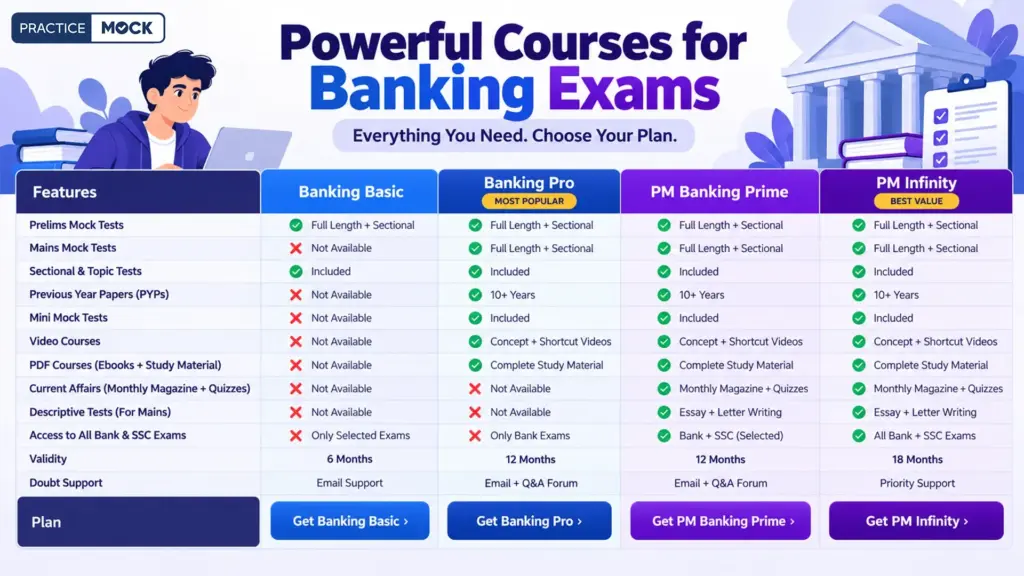
Powerful Courses for Banking Exams
FAQs on IBPS PO Interview Preparation
1. Can I prepare for the IBPS PO interview without coaching?
Yes, you can prepare for the IBPS PO interview at home without coaching. Focus on banking fundamentals, current affairs, your personal profile, graduation subjects and situational questions. Practise speaking regularly, record your answers and arrange mock interviews with friends or mentors to receive feedback.
2. What are the most important topics to study for the IBPS PO interview?
Banking awareness, RBI functions, monetary policy, NPAs, digital banking, economic concepts, government schemes, current affairs, graduation subjects, hometown awareness, personal questions and the responsibilities of a Probationary Officer are important areas to prepare.
3. How should I practise if no one is available to take my mock interviews?
You can practise independently by recording your answers on your phone, speaking in front of a mirror and using a list of interview questions. Review your recordings to identify unclear explanations, unnecessary pauses and repetitive answers. You can also ask a friend or family member to conduct a short mock session.
4. How much current affairs should I cover for the IBPS PO interview?
Cover approximately the last 4–6 months of current affairs, with a special focus on banking news, RBI announcements, government schemes, economic developments and important financial updates. Revise major developments again shortly before your interview.
5. What is the ideal length of an answer in the IBPS PO interview?
There is no fixed time limit for every answer. As a practical guideline, keep your self-introduction around 45–90 seconds and answer direct questions briefly. Explain concepts in more detail only when the panel asks follow-up questions.
6. How many mock interviews should I attempt for IBPS PO?
Attempting around 4–5 IBPS PO mock interviews can be useful, depending on the time available. The most important part is analysing feedback after every mock and improving weak areas before the next practice session.
7. What should I prepare from my graduation subjects for the IBPS PO interview?
Revise fundamental concepts from your graduation stream, particularly your favourite and final-year subjects. Prepare to explain why you chose your subject, what you learned and how your academic background can help you perform the responsibilities of a Probationary Officer.
8. What is the weightage of the IBPS PO interview in the final selection?
For IBPS CRP PO/MT-XVI, the final merit calculation gives 80% weightage to the Online Main Examination and 20% to the interview. The interview carries 100 marks.
9. Is the Personality Test compulsory for the IBPS PO interview?
Yes. Under IBPS CRP PO/MT-XVI, appearing for the Personality Test is mandatory to become eligible for the interview. However, the Personality Test is non-qualifying in nature, and its marks are not included in the final merit calculation.
10. What should I do if I do not know an answer during the IBPS PO interview?
Stay calm and politely admit that you are unable to recall the answer. Do not bluff or provide incorrect information. If you know part of the concept, explain only what you are confident about.
- Sign Up on Practicemock for Updated Current Affairs, Topic Tests and Mini Mocks
- Sign Up Here to Download Free Study Material
Free Mock Tests for the Upcoming Exams
- IBPS PO Free Mock Test
- RBI Grade B Free Mock Test
- IBPS SO Free Mock Test
- NABARD Grade A Free Mock Test
- SSC CGL Free Mock Test
- IBPS Clerk Free Mock Test
- IBPS RRB PO Free Mock Test
- IBPS RRB Clerk Free Mock Test
- RRB NTPC Free Mock Test
- SSC MTS Free Mock Test
- SSC Stenographer Free Mock Test
- GATE Mechanical Free Mock Test
- GATE Civil Free Mock Test
- RRB ALP Free Mock Test
- SSC CPO Free Mock Test
- AFCAT Free Mock Test
- SEBI Grade A Free Mock Test
- IFSCA Grade A Free Mock Test
- RRB JE Free Mock Test
- Free Banking Live Test
- Free SSC Live Test