


If you’re preparing for the SSC CGL or any other competitive exam, mastering Dice and Cube reasoning questions is important. These topics are part of the Logical Reasoning section and can be asked in government exams. Questions from this section have been seen in the SSC CGL exam, which is why we have provided this blog. This blog has provided a detailed concept of dice and cubes with SSC CGL exam-level questions. Along with that, we have provided some free preparation resources that you can access by clicking on the link given below. Prepare this topic carefully and increase your level of preparation for the exam.
Dice and Cube: Introduction, Basic Concepts, and Types
In reasoning, Dice and Cube questions are based on the 3D structure of a cube (and its rolled form, the dice). These problems test your spatial imagination and logical thinking.

- A cube has 6 equal faces, 12 edges, and 8 corners.
- A dice is a cube, typically with numbers or symbols on its faces.

Types of Dice Questions
There are 3 main types of dice problems in SSC CGL:
Type 1: Single Dice with Number Rotation
You’re shown 2 or 3 different views of the same dice with different visible faces.
Objective: Find opposite or adjacent faces.
Concept:
- If two dice show two common faces, the face not shown in either is opposite to the common face.
- Use the elimination method to find which face is opposite or adjacent.
Type 2: Dice with Cut Corners
You are shown 3D representations with numbers or symbols on multiple faces.
Objective: Identify face positions when rotated.
Concept:
- Practice visual rotation.
- Understand how top, bottom, front, and side faces shift.
Type 3: Non-Standard Dice (With Symbols or Colors)
Instead of numbers, symbols, colors, or letters are shown.
Objective: Apply the same rules as standard dice but focus on position, not number value.
Probability Concepts in Cubes and Dice Reasoning
Understanding probability in the context of dice and cube problems is important, especially when these topics are integrated into logical reasoning or quantitative aptitude. These types of questions combine basic probability formulas with cube/dice visualization.
1. Basic Probability Formula: Before jumping into cubes and dice, understand the fundamental formula of probability:

- Favorable outcomes: The number of desired results
- Total possible outcomes: All outcomes that can happen
2. Probability in Dice-Based Questions
A standard die has:
- 6 faces numbered from 1 to 6
- Each face has an equal chance of appearing
- So, total outcomes when 1 die is rolled = 6
Case 1: Single Die Probability
Example 1: What is the probability of getting a 3?

Case 2: Two Dice Probability
- Total outcomes when 2 dice are rolled = 6 × 6 = 36
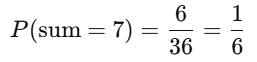
Example: What is the probability that the sum is 7?
Possible pairs: (1,6), (2,5), (3,4), (4,3), (5,2), (6,1) → 6 favorable outcomes
Common Dice Probability Types
| Condition | No. of Favorable Outcomes | Probability |
|---|---|---|
| Getting a prime number (2,3,5) | 3 | 3/6 = 1/2 |
| Getting a number > 4 | 2 (5,6) | 2/6 = 1/3 |
| Getting same number on 2 dice | 6 (1,1 to 6,6) | 6/36 = 1/6 |
| Getting different numbers | 30 | 30/36 = 5/6 |
Use This Table for Painted Cube Problems
When a cube of side n is painted and cut into smaller cubes of 1 unit:
| Cube Type | Formula |
|---|---|
| Total small cubes | n3 |
| 0 faces painted | (n−2)3 |
| 1 face painted | 6(n−2)2 |
| 2 faces painted | 12(n−2) |
| 3 faces painted | Always 8 |
Dice and Cube Questions for SSC CGL
Here, we have provided the questions on dice and cubes for SSC CGL exam preparation. You are strongly advised that if you do not know about the basics of dice and cubes, then first go through that and understand it, and then try to solve these questions by yourself. A PDF is provided with detailed solutions. So, after solving these questions, you can check your answers and understand their solutions if you made any mistakes.
Question 1: A cube is formed by folding the given sheet. What would be the letter on the opposite side of letter ‘A’?
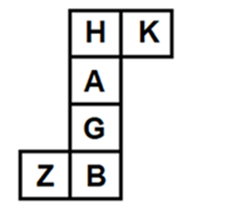
A) Z
B) B
C) G
D) K
Question 2: Two different positions of same dice are shown, the faces of which are marked with digits 4, 5, 6, 7, 8 and 9, Select the letter that will be on the face opposite to the face having digit ‘7’.
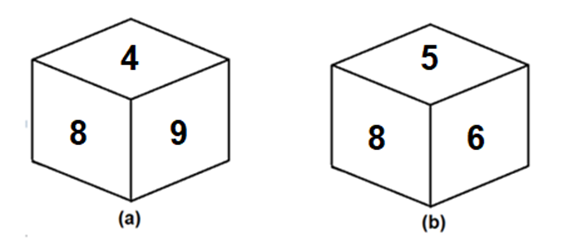
A) 9
B) 8
C) 5
D) 6
Question 3: A cube is made by folding the given sheet. In the cube so formed, which of the following pairs of letters are on opposite sides?
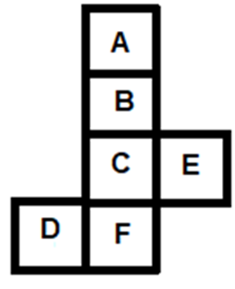
A) B, E
B) D, B
C) C, A
D) A, E
Question 4: A cube is formed by folding the given sheet. What would be the letter on the opposite side of number ‘K’?
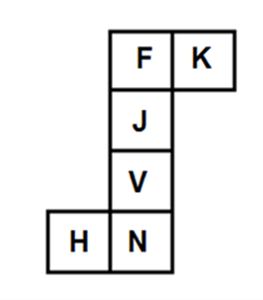
A) J
B) H
C) N
D) V
Question 5: Two different positions of the same dice are shown. When ‘@’ is at the bottom then what symbol will be at the top?
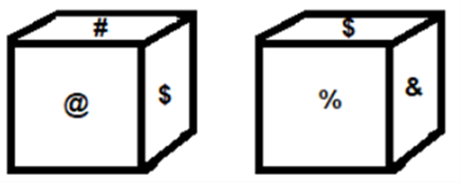
A) &
B) #
C) %
D) !
Question 6: Two cubes are formed by folding the sheet. Which of the following combination of letter and number would be on the face opposite to ‘9’ and ‘S’ respectively?
Sheet I:

Sheet II:
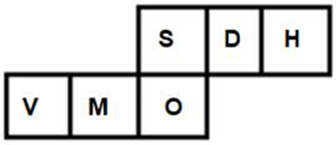
A) 4, D
B) 2, H
C) 7, V
D) 4, M
Question 7: Two positions of the same dice are given, which of the following number will be opposite to 1?

A) 5
B) 2
C) 4
D) 3
Question 8: A cube is made by folding the given sheet, in the cube so formed, which of the following pairs of letters will be on opposite sides?

A) 4, 2
B) 6, 3
C) 2, 5
D) 3, 1
Question 9: Two different positions of same dice are shown, the faces of which are marked with letters K, F, L, A,U and E. Select the letter that will be on the face opposite to the face having letter ‘F’.

A) L
B) A
C) U
D) E
Question 10: Two different positions of same dice are shown, the faces of which are marked with letters A, D, K, N, S and V. Select the letter that will be on the face opposite to the face having letter ‘A’.

A) V
B) D
C) S
D) K
Join our exclusive Telegram group for expert guidance, personalized tips, and real-time solutions to boost your SSC exam prep. [Click here to join now!]
| Other Blogs of SSC CGL 2025 | |
| SSC CGL Notification | SSC CGL Syllabus |
| SSC CGL Study Plan | SSC CGL Exam Pattern |
| SSC CGL Cut Off | SSC CGL Preparation Strategy |
| SSC CGL Previous Year Question Papers | |
FAQs: Dice and Cube for SSC CGL
A cube or dice has 6 equal square faces.
You can get the questions on dice and cube for SSC CGL for free in this blog. A PDF is provided for the detailed solutions.
A cube has 12 edges and 8 corners.
The sum of opposite faces is always 7 in a standard dice.
A cube is a 3D shape with 6 faces; a dice is a cube used for gaming, usually numbered 1–6.
Use (n − 2)³, where n is the side length of the big cube.
- Sign Up on Practicemock for Updated Current Affairs, Topic Tests and Mini Mocks
- Sign Up Here to Download Free Study Material
Free Mock Tests for the Upcoming Exams
- IBPS PO Free Mock Test
- RBI Grade B Free Mock Test
- IBPS SO Free Mock Test
- NABARD Grade A Free Mock Test
- SSC CGL Free Mock Test
- IBPS Clerk Free Mock Test
- IBPS RRB PO Free Mock Test
- IBPS RRB Clerk Free Mock Test
- RRB NTPC Free Mock Test
- SSC MTS Free Mock Test
- SSC Stenographer Free Mock Test
- GATE Mechanical Free Mock Test
- GATE Civil Free Mock Test
- RRB ALP Free Mock Test
- SSC CPO Free Mock Test
- AFCAT Free Mock Test
- SEBI Grade A Free Mock Test
- IFSCA Grade A Free Mock Test
- RRB JE Free Mock Test
- Free Banking Live Test
- Free SSC Live Test