


Profit and Loss Questions for Bank Exams are an important part of the Quantitative Aptitude section in banking examinations. These questions test how quickly you can calculate profit, loss, cost price, selling price, marked price, and discounts. Understanding the basic formulas and shortcuts can help you solve these questions accurately in less time. To help you prepare, we have provided 10 exam-level practice questions with answers, detailed explanations, and a free downloadable PDF.
Profit and Loss Questions for Bank Exams Free Quiz
Here are 10 Profit and Loss MCQs for Bank Exams, covering basic, moderate, and advanced difficulty levels.

These Profit and Loss Questions for Bank Exams are useful for candidates preparing for IBPS PO, IBPS Clerk, SBI PO, SBI Clerk, and RRB examinations.
Q1. A shopkeeper buys an article for ₹800 and sells it for ₹920. What is his profit percentage?
Cost Price (CP) = ₹800
Selling Price (SP) = ₹920
Profit = SP − CP = 920 − 800 = ₹120
Profit % = (Profit/CP) × 100 = (120/800) × 100 = 15%
Q2. An article is sold for ₹1,080 at a loss of 10%. Find its cost price.
SP = ₹1,080
Loss = 10%
CP = (SP × 100)/(100 − Loss%) = (1080 × 100)/90 = ₹1,200
Q3. A trader marks an article 25% above its cost price and allows a discount of 10%. Find his profit percentage.
Assume CP = ₹100.
MP = 100 + 25% of 100 = ₹125
Discount = 10%
SP = 125 × 90/100 = ₹112.50
Profit = 112.50 − 100 = ₹12.50
Profit % = 12.5%
Q4. A man sells two articles for ₹960 each. On one, he gains 20%, and on the other, he loses 20%. Find his overall result.
SP of each article = ₹960.
For the first article: CP = 960 × 100/120 = ₹800
For the second article: CP = 960 × 100/80 = ₹1,200
Total CP = 800 + 1,200 = ₹2,000
Total SP = 960 + 960 = ₹1,920
Loss = 2,000 − 1,920 = ₹80
Loss % = (80/2000) × 100 = 4% loss
Q5. A shopkeeper uses a weight of 900 grams instead of 1 kg but charges the price of 1 kg. What is his gain percentage?
Assume the cost price of 1 kg = ₹100.
Cost price of 900 grams = ₹90.
The shopkeeper charges ₹100 but gives goods worth ₹90.
Profit = 100 − 90 = ₹10
Profit % = (10/90) × 100 = 11 1/9%
Q6. The cost price of 15 articles is equal to the selling price of 12 articles. Find the profit percentage.
Assume CP of one article = ₹1.
CP of 15 articles = ₹15.
According to the question: SP of 12 articles = ₹15.
SP of one article = 15/12 = ₹1.25
Profit = 1.25 − 1 = ₹0.25
Profit % = (0.25/1) × 100 = 25%
Q7. An article is sold at a profit of 20%. If both its cost price and selling price were ₹50 less, the profit would be 25%. Find the original cost price.
Let the original CP = x.
Original SP = 120% of x = 1.20x.
According to the question:
1.20x − 50 = 1.25(x − 50)
1.20x − 50 = 1.25x − 62.5
12.5 = 0.05x
x = 12.5/0.05 = ₹250
Q8. A trader sells an article at a loss of 8%. If he had sold it for ₹180 more, he would have gained 7%. Find the cost price.
Loss = 8%
Expected profit = 7%
Difference = 8% + 7% = 15%
According to the question, 15% of CP = ₹180.
CP = (180 × 100)/15 = ₹1,200
Q9. A shopkeeper marks goods 40% above the cost price and gives two successive discounts of 10% and 5%. Find his profit percentage.
Assume CP = ₹100.
MP = ₹100 + 40% of ₹100 = ₹140
First discount = 10% ⇒ Price after first discount = 140 × 90/100 = ₹126
Second discount = 5% ⇒ Final SP = 126 × 95/100 = ₹119.70
Profit = 119.70 − 100 = ₹19.70
Profit % = 19.7%
Q10. A shopkeeper buys 50 items for ₹2,000. He sells 30 items at a 20% profit and the remaining 20 items at a 10% loss. Find his overall profit percentage.
Total CP = ₹2,000, Number of items = 50 ⇒ CP of one item = 2000/50 = ₹40
For the first 30 items: CP = 30 × 40 = ₹1,200; SP at 20% profit = 1200 × 120/100 = ₹1,440
For the remaining 20 items: CP = 20 × 40 = ₹800; SP at 10% loss = 800 × 90/100 = ₹720
Total SP = 1,440 + 720 = ₹2,160
Profit = 2,160 − 2,000 = ₹160
Profit % = (160/2000) × 100 = 8%
Quiz Summary
Profit and Loss Questions for Bank Exams: Understanding the Exam Trend
Profit and Loss is an important arithmetic topic in the Quantitative Aptitude section of bank exams. Profit and Loss Questions for Bank Exams can be direct or based on different situations involving cost price, selling price, discounts, and marked price.
Candidates preparing for IBPS, SBI, and RRB examinations should understand the basic concepts before moving towards lengthy questions.
Here are some common types of profit and loss questions asked in banking examinations:
- Basic Profit and Loss: Questions based on finding profit, loss, profit percentage, and loss percentage.
- Cost Price and Selling Price: Questions where candidates need to calculate the original buying or selling price.
- Marked Price and Discount: Questions involving marked prices, single discounts, and successive discounts.
- Dishonest Dealer: Questions based on incorrect weights and measures, where a shopkeeper earns extra profit by giving less quantity.
- Successive Transactions: Questions where one person sells an article to another at a profit or loss.
- Equal Selling Price: Questions involving two articles sold at the same price, with a profit on one and a loss on the other.
- Profit and Loss on Different Quantities: Questions based on the cost price of one quantity being equal to the selling price of another quantity.
Tip: Do not try to memorise every solution. First, understand the relationship between CP, SP, MP, and discount. This will help you solve different types of questions using simple calculations.
Profit and Loss Formulas for Bank Exams
Before attempting the practice Profit and Loss questions for bank exams, candidates should revise the important formulas. These formulas will help you solve most profit and loss aptitude questions quickly.
| Concept | Formula |
| Profit | SP − CP |
| Loss | CP − SP |
| Profit Percentage | (Profit/CP) × 100 |
| Loss Percentage | (Loss/CP) × 100 |
| Selling Price at Profit | CP × (100 + Profit%)/100 |
| Selling Price at Loss | CP × (100 − Loss%)/100 |
| Cost Price at Profit | SP × 100/(100 + Profit%) |
| Cost Price at Loss | SP × 100/(100 − Loss%) |
| Discount | MP − SP |
| Discount Percentage | (Discount/MP) × 100 |
| Selling Price after Discount | MP × (100 − Discount%)/100 |
Important Shortcuts for Profit and Loss
Apart from the basic Profit and Loss formulas, candidates should remember these useful shortcuts for bank exam preparation.
1. Cost Price of x Articles = Selling Price of y Articles
If the cost price of x articles is equal to the selling price of y articles, then: Profit/Loss % = [(x − y)/y] × 100
If x is greater than y, there is a profit. If x is smaller than y, there is a loss.
2. Same Selling Price with Equal Profit and Loss
If two articles are sold at the same selling price, one at a profit of p% and another at a loss of p%, the overall result is always a loss.
Loss % = p²/100
For example, if two articles are sold at a 20% profit and a 20% loss, the overall loss is: = 20²/100 = 4%
3. Successive Discounts
When two discounts are given one after another, use this formula: Net Discount = a + b − (ab/100)
Here, a and b are the two discount percentages.
For example, if a shopkeeper gives discounts of 10% and 20%:
Net Discount = 10 + 20 − (10 × 20)/100
= 30 − 2 = 28%
4. Marked Price and Discount
If an article is marked above its cost price and a discount is given, calculate the selling price after discount to find the final profit or loss.
For example:
- CP = ₹100
- MP = ₹140
- Discount = 15%
- SP = 140 × 85/100 = ₹119
Profit = ₹119 − ₹100 = ₹19
Therefore, the profit percentage is 19%.
5. Dishonest Dealer or False Weight
When a shopkeeper gives less quantity than promised but charges for the full quantity, use: Gain % = [(True Weight − False Weight)/False Weight] × 100
For example, if a shopkeeper gives 800 grams instead of 1 kg:
Gain % = [(1000 − 800)/800] × 100
= 25%
These shortcuts can save valuable time in the Quantitative Aptitude section.
Common Profit and Loss Question Types with Examples
Let us understand some common question types with simple examples before attempting the practice questions. These examples will help you understand how to apply basic formulas and shortcuts to solve Profit and Loss Questions for Bank Exams accurately and save time during the examination.
1. Equal Cost Price and Selling Price of Different Quantities
Question: The cost price of 12 articles is equal to the selling price of 10 articles. Find the profit percentage.
Solution: CP of 12 articles = SP of 10 articles
Profit % = [(12 − 10)/10] × 100
= (2/10) × 100
= 20% profit
2. Markup and Discount
Question: A shopkeeper marks an article 40% above its cost price and gives a discount of 15%. Find his profit percentage.
Solution: Assume CP = ₹100.
MP = ₹100 + 40% of ₹100
= ₹140
Discount = 15%
SP = 140 × 85/100
= ₹119
Profit = 119 − 100 = ₹19
Therefore, Profit = 19%.
3. Successive Transactions
Question: A sells an article to B at a profit of 20%. B sells it to C at a loss of 10%. If C pays ₹4,860, find the original cost price of A.
Solution: Let the original CP = x.
After a 20% profit:
New SP = 1.20x
B sells the article at a 10% loss:
Final SP = 1.20x × 0.90
4,860 = 1.08x
x = 4,860/1.08
Therefore, original CP = ₹4,500.
Strategy Checklist to Master Profit and Loss for Bank Exams
Solving Profit and Loss Questions for Bank Exams requires a clear understanding of formulas, quick calculations, and regular practice. Candidates should follow a simple preparation strategy to improve their speed and accuracy.
- Learn Basic Formulas: Remember the formulas for CP, SP, profit, loss, and discount. These are the foundations of this topic.
- Understand Percentage Calculations: Practise converting fractions into percentages and percentages into fractions to save time.
- Practise Marked Price and Discount Questions: Learn how successive discounts work and how they affect the final selling price.
- Solve False Weight Questions: Practise questions involving incorrect weights and measures to understand dishonest dealer problems.
- Use Shortcuts Carefully: Apply shortcuts only when you understand the basic calculation behind them.
- Attempt Timed Quizzes: Solve mixed-level questions with a timer to improve your calculation speed.
- Analyse Your Mistakes: Check every incorrect answer and understand where you made a calculation or concept error.
Conclusion
Profit and Loss Questions for Bank Exams are an important part of the Quantitative Aptitude section of banking examinations. Candidates should understand the basic concepts of cost price, selling price, marked price, profit, loss, and discounts before attempting advanced questions. Regular practice of different question types can help improve calculation speed and accuracy.
Attempt the 10 questions given above, revise the important formulas, and analyse your mistakes. Download the free Profit and Loss practice PDF and continue practising to strengthen your preparation for IBPS PO, IBPS Clerk, SBI PO, SBI Clerk, and RRB exams. For more exam preparation resources, mock tests, and practice questions, visit PracticeMock.
Related Blogs
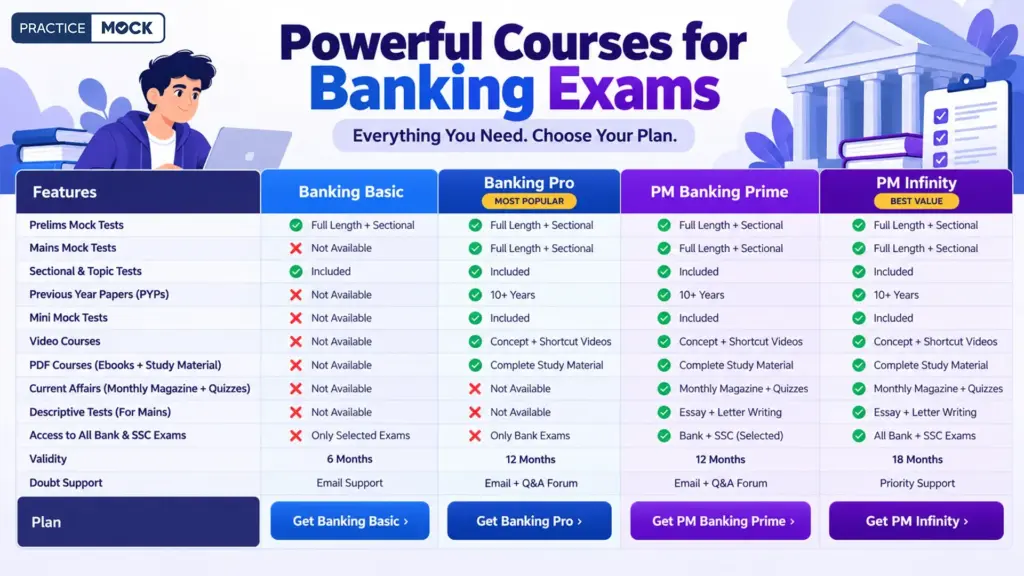
Powerful Courses for Banking Exams
FAQs on Profit and Loss Questions for Bank Exams
Q1. Are Profit and Loss questions important for bank exams?
Ans: Yes. Profit and Loss is an important arithmetic topic in the Quantitative Aptitude section of banking examinations such as IBPS PO, IBPS Clerk, SBI PO, SBI Clerk, and RRB exams. Candidates should practise different question types to improve their accuracy.
Q2. What are the basic formulas of Profit and Loss?
Ans: The basic formulas are:
- Profit = Selling Price − Cost Price
- Loss = Cost Price − Selling Price
- Profit % = (Profit/CP) × 100
- Loss % = (Loss/CP) × 100
Remember that profit and loss percentages are calculated on the cost price.
Q3. How can I solve Profit and Loss questions quickly?
Ans: Learn the basic formulas, practise percentage calculations, and understand shortcuts involving marked price, discounts, and false weights. Regular timed practice can also improve your speed.
Q4. What is the difference between Cost Price and Selling Price?
Ans: Cost Price (CP) is the amount paid to buy an article, while Selling Price (SP) is the amount received after selling it. If SP is greater than CP, there is a profit. If SP is less than CP, there is a loss.
Q5. How many Profit and Loss questions should I practise daily?
Ans: Beginners can start with 10–15 questions daily and gradually increase the number as their speed improves. Try solving questions from different difficulty levels and revise incorrect answers regularly.
Q6. Are Profit and Loss questions asked in both IBPS PO Prelims and Mains?
Ans: Profit and Loss is part of the Quantitative Aptitude syllabus for banking examinations. Candidates should prepare both basic and advanced arithmetic problems and practise questions according to the difficulty level of the examination.
Q7. Where can I download Profit and Loss Questions for Bank Exams PDF?
Ans: Candidates can use the free Profit and Loss practice PDF provided with this article. It contains 10 multiple-choice questions, answers, and detailed explanations for revision and offline practice.
- Sign Up on Practicemock for Updated Current Affairs, Topic Tests and Mini Mocks
- Sign Up Here to Download Free Study Material
Free Mock Tests for the Upcoming Exams
- IBPS PO Free Mock Test
- RBI Grade B Free Mock Test
- IBPS SO Free Mock Test
- NABARD Grade A Free Mock Test
- SSC CGL Free Mock Test
- IBPS Clerk Free Mock Test
- IBPS RRB PO Free Mock Test
- IBPS RRB Clerk Free Mock Test
- RRB NTPC Free Mock Test
- SSC MTS Free Mock Test
- SSC Stenographer Free Mock Test
- GATE Mechanical Free Mock Test
- GATE Civil Free Mock Test
- RRB ALP Free Mock Test
- SSC CPO Free Mock Test
- AFCAT Free Mock Test
- SEBI Grade A Free Mock Test
- IFSCA Grade A Free Mock Test
- RRB JE Free Mock Test
- Free Banking Live Test
- Free SSC Live Test