


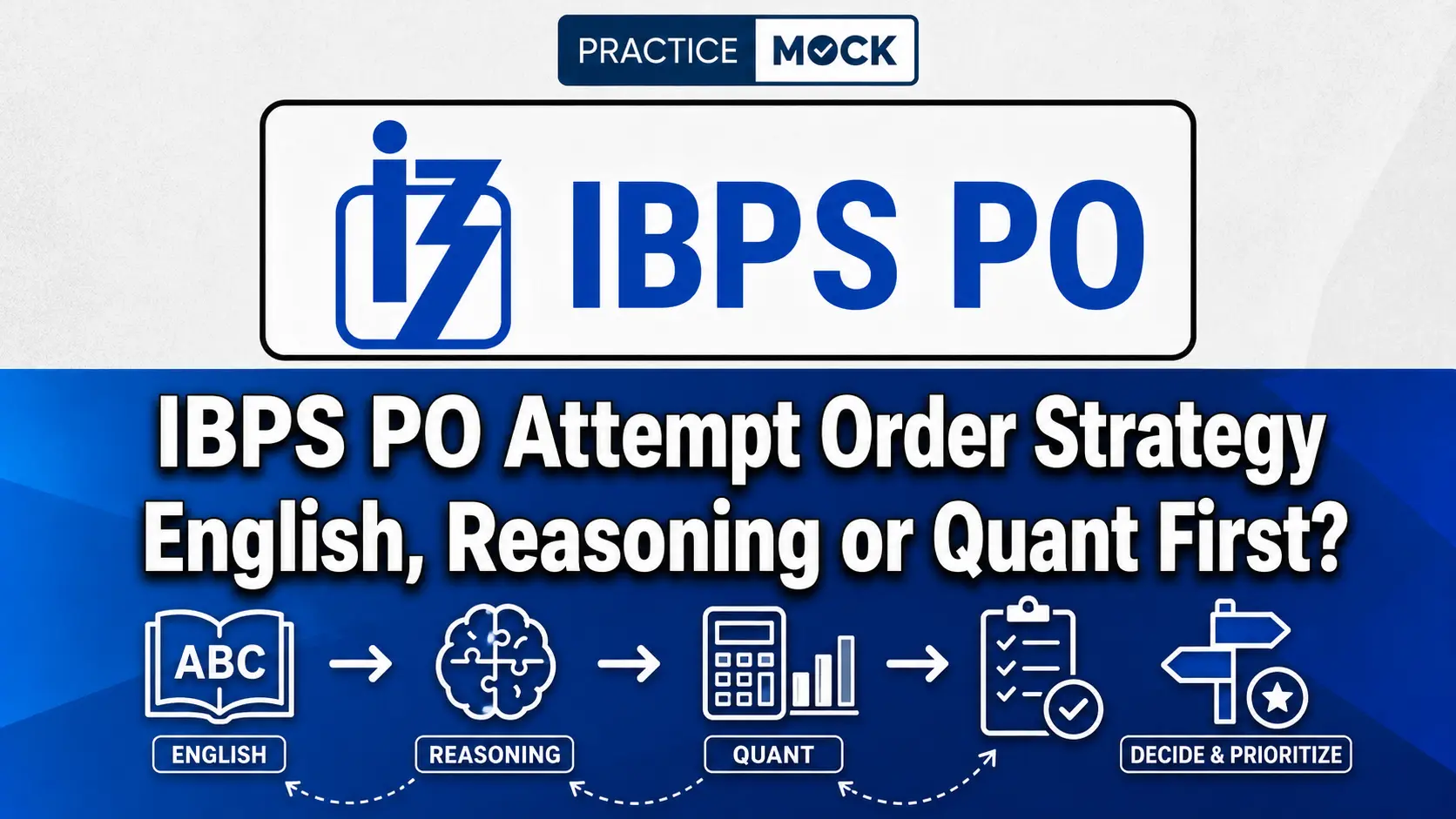
An effective IBPS PO Attempt Order Strategy can significantly improve your score in the exam. Since the IBPS PO Prelims has a fixed 20-minute sectional timer, you cannot switch time between sections. Therefore, following the right question sequence is essential.
Start with quick and high-confidence questions, leave lengthy puzzles and calculations for later, and prioritise accuracy over random attempts. A smart IBPS PO Attempt Order Strategy helps you maximise attempts, reduce negative marking, and improve your overall performance.

IBPS PO Attempt Order Strategy: Key Takeaways
The best IBPS PO attempt order strategy for Prelims is: English → Reasoning → Quantitative Aptitude. This helps you save time, build confidence, and manage the exam more effectively.

- Attempt easy and direct questions before moving on to lengthy ones.
- Stick to a fixed question sequence in every section to maintain speed and avoid confusion during the exam.
- Practise the same IBPS PO Attempt Order Strategy in mock tests to improve speed, accuracy, and time management.
- Save Reading Comprehension, Puzzles, and Data Interpretation questions for later after securing easy marks.
- Build confidence by collecting quick marks early instead of getting stuck on difficult questions.
- Skip time-consuming questions and revisit them only if time permits.
- Focus on improving question selection before increasing the number of attempts to maximize your overall score.
IBPS PO Prelims Attempt Order Strategy
The IBPS PO Attempt Order Strategy helps you use the 20 minutes allotted to each section effectively, as unused time cannot be carried forward.
Rather than attempting questions in serial order, follow a structured attempt sequence that helps you score maximum marks within the available time.
| Section | Target Attempts | Recommended Attempt Order |
| English Language | 20–26 | Grammar → Vocabulary → Cloze Test → Reading Comprehension |
| Reasoning Ability | 23–28 | Standalone Questions → Easy Puzzle → Moderate Puzzle |
| Quantitative Aptitude | 15–20 | Simplification → Quadratic Equations → Number Series → Arithmetic → Data Interpretation |
IBPS PO Prelims English Attempt Order Strategy
English is usually the easiest section to score in. Start with grammar and vocabulary questions to gain confidence, then attempt Reading Comprehension. This is a key part of the IBPS PO Attempt Order Strategy.
Recommended Attempt Order
| Question Type | Priority |
| Error Detection | First |
| Fill in the Blanks | Second |
| Sentence Improvement | Third |
| Cloze Test | Fourth |
| Para Jumbles | Fifth |
| Reading Comprehension | Last |
Why First
- Grammar-based questions usually take less time and have a higher accuracy rate than Reading Comprehension.
- Completing these questions first gives you enough time to focus on passages without feeling rushed.
- Solve vocabulary-based questions first, such as Synonyms, Antonyms, or Word Usage.
Target: 20-25 questions with 90% accuracy.
IBPS PO Prelims Reasoning Attempt Order Strategy
Reasoning can be your highest-scoring section if you follow the IBPS PO Attempt Order Strategy. Solve direct questions first, then move to Seating Arrangement and Puzzles to save time.
Recommended Attempt Order
| Question Type | Priority |
| Inequalities | First |
| Syllogism | Second |
| Coding-Decoding | Third |
| Direction Sense | Fourth |
| Blood Relations | Fifth |
| Miscellaneous Direct Questions | Sixth |
| Seating Arrangement | Seventh |
| Puzzles | Last |
Why Second
- Reasoning questions are high-scoring, easy to solve, and less-time consuming, so you should attempt the miscellaneous questions first (Syllogism, Inequality, Direction Sense, Blood Relations, and Coding-Decoding).
- Leave puzzles with multiple uncertain cases for the final round.
- Good puzzle selection often improves your score more than learning complex shortcuts.
Target: 20-25 questions.
IBPS PO Prelims Quantitative Aptitude Attempt Order Strategy
Many candidates spend too much time on lengthy calculations, leaving several easy questions unattempted. The best IBPS PO Attempt Order Strategy for Quant is to complete quick-scoring topics first and leave Data Interpretation (DI) and lengthy Arithmetic questions for later.
Recommended Attempt Order
| Question Type | Priority |
| Simplification/Approximation | First |
| Quadratic Equations | Second |
| Number Series | Third |
| Arithmetic | Fourth |
| Data Interpretation | Last |
Why Third
- It allows you to score marks easily before investing time in lengthy calculations.
- Simplification, Quadratic Equations, and Number Series have direct questions that require less calculation. Completing them first helps you build confidence and improve your attempts.
- Arithmetic and DI questions involve multiple calculations and careful interpretation. Attempt them only after completing the quick-scoring topics.
How Long Should You Spend on One Question?
A good IBPS PO Attempt Order Strategy is not only about choosing the right questions but also about knowing when to leave them. Below mentioned are the practice guidelines that you can use.
| Question Type | Suggested Decision Time |
| Grammar/Vocabulary | 20–30 Seconds |
| Simplification | 30–40 Seconds |
| Number Series | 30–40 Seconds |
| Direct Reasoning | 30–45 Seconds |
| Arithmetic | 60–90 Seconds |
| Puzzle or DI Selection | 60 Seconds |
IBPS PO Mains Attempt Order Strategy
The IBPS PO Attempt Order Strategy for Mains is different because the questions are more difficult and time-consuming. Choose easy and familiar questions first instead of getting stuck on lengthy sets to maximize your score.
Recommended Attempt Order
| Section | Best Attempt Sequence |
| English Language | Vocabulary → Grammar → Para Jumbles → Reading Comprehension |
| Reasoning & Computer Aptitude | Standalone Questions → Easy Puzzle → Difficult Puzzle |
| Data Analysis & Interpretation | Simplification → Arithmetic → Moderate DI → Difficult DI |
| Banking Awareness | Direct Questions First |
Common IBPS PO Attempt Order Mistakes
Following the right IBPS PO Attempt Order Strategy means avoiding common mistakes like starting with difficult questions or spending too much time on a single problem. These errors can reduce your overall score.
- Attempting questions in serial order.
- Starting with the toughest puzzle.
- Solving lengthy DI sets first.
- Spending too much time on one question.
- Ignoring easy standalone questions.
- Revisiting already correct answers repeatedly.
- Guessing randomly during the final minutes.
Expert Tips to Improve Your IBPS PO Attempt Order Strategy
A smart IBPS PO Attempt Order Strategy becomes effective with regular practice. Focus on improving question selection, speed, and accuracy through mock tests and consistent analysis.
Follow these practical tips during your preparation:
- Practice sectional tests regularly.
- Build the habit of scanning questions before solving them.
- Learn to skip questions without hesitation.
- Improve your speed in direct questions.
- Analyse every mock to identify slow-solving patterns.
- Increase attempts only after maintaining good accuracy.
- Stick to one strategy during the final weeks before the exam.
Also Read:
FAQs on IBPS PO Attempt Order Strategy
1. What is the best IBPS PO Attempt Order Strategy?
The best IBPS PO Attempt Order Strategy is to attempt easy and direct questions first, followed by moderate-level questions, and finally lengthy or difficult questions if time permits.
2. Which section should I attempt first in the IBPS PO Prelims?
Since the IBPS PO Prelims has fixed sectional timings, you cannot choose the section order. Within each section, start with quick-scoring questions before attempting lengthy ones.
3. Should I solve Reading Comprehension first?
No. Complete grammar, vocabulary, and Cloze Test questions first. Attempt Reading Comprehension after securing easy marks.
4. Should I attempt puzzles first in Reasoning?
No. Always complete standalone questions before moving to Seating Arrangement and Puzzles. Scan all puzzles and select the easiest one first.
5. What is the best attempt order for Quantitative Aptitude?
Start with Simplification, Quadratic Equations, and Number Series. Attempt Arithmetic and Data Interpretation after completing these quick-scoring topics.
6. How can I improve my question selection?
Practise mock tests regularly, analyse the time spent on each question, and develop the habit of skipping lengthy questions that do not have an immediate solution.
7. Should I change my attempt order in every mock test?
No. Follow one consistent strategy, evaluate your performance, and make gradual improvements based on mock test analysis.
8. Is accuracy more important than attempts?
Yes. A balanced number of attempts with high accuracy usually produces a better score than making excessive attempts with more incorrect answers.
9. How much time should I spend deciding whether to attempt a question?
If you cannot identify a clear solution within 30–60 seconds, skip the question and return to it later if time permits.
10. Can a better attempt order improve my IBPS PO score?
Yes. A structured IBPS PO Attempt Order Strategy helps you maximise productive attempts, reduce time wastage, improve accuracy, and increase your chances of clearing exam.
- Sign Up on Practicemock for Updated Current Affairs, Topic Tests and Mini Mocks
- Sign Up Here to Download Free Study Material
Free Mock Tests for the Upcoming Exams
- IBPS PO Free Mock Test
- RBI Grade B Free Mock Test
- IBPS SO Free Mock Test
- NABARD Grade A Free Mock Test
- SSC CGL Free Mock Test
- IBPS Clerk Free Mock Test
- IBPS RRB PO Free Mock Test
- IBPS RRB Clerk Free Mock Test
- RRB NTPC Free Mock Test
- SSC MTS Free Mock Test
- SSC Stenographer Free Mock Test
- GATE Mechanical Free Mock Test
- GATE Civil Free Mock Test
- RRB ALP Free Mock Test
- SSC CPO Free Mock Test
- AFCAT Free Mock Test
- SEBI Grade A Free Mock Test
- IFSCA Grade A Free Mock Test
- RRB JE Free Mock Test
- Free Banking Live Test
- Free SSC Live Test