



To stay ahead in your RBI, SEBI, or NABARD exam preparation, it’s important to stay updated with important economic and regulatory developments. In today’s edition of Vishleshan, we break down two important topics: SEBI issues new rules for angel investors and doubling India’s labour productivity. Both topics are not only relevant from an exam perspective but also crucial for understanding India’s economic landscape. Read on to get well-informed on this new topic.
ALSO CHECK: News Analysis of 23rd June 2025
Also, know why RBI Grade B Phase 1 Exam: The Silent Eliminator of 99% Aspirants & What is the Finance and Management Syllabus for RBI Grade B Exam?
SEBI Issues New Rules for Angel Investors
Context: Mandatory accreditation for investors could sideline early-stage backers, slow deal flow, and hit tier-2, tier-3 founders, until the ecosystem adjusts
Source: Mint
India’s capital markets regulator, the Securities and Exchange Board of India (SEBI), has introduced a significant change in the early-stage startup funding landscape by restricting angel fund investments exclusively to accredited or “sophisticated” investors. This move, while aimed at enhancing credibility and governance in the angel investing ecosystem, is expected to cause short-term disruptions, particularly for new and small-ticket angel investors and founders in smaller cities. The changes highlight SEBI’s intent to formalize early-stage funding but also bring to light the complexities of implementing such reforms in a rapidly evolving market.
Understanding Funding Mechanisms:
Different stages of a company’s growth are typically funded by distinct types of investors and mechanisms:
- Seed Fund:
- What: The very first capital raised by a startup to get its idea off the ground, conduct market research, build a prototype, and cover initial operating expenses. It’s typically a relatively small amount.
- How it’s different: It precedes angel and venture capital, focusing on nascent ideas with high risk and potential. Often comes from founders’ personal savings, friends, family, or very early-stage investors.
- Angel Investment:
- What: Funding provided by affluent individuals (angel investors), usually early in a startup’s lifecycle (seed or pre-seed stage), in exchange for equity ownership. Angels often bring not just capital but also mentorship, industry contacts, and experience.
- How it’s different: Angels invest their own money directly. They often take on higher risks than VCs and may have a more hands-on approach. Previously, an angel investor was characterized by net tangible assets of at least ₹2 crore (excluding primary residence), prior startup or entrepreneurial experience, or 10 years of senior management experience, and a minimum investment of ₹25 lakh in an angel fund. Body corporates qualified with a net worth of at least ₹10 crore. The new SEBI rules specifically target these investors.
- Venture Capital (VC):
- What: Funding provided by Venture Capital firms (which manage funds pooled from institutional investors and high-net-worth individuals) to startups and small businesses that have high growth potential. VC funding comes in various rounds (Series A, B, C, etc.) as the company scales.
- How it’s different: VCs invest institutional money and typically take larger equity stakes, often requiring board seats. They focus on scalability and exit strategies (IPO, acquisition).
- Promoter’s Funding:
- What: The initial capital injected by the founders (promoters) themselves to start and sustain the business in its very early stages. This often comes from personal savings, friends, and family.
- How it’s different: It is the earliest and most personal form of funding, representing the founders’ direct financial commitment and belief in their venture.
- Initial Public Offering (IPO) / Further Public Offering (FPO):
- What:
- IPO: The process by which a privately held company offers its shares to the public for the first time, getting listed on a stock exchange.
- FPO: A subsequent offering of shares to the public by a company that is already listed on a stock exchange.
- How it’s different: These are mechanisms for companies to raise capital directly from the public market, typically for growth-stage or mature companies, providing an exit opportunity for early investors like angels and VCs.
- What:
- Offer for Sale (OFS):
- What: A method for promoters or existing shareholders of a listed company to sell their shares to the public through the stock exchange mechanism. The proceeds of the sale go to the selling shareholders, not to the company itself.
- How it’s different: Unlike an IPO/FPO where the company raises fresh capital for its operations, OFS is primarily about existing investors exiting their holdings and monetizing their investment.
Newly Introduced Changes by SEBI:
SEBI, through its board meeting on June 18, has mandated significant changes for angel fund investments:
- Accredited Investor Requirement: An entity investing in an angel fund must now be registered as an accredited investor (AI). This replaces the “outdated norms set in 2013” for defining angel investors.
- Definition of Accredited Investor (AI): To qualify as an accredited investor, individuals or entities must meet one of the following specific financial thresholds:
- An annual income exceeding ₹2 crore.
- An annual income exceeding ₹1 crore alongside a net worth surpassing ₹5 crore.
- A net worth exceeding ₹7.5 crore.
- Formal Accreditation Process: Previously, fund managers informally verified investor eligibility. Now, accreditation will standardize this by requiring verification from designated agencies like CDSL Ventures Limited and NSDL Data Management Ltd.
- The accreditation certificate is valid for two years and comes with a fee of ₹12,000.
Decoding the Whole Issue: Analysis of SEBI’s New Norms
SEBI’s new regulations aim to bring more formality and investor protection to the angel investment space, but they come with short-term challenges and long-term implications.
1. Rationale for the Changes (“Why”):
- Higher Credibility and Better Governance: By mandating accredited investors, SEBI aims for higher credibility and better governance in angel funds. This ensures that investors understand the inherent risks of complex financial products like early-stage startup investments.
- Risk Mitigation: The accreditation process ensures that fund managers can verify an investor’s suitability to take risks, potentially preventing individuals with insufficient financial understanding or capacity from investing in highly risky ventures.
- Attracting “Serious Capital”: The change is expected to “clean up grey areas and attract more serious capital in the long run.”
2. Immediate Impact and “Pain for Early-Stage Startups” (“How”):
- Temporary Slowdown in Funding: The most acute fallout is “expected to be felt most acutely at the pre-seed and seed stages,” as “many angels, especially new ones, might stay on the sidelines” until they get accredited. This “may temporarily slow early-stage startup funding.”
- Impact on First-Time/Small-Ticket Angels: The new norms disproportionately affect “first-time and small-ticket angel investors,” many of whom rely on informal networks.
- Hardest Hit – Tier 2 and Tier 3 Cities: Founders in “tier 2 and tier 3 cities could be hit hardest” as they “rely heavily on informal angel networks” and a “web of personal contacts”.
- Complexity of Accreditation: The current accreditation process is seen as “complex, slow, and not equipped to handle a surge in applicants.” It involves a fee and a validity period of two years.
- Limited Capacity: As of May 2025, there are only 750 accredited investors registered. The two existing accreditation agencies (CDSL Ventures Limited and NSDL Data Management Ltd) are not deemed prepared to handle the expected load, potentially slowing down angel investing.
- Foreign Investors Face Challenges: The process is even more difficult for global investors, requiring Indian tax returns even for new entrants and lacking self-certification options common in other countries.
3. Mitigation Measures and Outlook:
- Market Adaptation: The investor community views this as a “temporary setback” that “might not last too long as investors are expected to get themselves accredited and adapt to the changes in the long run.”
- SEBI’s Responsive Steps: SEBI is “likely aware of the issues and is taking steps to ease the concerns.” On June 17, it released a consultation paper to “enhance the current accreditation process”.
- Increased Accreditation Agencies: The draft paper proposes to “increase the number of accreditation agencies to all KYC Registration Agencies (KRAs).”
- Provisional Onboarding by AIFs: AIFs may be allowed to “provisionally onboard investors as accredited investors on the basis of their own due diligence, subject to certain conditions.”
- Call for Simpler Regulation: Experts like Siddarth Pai of 3one4 Capital welcome the move but call for a “less prescriptive and more principle-based” regulatory regime, emphasizing the need for KRAs to “scale up, have a Standard Operating Procedure (SOP), cost effective structure and issue accreditation certificates quickly.”
- Angel Fund Landscape: As of March 2025, commitments raised by angel funds were ₹10,138 crore, and investments made were ₹4,134 crore. There were 82 angel funds registered under AIF regulations as of March 31, 2024.
In conclusion, SEBI’s move to mandate accredited investors for angel funds is a strategic step towards maturing India’s early-stage investment ecosystem by enhancing governance and attracting more sophisticated capital. While it will likely create short-term friction and an “adjustment phase” for angel investing, particularly affecting first-time investors and those in smaller cities, SEBI’s proactive response to address capacity and complexity concerns through a consultation paper suggests a willingness to refine the process for long-term growth and stability.
Ready to start your RBI Grade B journey? Start preparing with the courses below!

Doubling India’s Labour Productivity
Context: Rising labour productivity is the foundation of long-term improvements in real incomes, which are crucial for improving living standards and enhanced personal empowerment. While productivity growth ultimately depends on workers and businesses, governments also play an important role through their policies and actions.
Source: Business Standard
India’s ambitious goal of becoming a developed nation (Viksit Bharat by 2047) hinges critically on achieving faster growth in labour productivity. While individual workers and businesses are fundamental to this process, government policies play an indispensable role in creating an environment conducive to productivity enhancements. India, as a fast-growing emerging market with a large labour force, has unique advantages in this journey compared to advanced economies, yet it must strategically integrate existing initiatives and learn from global experiences to realize its full potential.
Key Labour Market Indicators:
To understand the dynamics of a country’s workforce and economic output, several key indicators are used:
Labour Force Participation Rate (LFPR):
- What: The percentage of persons in the labour force (working or seeking/available for work) in the population. It indicates the proportion of the population that is economically active.
- Importance: A high LFPR signifies a large and active workforce contributing to the economy.
Worker Population Ratio (WPR):
- What: The percentage of employed persons in the population. It directly measures the proportion of the population that is engaged in productive work.
- Importance: A high WPR suggests high employment levels and efficient utilization of human resources.
Unemployment Rate (UR):
- What: The percentage of unemployed persons among those in the labour force. It measures the proportion of the economically active population that is willing and able to work but cannot find a job.
- Importance: A low unemployment rate indicates a healthy labour market, efficient matching of skills with jobs, and robust economic activity.
Labour Productivity:
- Definition: Output per worker or output per hour worked. It is typically measured as GDP (constant 2021 international $ at PPP) per person employed or output per hour worked. It reflects how efficiently labour is utilized to produce goods and services.
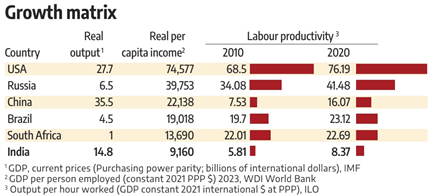
- Trends around the world (as per the “Growth matrix” table):
- USA: High labour productivity in 2020 at 76.19 (output per hour worked), up from 68.5 in 2010.
- China: Showed significant growth, doubling its real productivity in the decade before 2020, rising from 7.53 in 2010 to 16.07 in 2020.
- India: While its productivity performance has been “respectable,” it remains significantly lower than advanced and rapidly growing economies. India’s output per hour worked increased from 5.81 in 2010 to 8.37 in 2020. In 2020, an American worker was nine times more productive than an Indian worker, roughly equal to the gap in real per capita income between the two countries.
- Russia: From 34.08 in 2010 to 41.48 in 2020.
- Brazil: From 19.7 in 2010 to 23.12 in 2020.
- South Africa: From 22.01 in 2010 to 22.69 in 2020.
- Importance in an Economy:
- Standard of Living: As Nobel-prize winning economist Paul Krugman observed, “Productivity isn’t everything, but, in the long run, it’s almost everything. A country’s ability to improve its standard of living over time depends almost entirely on its ability to raise its output per worker.” Rising labour productivity is the “foundation of long-term improvements in real incomes,” which are crucial for improving living standards and enhanced personal empowerment. These are the ultimate goals of Viksit Bharat.
- Competitiveness: Higher productivity makes a country’s goods and services more competitive globally.
- Inflation Control: Productivity growth can offset wage increases, allowing for higher real wages without fuelling inflation.
- Sustainable Growth: It is key to achieving sustainable economic growth without relying solely on increased labour input.
Analysis of the Article: Decoding India’s Productivity Challenge and Path Forward
The article comprehensively dissects India’s labour productivity imperative, outlining its unique context, the drivers of productivity growth, and the strategic measures needed to achieve Viksit Bharat.
1. The Centrality of Productivity for India’s Ambition:
- Viksit Bharat Goal: Faster growth in labour productivity is “central to India’s development ambition”. This is the foundation for “long-term improvements in real incomes” and “enhanced personal empowerment,” which are the “ultimate goals of Viksit Bharat”.
- Government’s Role: While productivity depends on workers and businesses, “governments also play an important role through their policies and actions”. India needs to impart “increased urgency to an internally consistent, mutually reinforcing set of measures that better integrates many existing initiatives”.
2. Drivers of Productivity Growth (Stanley Fischer’s Lens):
- The late Stanley Fischer, former Vice Chair of the Federal Reserve System, provided a useful framework for understanding productivity growth, highlighting three key drivers:
- Capital Investment: Both physical capital (machinery, transport) and intangible capital (software, design, business knowledge retrieval systems) can raise output per worker.
- Improved Labour Quality: Achieved through education, vocational training, and experience, enhances workforce capability.
- Systematic Innovation: Allows existing physical and human resources to “generate more value” (e.g., Henry Ford’s assembly line, computer-aided design, artificial intelligence).
3. India’s Unique Context and Advantages:
- Different from US: India’s agenda “must clearly be different from that of the US,” as the latter is an advanced country at the technological frontier. India is a “fast-growing emerging market with a giant (and still growing) labour force and enormous regional diversity”.
- Two Advantages for Emerging Markets (like India):
- Unsatisfied Demand for Manufactured Goods: In emerging markets, as incomes rise, demand for manufactured goods increases. This should lead to a rise in manufacturing’s share of national output, increasing economy-wide productivity, as manufacturing workers typically have higher productivity than agricultural workers (provided they are skilled for the transition). This is particularly relevant for a “large, relatively closed economy” like India.
- Technological Catch-up: Advanced countries’ technological innovations provide a pathway to higher labour productivity in both goods and services for countries with relevant capabilities (like India), “without the cost of local invention”.
- India’s Departure from Asian Prototype: India “departs from this prototype in two important ways”:
- Its transition out of agriculture (both in output and employment) has been relatively slow.
- Its export success has been in services (offshore ‘body-shopping’ and onshore ‘global capability centres’) rather than manufactures. This contrasts with Asian peers (Japan, China, Vietnam, Bangladesh) who accelerated growth by exporting manufactures.
4. Policy Initiatives and Learnings:
- National Initiatives: India has already taken important steps:
- Production-Linked Incentive (PLI) scheme: To boost manufacturing.
- Labour law reforms: To improve labour market efficiency.
- Skill India: To enhance labour quality.
- National Education Policy 2020: To improve human capital.
- Digital India: To promote digitalization and innovation.
- PM Gati Shakti: For integrated infrastructure development, enabling capital formation.
- State-level Reforms: Many states are advancing complementary reforms in skill development, agro-modernization, industrial corridors, and services-led urban growth.
- Learning from Global Experience:
- East Asia: Highlights importance of infrastructure and export orientation.
- Germany: Demonstrates support to medium enterprises (Mittelstand) and vocational training.
- Nordic Countries: Show how inclusive labour market policies support broad participation in high-productivity sectors.
- United States and Japan: Illustrate investment in research, innovation ecosystems, and digital technologies (especially for smaller firms).
5. Role of Emerging Technologies and NITI Aayog:
- Artificial Intelligence (AI): Emerging technologies, particularly AI and generative AI, offer a “transformative opportunity” to automate routine tasks, improve decision-making, and “raise efficiency — especially in services”.
- Harnessing AI Potential: To harness AI’s full potential, India must invest in digital infrastructure, promote inclusive access, and scale up reskilling, especially for rural and informal workers.
- NITI Aayog’s Central Role: NITI Aayog has a central role in this effort by “aligning national policy with state-level initiatives, supporting skill development institutions, empowering women and youth, and promoting innovation in aspirational districts”.
- States as Laboratories of Reform: Ultimately, “India’s states — being the real laboratories of reform — must lead the way,” with “strong coordination between the Centre and states” being essential for “inclusive, resilient, and sustained growth on the path to a Viksit Bharat by 2047”.
In summary, India’s quest for higher labour productivity is a multifaceted challenge requiring integrated policy actions across various sectors, investments in human and physical capital, fostering innovation, and learning from both domestic and global experiences, with strong Centre-state coordination being key to achieving its ambitious development goals.
Join our unique Telegram group immediately to skyrocket your preparation for Regulatory exams via expert guidance, top tips, perfect feedback, and much more!
[ Click Here to join the PracticeMock Telegram Group! ]
[ Click Here to join the PracticeMock Telegram Discussion Group Link! ]
Related Posts:
- Sign Up on Practicemock for Updated Current Affairs, Topic Tests and Mini Mocks
- Sign Up Here to Download Free Study Material
Free Mock Tests for the Upcoming Exams
- IBPS PO Free Mock Test
- RBI Grade B Free Mock Test
- IBPS SO Free Mock Test
- NABARD Grade A Free Mock Test
- SSC CGL Free Mock Test
- IBPS Clerk Free Mock Test
- IBPS RRB PO Free Mock Test
- IBPS RRB Clerk Free Mock Test
- RRB NTPC Free Mock Test
- SSC MTS Free Mock Test
- SSC Stenographer Free Mock Test
- GATE Mechanical Free Mock Test
- GATE Civil Free Mock Test
- RRB ALP Free Mock Test
- SSC CPO Free Mock Test
- AFCAT Free Mock Test
- SEBI Grade A Free Mock Test
- IFSCA Grade A Free Mock Test
- RRB JE Free Mock Test
- Free Banking Live Test
- Free SSC Live Test