


Data Interpretation for IBPS RRB Exam: Data interpretation (D) is one of the toughest yet one of the most expected, most scoring, and time-consuming topics in the quantitative aptitude section. IBPS RRB Exam invites different types of questions from this topic. Aspirants who have started preparing for the IBPS RRB Exam should start mastering this topic to maximize their overall score. Therefore, aspirants who are looking for Data Interpretation questions IBPS RRB Exams are in the right place. Here you’ll not only get the best and the simplest tips needed to master this part of the exam but will also get sample questions with solutions. The different types of questions that you can face in the exam will be Table-based, Line Graph, Bar Graph, Pie Chart, Missing data types, caselet type, and more.
In this blog, we’ll provide you with the best tip and tricks needed to master Data Interpretation for IBPS RRB Exam along with the samples.

Tips for Maximizing Your Score in the IBPS RRB Exam by Mastering DI
With practice and understanding you can master Data Interpretation for IBPS RRB Exam. While practicing different types of questions, you should set a timer and aim at improving your speed and along with accuracy. Given below are some simple yet effective tips that will help you master Data Interpretation for IBPS RRB Exam.
1. Understand the Basics: know different types of formats for DI, like line graphs, bar graphs, pie charts, tables, and caselets. Learn to interpret data quickly and accurately.
2. Practice Regularly: Practice is essential. Solve a different typed of DI questions from previous years’ papers. Also, take mock tests and try to improve your timing and accuracy while solving DI questions. Solve easy questions first and then do for hard ones. Regular practice will improve your performance and build confidence and proficiency.
3. Improve Calculation Speed: Practice mental math techniques and practice shortcuts for quick calculations.Use approximation methods where exact values are not required.
4. Improve Accuracy: Avoid misinterpretation of date by reading the questions and data carefully. Always check your calculations and interpretations twice to make sure they are accurate.
5. Develop Analytical Skills: Analyze patterns, trends and relationships in the data. Practice to master the art of drawing logical conclusions based on the given data.
6. Time Management: Invest a specific amount of time to each DI question or set of questions. Moreover, focus on questions based on your strengths and the marks allotted to them.
7. Use Elimination Technique: Master using the elimination technique for solving multiple-choice questions. Train your mind to remove clearly wrong/incorrect options to reduce the choices.Select the most appropriate answer by using use logical reasoning.
8. Revise Regularly and Learn: Review your mistakes properly and carefully and understand where you went wrong after practicing different types of questions.Learn from errors. This will help you avoid repeating those mistakes in the exam.
Data Interpretation For IBPS RRB Exam, Sample Questions For Practice
Directions: Answer the questions based on the information given below.
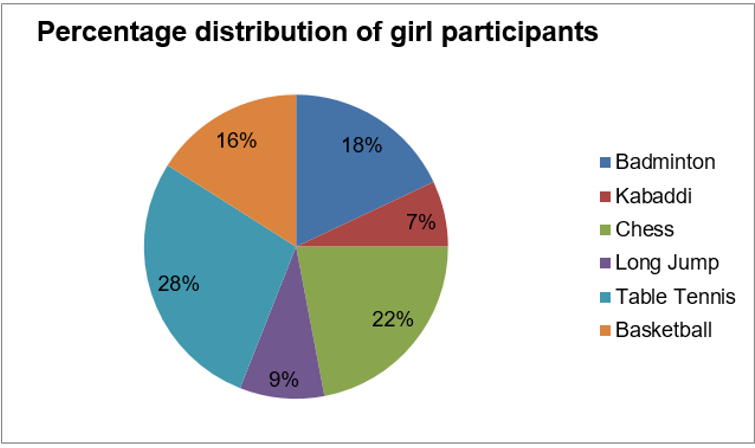
The pie-chart below shows the percentage distribution of the total number of girl participants in 6 different games.
Note1: Total number of girl participants in all the 6 games = 8400.
Note2: Total number of participants = Number of boy participants + number of girl participants.
Question 1: Find the difference between the number of girl participants in Chess and the number of girl participants in Long Jump.
A) 1092
B) 1056
C) 978
D) 1140
E) 1246
Question 2: If the total number of participants in basketball is 2979 then find the number of boy participants in basketball.
A) 1496
B) 1635
C) 1784
D) 1480
E) 1575
Question 3: If the number of boy participants in Kabaddi is 539, then find the ratio of number of girl participants in Kabaddi to the number of boy participants in Kabaddi.
A) 8:5
B) 9:7
C) 12:11
D) 10:7
E) 11:9
Question 4: Total number of girl participants in badminton is approximately what percentage of the total number of girl participants in table tennis?
A) 56%
B) 67%
C) 59%
D) 64%
E) 70%
Question 5: If the total number of participants in all the 6 games is 18000, then the total number of girl participants is what percent of the total number of boy participants in all the games together?
A) 85%
B) 90%
C) 87.5%
D) 82.5%
E) None of these
Solution 1: A)
Number of girl participants in chess = 22% of 8400 = 1848
Number of girl participants in Long Jump = 9% of 8400 = 756
Required difference = 1848 – 756 = 1092
Hence, option a.
Solution 2: B)
Number of girls participants in basketball = 16% of 8400 = 1344
Number of boys participants = 2979 – 1344 = 1635
Hence, option b.
Solution 3: C)
Number of girls participants in Kabaddi = 7% of 8400 = 588
Required ratio = 588:539 = 12:11
Hence, option c.
Solution 4: D)
Number of girl participants in badminton = 18% of 8400 = 1512
Number of girl participants in table tennis = 28% of 8400 = 2352
Required % = (1512/2352) × 100 ~ 64%
Hence, option d.
Solution 5: C)
Total number of boy participants = 18000 – 8400 = 9600
Required % = (8400/9600) × 100 = 87.5%
Hence, option c.
Data Interpretation For IBPS RRB Exam FAQs
Data Interpretation (DI) involves analyzing and drawing conclusions from data presented in various formats like graphs, charts, and tables.
DI is crucial because it is one of the most scoring yet time-consuming sections in the quantitative aptitude part of the IBPS RRB exam.
Common types of DI questions include Line Graphs, Bar Graphs, Pie Charts, Table DI, and Caselets.
Regular practice improves performance, builds confidence, and enhances speed and accuracy in solving DI questions.
Understand different DI formats, practice regularly, improve calculation speed and accuracy, develop analytical skills, manage time, and use the elimination technique.
- Sign Up on Practicemock for Updated Current Affairs, Topic Tests and Mini Mocks
- Sign Up Here to Download Free Study Material
Free Mock Tests for the Upcoming Exams
- IBPS PO Free Mock Test
- RBI Grade B Free Mock Test
- IBPS SO Free Mock Test
- NABARD Grade A Free Mock Test
- SSC CGL Free Mock Test
- IBPS Clerk Free Mock Test
- IBPS RRB PO Free Mock Test
- IBPS RRB Clerk Free Mock Test
- RRB NTPC Free Mock Test
- SSC MTS Free Mock Test
- SSC Stenographer Free Mock Test
- GATE Mechanical Free Mock Test
- GATE Civil Free Mock Test
- RRB ALP Free Mock Test
- SSC CPO Free Mock Test
- AFCAT Free Mock Test
- SEBI Grade A Free Mock Test
- IFSCA Grade A Free Mock Test
- RRB JE Free Mock Test
- Free Banking Live Test
- Free SSC Live Test