


For learners navigating India’s fast‑evolving education landscape, the edtech boom solved access but not learning. AI now promises to bridge that gap—reshaping how students receive feedback, overcome language barriers, and resolve doubts at scale. Platforms like Scaler, NxtWave, Coursera, and PhysicsWallah are embedding AI into pedagogy, tackling structural flaws that traditional models ignored. Yet this is not just about smarter delivery—it is about redefining the very structure of learning. Should education remain fixed in uniform courses, or evolve into personalised, competency‑based pathways? In this Vishleshan, we decode the problems AI is actually solving, examine the four mechanisms of personalised learning, and analyse who gains, who bears the cost, and what this shift means for the future of credentials in India’s edtech ecosystem.
Edtech taps AI to bring learning just the way you want it
Context: India has 250 million students in formal education, yet most learn the same content, at the same pace, in the same language — regardless of where they come from or what they already know. Artificial intelligence is beginning to change that, offering real-time, personalised learning at a scale and cost the traditional edtech model could never reach. Platforms like PhysicsWallah, Scaler, Coursera, and NxtWave are embedding AI into their core products — but the same shift that strengthens their offering is also eroding the revenue models they were built on. The central question is no longer whether AI can personalise learning — it clearly can — but whether that personalisation translates into better outcomes, and who pays for it.
Link to the Article: Mint
The Problem AI Is Actually Solving
- The Access-Learning Confusion — The edtech boom of 2020–2023 solved the access problem: it put content online, made it affordable, and removed geography as a barrier. What it never solved was the learning problem — that every student arrives with a different foundation, a different language, a different threshold for confusion. Access to identical content is not the same as access to effective learning.
- The Language Filter — English-medium delivery was never a neutral choice. It was a structural filter that systematically eliminated learners before they could demonstrate capability. A student who understands recursion in Telugu but cannot parse an English explanation is not struggling with recursion — they are being failed by the medium.
- The Feedback Gap — The slow study-test-review cycle was not a pedagogical choice; it was a technological constraint. By the time feedback arrived, the confusion had already calcified. AI removes that constraint — and with it, the single biggest structural inefficiency in how students learn.
The Four Mechanisms of AI-Driven Personalised Learning
AI’s impact on learning operates through four distinct mechanisms — each addressing a different failure of the traditional model.
1. Faster Feedback Loops
- In traditional learning, students studied, attempted problems, and waited days for feedback — by which point the confusion had already deepened.
- AI closes that gap to minutes. A student attempts a problem, gets a hint specific to the error they made, retries, and moves to a harder variant in the same session.
- Scaler goes a step further — its AI generates code for students to review and critique, mirroring the reality of modern workplaces where evaluating AI output is as important a skill as writing original code.
2. Language as a Barrier, Not a Detail
- India’s edtech sector long treated language as a minor variable. NxtWave’s model treats it as the central one.
- A student who grasps a concept intuitively but cannot process an English explanation is not struggling with the subject — they are struggling with the medium.
- Reaching learners across 650+ districts in regional languages is not a distribution strategy; it is a correction of a structural flaw the old model never acknowledged.
3. The Hallucination Risk
- General-purpose AI tools can produce explanations that are fluent, confident, and factually wrong — a serious problem in high-stakes exam preparation for JEE or NEET.
- Platforms like Coursera and PhysicsWallah address this by grounding their AI in vetted, proprietary course content.
- The model only draws from verified material, not the open internet. For exam aspirants, that boundary is not a restriction — it is the core value of the product.
4. Doubt Resolution at Scale
- PhysicsWallah’s Ask AI resolved nearly three million student queries between September 2025 and early 2026 — a volume no human teacher network could match at equivalent cost or consistency.
- For a student in a tier-III town at 11 PM with no teacher to call, this is not a convenience feature. It is the difference between getting unstuck that night and carrying the confusion into the next day’s class.
- The question platforms must now answer is what the paid product looks like once AI handles what students previously paid for.
Who Bears the Cost — and Who Gains
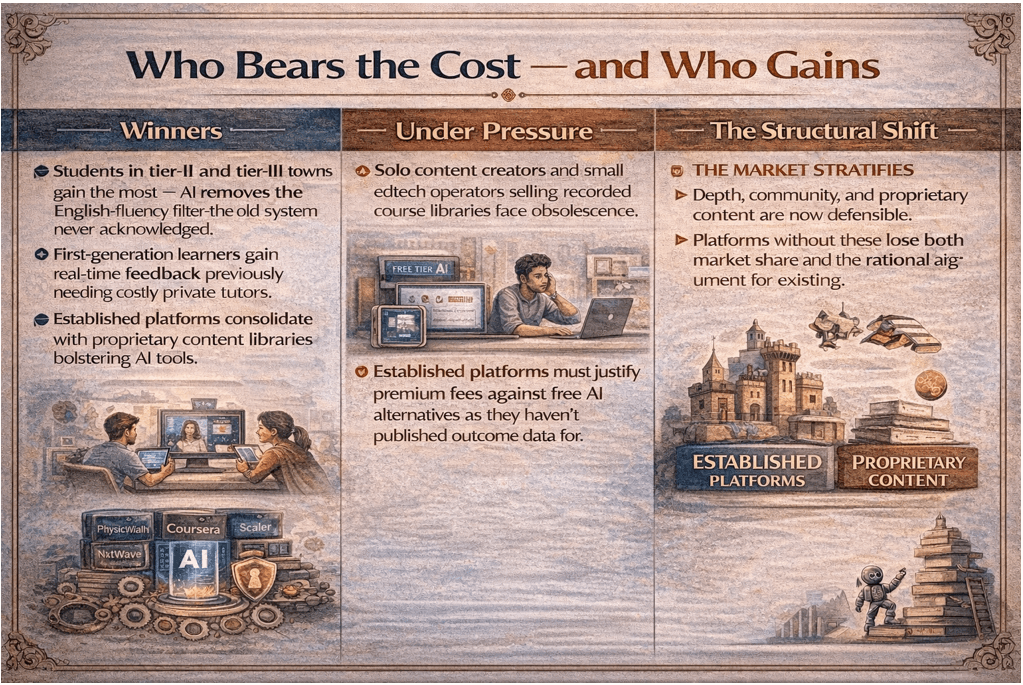
The gains and losses from AI-driven edtech are not distributed evenly — the image below maps who benefits, who faces pressure, and why the market is stratifying rather than collapsing.
Action Agenda
| Area | Problem | Solution |
| Outcome disclosure standards | Platforms cite satisfaction rates and query volumes — not placements, exam scores, or income changes. Users cannot evaluate real value | DPIIT and the Ministry of Education should mandate standardised outcome reporting for edtech platforms above a defined revenue threshold — placement rates, exam pass rates, and 12-month income data |
| AI hallucination safeguards in education | General-purpose AI tools used for exam prep can generate confident, factually wrong answers — particularly dangerous for high-stakes exams like JEE and NEET | BIS or a designated education-tech standards body should certify AI tools used in exam preparation as “grounded” or “open-web” — enabling students to make informed choices about the reliability of their AI assistant |
| Regional language content parity | AI personalisation in regional languages depends on the quality and volume of regional language training data — which is significantly lower than English | The National Education Policy 2020’s language mandate should be backed by a Centre-funded regional language content corpus for STEM subjects — available to all edtech platforms as a public dataset |
| Teacher transition support | Solo content creators and small edtech operators with no adaptive or community layer face a structural displacement with no policy safety net | The Ministry of Skill Development should create a reskilling programme specifically for educators transitioning from recorded-content models to live mentoring, community facilitation, and AI-assisted teaching roles |
| Equity in device and connectivity access | AI-driven personalised learning is only accessible to students with reliable internet and capable devices — the tier-III access gap is infrastructure, not content | PM eVidya and BharatNet capex should be explicitly linked to edtech access metrics — not just connectivity coverage, but actual AI tool usage rates in underserved districts |
The Structural Measure That Matters Most
The article treats AI as a better way to deliver existing education. That framing undersells the real shift — AI is not just changing how content is delivered, it is making the structure of learning itself negotiable.
Once a student can learn data structures through a module calibrated to their pace, language, and error pattern, the case for a fixed six-month programme at a fixed price becomes difficult to defend. The logical endpoint is not a smarter edtech platform — it is a system where a credential reflects what a student can do, not what course they completed.
India’s credentialing system — board exams, entrance tests, degrees — is built on the opposite premise. Employers in the tech sector are already moving away from it, quietly deprioritising college tier in favour of demonstrated skill. When that preference becomes explicit policy, the credential question will be impossible to ignore.
What to Watch
Google’s Gemini offering free JEE and NEET practice tests on Physics Wallah content is the week’s most consequential signal — not as a content deal, but as a market entry.
A platform with unlimited distribution reach and a zero-cost product model has entered India’s most competitive learning segment. Whether Physics Wallah retains the student relationship or gradually cedes it to Google’s interface will define its competitive position through FY28.
Three markers will determine whether this AI shift actually delivers on its equity promise:
- Whether regional language AI tools reach content parity with English-medium equivalents by FY28
- Whether any major platform publishes auditable placement and income outcome data by FY27
- Whether UGC or AICTE initiates a competency-based certification pilot within the next 18 months — the slowest of the three, because it requires a policy decision, not a product one
- Sign Up on Practicemock for Updated Current Affairs, Topic Tests and Mini Mocks
- Sign Up Here to Download Free Study Material
Free Mock Tests for the Upcoming Exams
- IBPS PO Free Mock Test
- RBI Grade B Free Mock Test
- IBPS SO Free Mock Test
- NABARD Grade A Free Mock Test
- SSC CGL Free Mock Test
- IBPS Clerk Free Mock Test
- IBPS RRB PO Free Mock Test
- IBPS RRB Clerk Free Mock Test
- RRB NTPC Free Mock Test
- SSC MTS Free Mock Test
- SSC Stenographer Free Mock Test
- GATE Mechanical Free Mock Test
- GATE Civil Free Mock Test
- RRB ALP Free Mock Test
- SSC CPO Free Mock Test
- AFCAT Free Mock Test
- SEBI Grade A Free Mock Test
- IFSCA Grade A Free Mock Test
- RRB JE Free Mock Test
- Free Banking Live Test
- Free SSC Live Test