


Staying updated on economic and regulatory issues is non-negotiable for exams like RBI, SEBI, or NABARD. Every topic matters. Every update can turn into a question. In today’s Vishleshan, we focus on ”Low Inflation: A Consumer’s Dream, a Finance Minister’s Nightmare” This issue is timely. Its relevance is growing. And its impact is deeply linked with policy and regulation. Understanding it now will not just help in exams but also sharpen your perspective.
Low Inflation: A Consumer’s Dream, a Finance Minister’s Nightmare
Context: Subdued inflation is a dream for households but a nightmare for budget planners. Low prices suppress nominal GDP growth, the basis for tax revenue projections, putting the government’s fiscal targets for the year at significant risk.
Link to the Article: Indian Express
The article discusses a classic economic paradox currently facing India: low inflation. While this is welcome news for households as it protects their purchasing power, it poses a significant challenge for the government’s financial management. The core issue is that low inflation is suppressing the growth of Nominal GDP, which is the base for the government’s tax revenue projections and fiscal deficit targets. This mismatch between budget assumptions and economic reality is straining government finances, even as the Real GDP shows healthy growth.
The Double-Edged Sword of Inflation:
Inflation is the rate at which the general level of prices for goods and services is rising, and subsequently, the purchasing power of currency is falling. It has wide-ranging implications for both citizens and the government.
1. High Inflation
- Negative Impact:
- On Citizens: It erodes purchasing power, meaning your money buys less than it did before. It hurts people on fixed incomes (like pensioners) the most and diminishes the real value of savings. High inflation creates economic uncertainty, making it difficult for families and businesses to plan for the future.
- On the Government: It can lead to social and political unrest. The central bank (like the RBI) is forced to raise interest rates to control it, which can slow down economic growth by making loans more expensive.
- Positive Impact:
- On the Government (in moderation): For a government with significant debt, moderate inflation can be beneficial as it erodes the real value of that debt over time. The government pays back the loan with money that is worth less than when it was borrowed.
2. Low Inflation / Deflation
- Positive Impact:
- On Citizens: This is the “good news” mentioned in the article. It protects and can even increase purchasing power. The cost of living remains stable, making daily essentials affordable.
- Negative Impact:
- On Citizens: Persistently low inflation can be a sign of weak consumer demand, which may lead to businesses cutting production and jobs. In an extreme case of deflation (falling prices), consumers may postpone purchases, expecting prices to fall further, which can severely stall the economy.
- On the Government: This is the central problem highlighted in the article.
- Lower Tax Revenue: Corporate and individual incomes, and the value of goods and services (on which GST is levied), are all measured in nominal (current) terms. When prices grow slowly, the monetary value of these items also grows slowly, leading to lower-than-expected tax collections.
- Higher Debt Burden: Low inflation increases the real burden of government debt. The government’s revenue growth slows down, but its debt obligations remain fixed, making repayment more difficult.
Real GDP vs. Nominal GDP: The Full Picture
Understanding the difference between Real and Nominal GDP is critical to decoding the article.
- Nominal GDP: This measures a country’s economic output using current market prices. It includes the effects of both the change in the quantity of goods produced and the change in their prices (inflation).
- Purpose: It is essential for government budgeting. Tax revenues are collected on nominal values, and fiscal targets like the debt-to-GDP ratio are calculated using Nominal GDP as the denominator. It reflects the economy in monetary terms.
- Real GDP: This measures a country’s economic output using the prices of a fixed base year. By keeping prices constant, it removes the effect of inflation and shows the actual change in the volume of goods and services produced.
- Purpose: It is the true indicator of economic growth. It answers the question: “Is our country actually producing more stuff than before?” A high Real GDP growth rate signifies a healthy, productive economy.
Why the Gap Matters: The difference between Nominal and Real GDP growth is roughly equal to the inflation rate (GDP Deflator).
- A large gap means high inflation (prices are rising much faster than production).
- A small gap, as seen in the article, means very low inflation (prices are almost stagnant, so nominal growth is only slightly higher than real growth).
Decoding the Article: An Analysis
Let’s break down the data from the article using the concepts above.
1. The Core Conflict: Good News vs. Bad News
- The Good News (for consumers): Retail (CPI) inflation is just 2.07% and Wholesale (WPI) inflation is 0.52%. This means prices are very stable.
- The Bad News (for the government): The Real GDP grew by a robust 7.8% (meaning production volume is up), but due to low inflation, the Nominal GDP grew by only 8.8%.
- The Problem: The government’s budget for 2025-26 was based on an assumed Nominal GDP growth of 10.1%. The actual growth of 8.8% is significantly lower, creating a major shortfall.
2. Impact on Government Finances
- Missed Tax Targets: Because the economy’s monetary value isn’t growing as fast as projected, tax collections are suffering. The data shows that in the first four months (April-July), gross tax revenue grew by a mere 1% and net tax revenue actually shrank by 7.5%. This is a direct consequence of lower-than-expected nominal growth.
- Fiscal Deficit & Debt Under Pressure: The government aims for a fiscal deficit of 4.4% of GDP and a debt-to-GDP ratio of 56.1%. Both these targets depend on the absolute value of the Nominal GDP. If the final Nominal GDP figure is lower than the budgeted ₹357 lakh crore, these percentage ratios will automatically worsen unless the government drastically cuts its spending.
3. Making Sense of the Chart and ‘Base Effect’
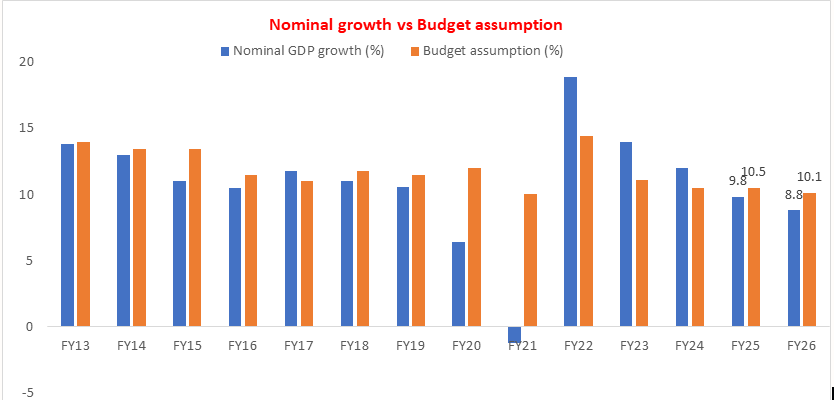
- The Chart’s Story: The chart above shows that the government has frequently overestimated nominal GDP growth (in 9 of the last 13 years). However, the trend in the three years prior to 2024-25 was positive, with actual growth beating assumptions. The current fiscal year (FY26) seems to be reverting to the old pattern of missing the target.
- A Silver Lining (The ‘Base Effect’): The article mentions a crucial detail. The GDP for the previous year (2024-25) has been revised upwards to ₹331 lakh crore. This means the starting point, or ‘base’, is higher. To reach the budget’s absolute target of ₹357 lakh crore, the economy now only needs to grow by 8% in nominal terms, which is much more achievable than the initial 10.1% and is close to the current 8.8% rate. This provides some hope that the absolute deficit and debt targets can still be met.
4. The Crucial Question: Why is Inflation Low?
Low inflation isn’t always bad. Its nature depends on its cause.
- Good Reason: If prices are low due to oversupply, higher productivity, or efficiency gains (e.g., lower commodity prices), it’s a sign of a healthy economy.
- Bad Reason: If prices are low due to weak consumer demand, it’s a sign of an ailing economy where people are not spending, forcing businesses to keep prices down.
The article points to a worrying sign. An RBI study found that while company sales rose modestly by 5.5%, their net profits soared by 17.6%. This suggests companies are profiting from cheaper raw materials but aren’t seeing strong demand for their final products. Furthermore, they are not reinvesting these profits into new projects (“weak capex sentiment”). This indicates that the current low inflation may be driven more by weak underlying demand, which is not a positive signal for long-term economic health.
- Sign Up on Practicemock for Updated Current Affairs, Topic Tests and Mini Mocks
- Sign Up Here to Download Free Study Material
Free Mock Tests for the Upcoming Exams
- IBPS PO Free Mock Test
- RBI Grade B Free Mock Test
- IBPS SO Free Mock Test
- NABARD Grade A Free Mock Test
- SSC CGL Free Mock Test
- IBPS Clerk Free Mock Test
- IBPS RRB PO Free Mock Test
- IBPS RRB Clerk Free Mock Test
- RRB NTPC Free Mock Test
- SSC MTS Free Mock Test
- SSC Stenographer Free Mock Test
- GATE Mechanical Free Mock Test
- GATE Civil Free Mock Test
- RRB ALP Free Mock Test
- SSC CPO Free Mock Test
- AFCAT Free Mock Test
- SEBI Grade A Free Mock Test
- IFSCA Grade A Free Mock Test
- RRB JE Free Mock Test
- Free Banking Live Test
- Free SSC Live Test