


Preparing for RBI Grade B and RBI Assistant 2026 together may sound overwhelming, but with the right strategy, it becomes not only manageable but also highly efficient. The exams overlap in several areas, and a smart plan allows aspirants to maximize their study hours without duplication of effort. With Assistant Prelims in April 2026 and Grade B Phase 1 later in the year, aspirants have a golden opportunity to align preparation for both exams. This blog outlines a time‑management strategy that balances Assistant basics with Grade B’s advanced demands, ensuring aspirants stay exam‑ready throughout the year.
Why Prepare Together?
The biggest advantage of preparing for both exams together lies in the shared syllabus. Quantitative Aptitude, Reasoning, and English form the backbone of both exams, while General Awareness connects them even more strongly. By treating preparation as a unified journey, aspirants avoid wasted effort and gain confidence. Assistant preparation builds speed and accuracy, while Grade B preparation develops analytical depth. This dual approach ensures readiness for both exams without overwhelming study hours, making every effort count.

- Overlap of subjects: Quantitative Aptitude, Reasoning, and English form the backbone of both exams.
- GA advantage: Current Affairs and Banking Awareness prepared for Assistant Mains directly benefit Grade B Phase 1 and Phase 2.
- Efficiency: Instead of treating them separately, aspirants can save time by following a structured split.
- Confidence building: Assistant exam acts as a warm‑up, while Grade B requires deeper conceptual mastery.
The 50‑50 Time Split Method
Dividing the day into two halves is the most effective way to balance Assistant and Grade B preparation. The morning session focuses on Assistant basics, while the afternoon is dedicated to Grade B’s advanced subjects. This split ensures that aspirants warm up with foundational practice before tackling complex topics later in the day. It also prevents fatigue by aligning easier tasks with early hours and tougher subjects with peak concentration periods, maximizing efficiency across both exams.
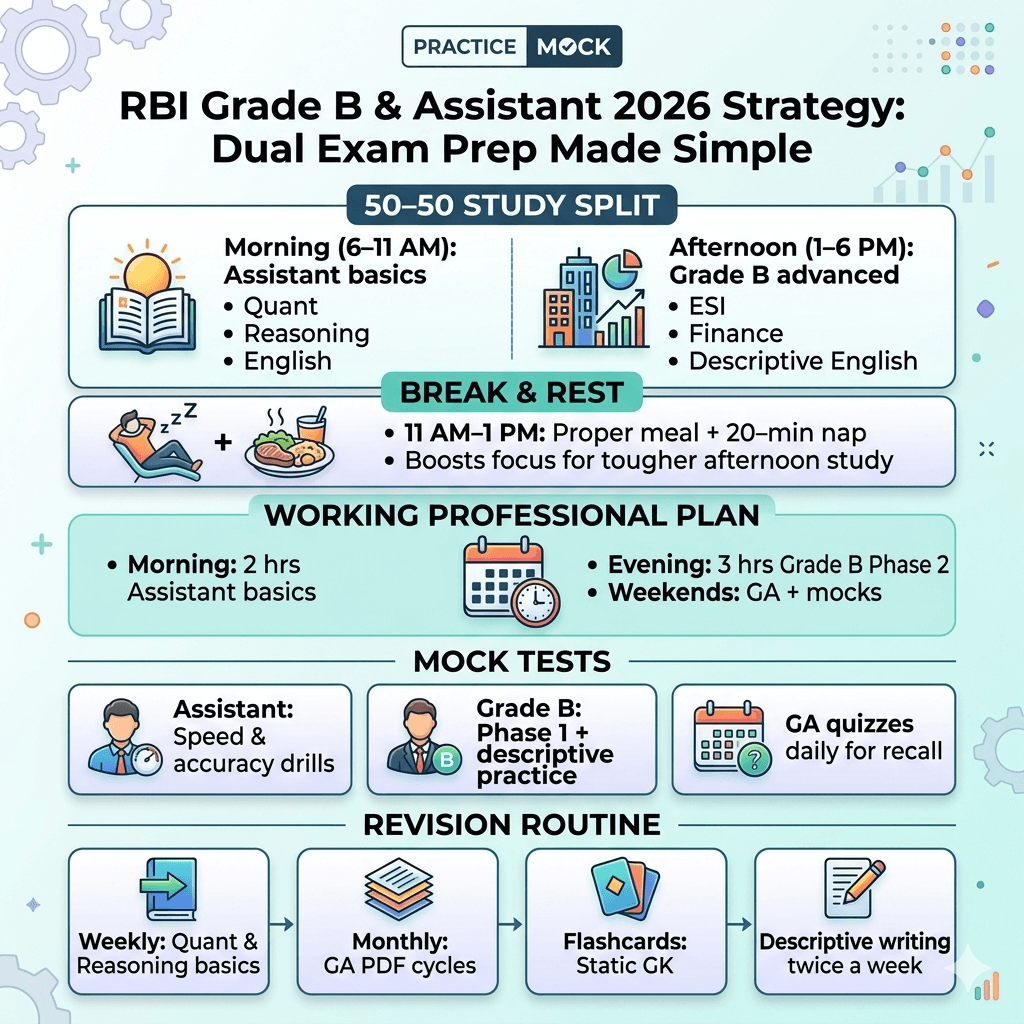
The most effective way to balance both exams is the 50‑50 split strategy. Divide your day into two halves:
- Morning (Assistant basics): Focus on Quantitative Aptitude and Reasoning at the Assistant level. These questions overlap with Grade B Phase 1 but are simpler, helping build speed and accuracy.
- Afternoon (Grade B advanced): Dedicate uninterrupted hours to Phase 2 subjects like Economics & Social Issues (ESI), Finance, and English descriptive writing.
This ensures Assistant preparation strengthens fundamentals while Grade B prep builds advanced knowledge.
Morning Study Session (6:00 AM – 11:00 AM)
The morning hours are best used for Assistant‑level Quantitative Aptitude and Reasoning, along with optional English basics. These subjects overlap with Grade B Phase 1 but are simpler, making them ideal for building speed and accuracy. By focusing on basics first, aspirants strengthen their foundation while indirectly preparing for Grade B. Daily quizzes, topic‑wise tests, and concise PDFs ensure steady progress. This session guarantees Assistant Prelims readiness while laying groundwork for Grade B Phase 1 simultaneously.
- Subjects: Quantitative Aptitude, Reasoning, and optionally English basics.
- Approach: Stick to Assistant‑level questions. Avoid advanced puzzles or high‑level DI in the morning.
- Rationale: These subjects warm up the brain, build speed, and indirectly prepare for Grade B Phase 1.
- Resources:
- Daily quizzes for Quant & Reasoning.
- Monthly PDFs for English vocabulary and grammar practice.
- Topic‑wise tests to track progress.
This session ensures Assistant Prelims readiness while laying the foundation for Grade B Phase 1.
Afternoon Study Session (1:00 PM – 6:00 PM)
Afternoons are highly productive and should be reserved for Grade B Phase 2 subjects like Economics & Social Issues, Finance, and English descriptive writing. These require deeper focus and longer study blocks. By dedicating uninterrupted hours, aspirants can master complex concepts and practice analytical writing. PIB‑based notes, Budget highlights, and descriptive practice sets are essential here. This session ensures aspirants gradually build advanced knowledge while keeping Assistant preparation intact, balancing both exams effectively without losing momentum.
- Subjects: RBI Grade B Phase 2 (ESI, Finance, English descriptive).
- Approach: Longer, uninterrupted study blocks. Focus on conceptual clarity and analytical writing.
- Rationale: Afternoon hours are highly productive; use them for tougher subjects requiring concentration.
- Resources:
- PIB‑based notes for schemes, reports, and social issues.
- Budget & Economic Survey highlights for Finance.
- Descriptive practice sets for English essays and precis writing.
This session ensures aspirants gradually master Grade B’s advanced syllabus while keeping Assistant prep intact.
Break & Rest Strategy
Breaks are not wasted time—they are essential for maintaining stamina. Between 11:00 AM and 1:00 PM, aspirants should eat properly, rest, and avoid distractions. A short nap rejuvenates the mind, preparing it for the demanding afternoon session. Structured breaks prevent burnout and ensure consistent productivity. By respecting rest as part of the plan, aspirants maintain focus across long study hours. This balance between effort and recovery is crucial for dual exam preparation, especially during intensive schedules.
Between 11:00 AM and 1:00 PM, take a structured break:
- Eat a proper meal.
- Rest or power nap for 20 minutes.
- Avoid distractions like social media.
This rejuvenation ensures the afternoon session remains focused and productive.
Strategy for Working Professionals
Working aspirants face time constraints, but preparation remains possible with smart adjustments. Morning hours (6:00–8:00 AM) can be used for Assistant basics, while evenings (3 hours) focus on Grade B Phase 2. Weekends should be reserved for GA revision and mock tests. Even with fewer hours, consistency ensures steady progress. The principle remains the same: efficiency matters more than quantity. By prioritizing essential subjects, working professionals can balance job responsibilities with exam readiness and avoid unnecessary stress.
Not everyone can dedicate 10 hours daily. For working aspirants:
- Morning (6:00 AM – 8:00 AM): 2 hours for Assistant basics (Quant/Reasoning/English).
- Evening (3 hours): Grade B Phase 2 subjects.
- Integration: Use weekends for GA revision and mock tests.
Even with limited hours, consistent study ensures steady progress.
General Awareness Preparation
General Awareness is the deciding factor in both exams. Covering October 2025–May 2026 current affairs ensures Assistant Mains success, while continuous updates benefit Grade B. Focus areas include current events, banking awareness, RBI updates, Budget, and Economic Survey. Daily capsules, PIB‑based compilations, topic‑wise GA tests, and newspapers provide complete coverage. Spending 30–40 minutes daily on GA builds retention and confidence. This consistent approach ensures GA becomes a scoring section across both exams, strengthening overall performance.
GA is the deciding factor in both exams.
- Coverage window: October 2025 – May 2026 for Assistant Mains; continue updating for Grade B.
- Focus areas: Current Affairs, Banking Awareness, RBI updates, Budget, Economic Survey.
- Resources:
- Monthly Current Affairs PDFs (Bazooka PDFs).
- PIB‑based compilations for schemes and reports, like PIB Sutra.
- Topic‑wise GA tests for recall speed. Take PracticeMock’s free GA topic tests
- Newspapers like The Hindu and Business Standard for depth.
Daily 30–40 minutes of GA ensures Assistant success and builds Grade B readiness.
Mock Test Integration
Mocks simulate exam conditions and highlight weak areas early. For Assistant, focus on speed and accuracy in Prelims mocks. For Grade B, attempt Phase 1 mocks and gradually move to descriptive Phase 2 practice. Take a Free RBI Grade B Mock Test here to start your preparation journey for free. GA quizzes should be attempted daily to sharpen recall. Regular mock practice ensures aspirants adapt to exam pressure and improve accuracy. By integrating mocks into preparation, aspirants build confidence and track progress effectively across both exams, ensuring readiness for real exam conditions.
Mocks are essential for both exams:
- Assistant: Focus on speed and accuracy in Prelims mocks.
- Grade B: Attempt Phase 1 mocks, then gradually move to descriptive Phase 2 practice.
- GA quizzes: Daily 10–15 questions to sharpen recall.
Mocks simulate exam conditions and highlight weak areas early.
Revision Plan
Revision is the backbone of preparation. Weekly reviews of Quant and Reasoning basics keep fundamentals fresh. Monthly GA PDF revisions ensure current affairs retention. Flashcards help with Static GK, while descriptive writing practice strengthens Grade B skills. Consistent revision bridges Assistant and Grade B prep seamlessly. Without revision, facts fade quickly, but with structured cycles, aspirants retain knowledge and recall effortlessly during exams. Revision ensures preparation translates into performance, making it the most critical step.
Revision ensures retention across both exams:
- Weekly review of Quant & Reasoning basics.
- Monthly GA PDF revision (at least 3 cycles).
- Flashcards for Static GK.
- Descriptive writing practice twice a week.
Consistent revision bridges Assistant and Grade B prep seamlessly.
Common Mistakes to Avoid
Many aspirants make avoidable mistakes when preparing for both exams. Treating them separately leads to duplication of effort. Ignoring GA until later weakens scoring potential. Skipping descriptive practice leaves Grade B preparation incomplete. Studying without mocks prevents speed and accuracy improvement. Avoiding these mistakes ensures aspirants maximize efficiency and strengthen overall performance. By learning from past errors, aspirants can refine their strategy and stay ahead in both exams, turning preparation into a confident journey.
- Treating exams separately: Leads to duplication of effort.
- Ignoring GA until later: GA requires long‑term preparation.
- Skipping descriptive practice: Grade B demands strong writing skills.
- Studying without mocks: Without simulation, speed and accuracy suffer.
Final Word
Preparing for RBI Grade B and Assistant 2026 together is not just possible. It’s the smartest approach. The 50‑50 split method ensures Assistant basics strengthen fundamentals while Grade B prep builds advanced knowledge. With structured breaks, consistent GA coverage, and regular mocks, aspirants can balance both exams effectively. Remember: Efficiency matters more than hours. Whether you study 3 hours or 10, focused preparation with the right resources ensures success. By aligning strategies, aspirants can clear Assistant confidently in April and move into Grade B with momentum.
FAQs
Yes. With a 50‑50 time split, you can cover Assistant basics in the morning and Grade B advanced subjects in the afternoon, ensuring efficient dual preparation.
GA is the deciding factor. Cover October 2025–May 2026 current affairs for Assistant Mains, and continue updating for Grade B. Banking awareness and RBI updates are equally critical.
Working aspirants can study 2 hours in the morning for Assistant basics and 3 hours in the evening for Grade B Phase 2. Weekends should be used for GA revision and mocks.
Weekly reviews of Quant & Reasoning, monthly GA PDF revisions, flashcards for Static GK, and descriptive writing practice twice a week ensure retention and exam readiness.
Absolutely. Mocks simulate exam conditions, sharpen speed and accuracy for Assistant, and prepare you for descriptive writing in Grade B. Daily GA quizzes further strengthen recall.
- Sign Up on Practicemock for Updated Current Affairs, Topic Tests and Mini Mocks
- Sign Up Here to Download Free Study Material
Free Mock Tests for the Upcoming Exams
- IBPS PO Free Mock Test
- RBI Grade B Free Mock Test
- IBPS SO Free Mock Test
- NABARD Grade A Free Mock Test
- SSC CGL Free Mock Test
- IBPS Clerk Free Mock Test
- IBPS RRB PO Free Mock Test
- IBPS RRB Clerk Free Mock Test
- RRB NTPC Free Mock Test
- SSC MTS Free Mock Test
- SSC Stenographer Free Mock Test
- GATE Mechanical Free Mock Test
- GATE Civil Free Mock Test
- RRB ALP Free Mock Test
- SSC CPO Free Mock Test
- AFCAT Free Mock Test
- SEBI Grade A Free Mock Test
- IFSCA Grade A Free Mock Test
- RRB JE Free Mock Test
- Free Banking Live Test
- Free SSC Live Test