


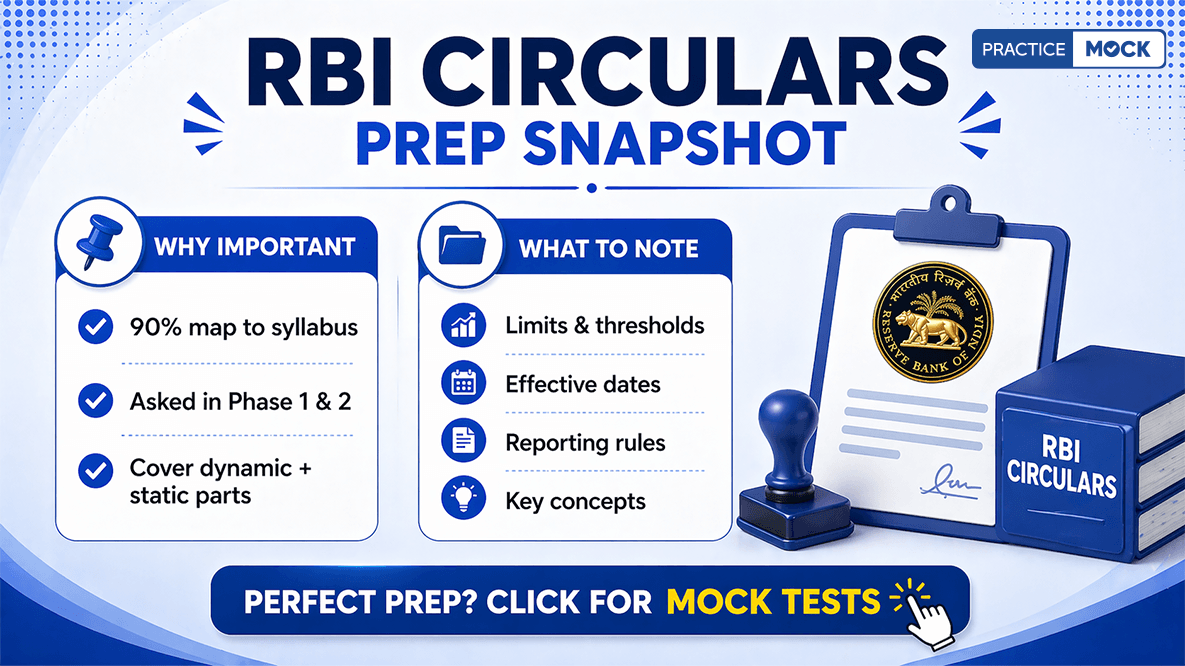
RBI circulars are not just regulatory updates — they are direct exam material for RBI Grade B aspirants. Almost 90% of circular topics map to the syllabus, making them vital for both Phase 1 General Awareness and Phase 2 Finance & Management. These circulars cover dynamic changes, limits, timelines, and static concepts that often appear as exam questions. If you want to score high, mastering circulars is non‑negotiable. Keep reading to know how to cover circulars effectively and the types of questions asked from them in the exam.
How to Cover Circulars
Circulars are dense and technical, but the right approach makes them manageable. Begin by identifying the background and objective of each circular — what problem RBI is solving. Then note the effective date and the change introduced (new limits, reporting requirements, or relaxations). Avoid reading line‑by‑line; instead, focus on exam‑relevant buckets: limits, timelines, eligibility, and reporting. Create one‑page summaries for each circular with 3–4 crisp pointers. This ensures quick revision before exams. For a structured plan, check this RBI Grade B 2026 Preparation Strategy.

Types of Questions Asked
Circulars appear in both Phase 1 GA and Phase 2 Finance & Management. In Phase 1, expect direct MCQs on limits, dates, and applicability. For example, “What is the new dividend cap for NBFCs as per RBI’s March circular?” In Phase 2, questions test conceptual clarity — linking circulars with finance topics like credit default swaps or payment systems. Descriptive answers may require explaining the impact of a circular on financial stability. Practicing MCQs and short notes ensures you can recall details quickly. For deeper FM prep, see Finance & Management RBI Grade B 2026 Preparation.
Structure of RBI Circulars
The RBI website hosts circulars, master circulars, master directions, and notifications. Each addresses regulated entities like banks, NBFCs, or payment systems. Circulars usually contain:
- Title and objective
- Applicability (who it affects)
- Effective date
- Key changes (limits, reporting, governance)
Understanding this structure helps aspirants quickly extract exam‑relevant points. For example, a circular on dividend remittance may include thresholds, board oversight, and reporting timelines. Mapping these directly to the syllabus ensures no topic is missed. For overall exam context, refer to RBI Grade B 2026 Exam Guide.
Preparation Strategy for Circulars
A time‑bound approach is essential. Cover circulars from January to May 2026 thoroughly, as most exam questions come from this window. November and December can be reviewed later if time permits. Focus on two portions:
- Dynamic: Limits, dates, thresholds, reporting requirements.
- Static: Concepts like CDS, payment systems, or governance terms.
Integrate both portions in your notes. Practice MCQs after each circular to reinforce memory. Avoid chasing trends; complete all circulars systematically. For self‑paced learners, see RBI Grade B Self‑Study Plan.
Key Focus Areas in Notes
When preparing notes, prioritize:
- Limits & Data: Thresholds, dividend caps, profit adjustments.
- Timelines: Effective dates, reporting deadlines.
- Reporting Requirements: Frequency, approval mandates.
- Consequences: Penalties or governance actions.
Each circular should be summarized into 3–4 exam‑ready points. For example: “Dividend cap revised to 50% of adjusted PAT, effective March 2026, applicable to NBFCs.” Such crisp notes allow revision in minutes before the exam.
Common Mistakes to Avoid
Many aspirants waste time reading circulars line‑by‑line, which is inefficient. Others ignore the background and objective, leading to poor conceptual clarity. Another mistake is failing to practice MCQs — the exam tests application, not rote memorization. Avoid overloading notes with exhaustive details; focus only on exam‑relevant points. Finally, don’t separate static and dynamic portions rigidly — integrate them for better understanding. Smart preparation means concise notes + regular MCQ practice.
Application Example
Take the March circular on Declaration of Dividend and Remittance of Profits. Key exam‑relevant points include:
- Adjusted profit after tax as the base.
- Board oversight requirements.
- Reporting timelines for regulated entities.
Instead of memorizing every clause, note the crux: “Dividend capped at X%, effective March 2026, subject to board approval.” Then practice MCQs to test recall. This approach ensures you can revise the entire circular in 5 minutes before the exam.
Memorization Tips & Pattern Recognition
Avoid memorizing tables verbatim. Instead, identify patterns — e.g., dividend caps often expressed as percentages of PAT. Create consolidated summary tables for quick revision. Leave space in notes for updates. Recognizing patterns helps in descriptive answers, where you may need to explain the rationale behind RBI’s changes. Visual aids like tables or charts make revision faster and more effective.
Grab the Best Courses to Cover Essential Circulars – Click here
Conclusion
RBI circulars are the backbone of RBI Grade B preparation. They directly feed into Phase 1 GA and Phase 2 FM, making them indispensable. By focusing on background, effective dates, limits, and reporting requirements, aspirants can prepare concise notes that are easy to revise. Avoid common mistakes, practice MCQs, and integrate static concepts with dynamic updates. With this strategy, you’ll be able to recall circulars confidently in the exam hall and maximize your score.
FAQs
RBI has tightened digital payment security (phasing out SMS OTPs), revised auto‑debit rules, upgraded zero‑balance accounts, and reinforced loan recovery transparency.
RBI extended the KYC deadline for low‑risk customers till June 30, 2026. Banks must send reminders and allow updates via Business Correspondents or digital self‑declarations.
The Cash Reserve Ratio (CRR) is currently 3% (April 2026 policy). Repo rate is 5.25%, Reverse Repo 3.35%, and SLR 18%.
- Sign Up on Practicemock for Updated Current Affairs, Topic Tests and Mini Mocks
- Sign Up Here to Download Free Study Material
Free Mock Tests for the Upcoming Exams
- IBPS PO Free Mock Test
- RBI Grade B Free Mock Test
- IBPS SO Free Mock Test
- NABARD Grade A Free Mock Test
- SSC CGL Free Mock Test
- IBPS Clerk Free Mock Test
- IBPS RRB PO Free Mock Test
- IBPS RRB Clerk Free Mock Test
- RRB NTPC Free Mock Test
- SSC MTS Free Mock Test
- SSC Stenographer Free Mock Test
- GATE Mechanical Free Mock Test
- GATE Civil Free Mock Test
- RRB ALP Free Mock Test
- SSC CPO Free Mock Test
- AFCAT Free Mock Test
- SEBI Grade A Free Mock Test
- IFSCA Grade A Free Mock Test
- RRB JE Free Mock Test
- Free Banking Live Test
- Free SSC Live Test