


The RBI Assistant Exam 2026 is scheduled with the Prelims on April 11 and the Mains on June 7, leaving aspirants with just 25 days to prepare strategically. With applications closed on March 8, every day now counts. Success in this exam depends less on syllabus volume and more on speed, accuracy, and smart revision. A focused 25‑day roadmap can help aspirants cover essential topics, practice mocks effectively, and build exam temperament. In this blog, we’ll outline a clear plan to maximize preparation, balance prelims and mains, and build confidence to crack RBI Assistant 2026 on the first attempt.
25‑Day Roadmap
A structured 25‑day plan ensures aspirants cover the syllabus quickly, revise multiple times, and practice mocks effectively. With exam dates fixed, every day counts. This roadmap balances speed, accuracy, and revision to help candidates crack RBI Assistant in their first attempt.

The RBI Assistant exam is unique because it demands 100 questions in 60 minutes. Many aspirants fail not due to lack of knowledge but because they cannot manage time effectively. A 25‑day roadmap ensures systematic preparation without burnout.
What Exam Demands?
Before diving into preparation, aspirants must understand the exam’s structure. Knowing the pattern helps allocate time wisely across sections and avoid surprises. This clarity is the foundation of any effective 25‑day plan.
- Prelims: 100 questions, 60 minutes, sections include English, Quant, Reasoning.
- Mains: 200 questions, 135 minutes, includes GA, Computer Knowledge, and Descriptive English.
- Cut‑off: Around 90/100 in Prelims, demanding near‑perfect attempts.
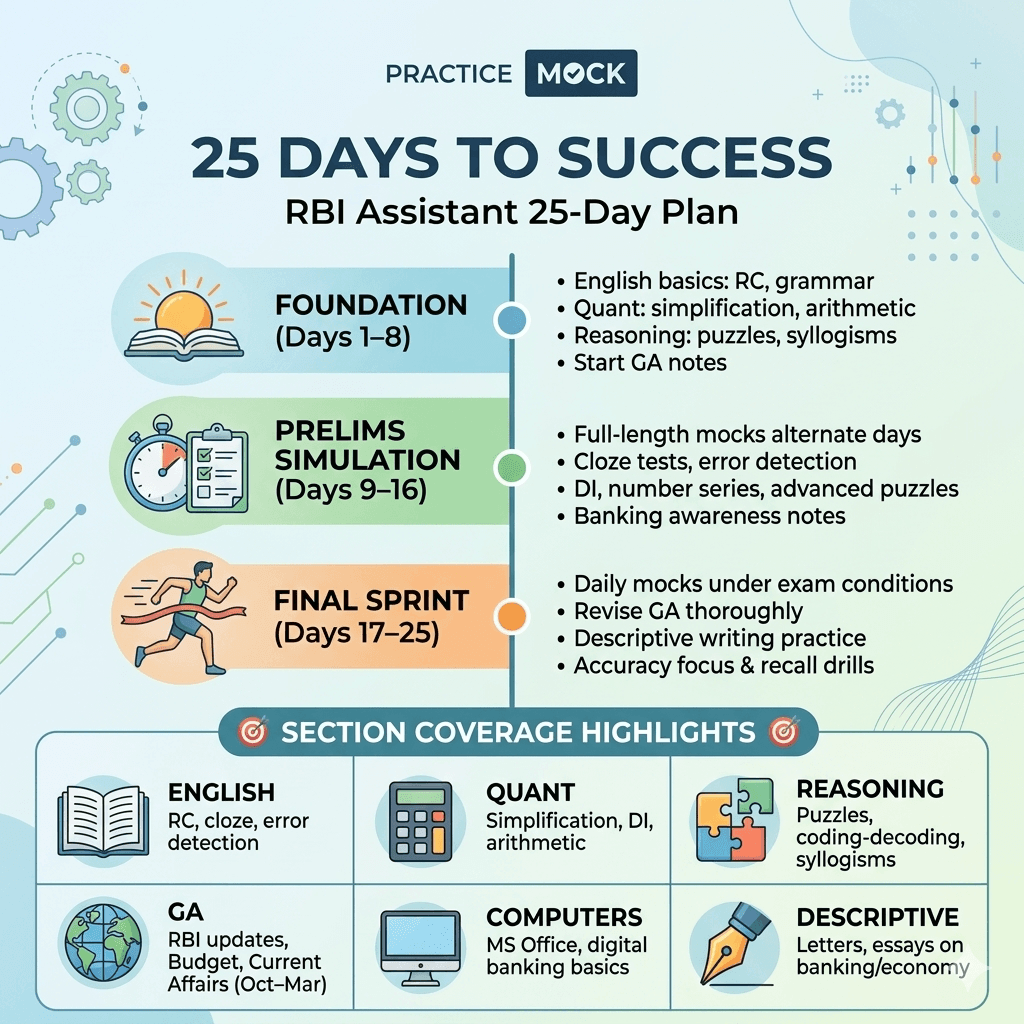
Phase 1: Days 1–8 – Solidify Foundation
The first 8 days are about building a strong base. Aspirants should focus on sectional practice, mastering fundamentals, and identifying weak areas. This phase sets the tone for speed and accuracy in later stages.
- Cover basics in English (RC, grammar rules).
- Practice simplification and arithmetic daily in Quant.
- Solve puzzles and syllogisms in Reasoning.
- Begin daily current affairs notes for GA.
- Attempt 2–3 sectional mocks per week.
Phase 2: Days 9–16 – Prelims Simulation
The next 8 days are dedicated to simulating prelims conditions. Aspirants should shift from sectional practice to full‑length prelims mocks, focusing on speed and accuracy under time pressure.
- Attempt 1 full‑length prelims mock every alternate day.
- Analyze mistakes after each mock.
- Revise high‑yield English topics like cloze tests and error detection.
- Strengthen DI and number series in Quant.
- Practice advanced puzzles in Reasoning.
Phase 3: Days 17–25 – Final Sprint
The last 9 days are about confidence building. Aspirants should attempt daily mocks, revise relentlessly, and sharpen recall speed. This phase ensures readiness for the Prelims on April 11, 2026.
- Attempt daily prelims mocks under exam conditions.
- Revise GA notes thoroughly.
- Practice descriptive writing for Mains.
- Focus on accuracy—minimize silly mistakes.
- Build exam temperament through consistent practice.
25‑Day Study Plan Table
A structured table helps aspirants visualize their preparation journey clearly. This 25‑day plan balances prelims and mains, dedicating 80% of time to prelims while reserving 20% for mains exposure. It ensures systematic coverage, speed training, and confidence building before the exam.
| Day Range | Focus Areas | Prelims (80%) | Mains (20%) |
| Days 1–5 | Foundation | English basics (RC, grammar), Quant simplification, Reasoning puzzles | Start GA notes (daily current affairs) |
| Days 6–8 | Sectional Practice | Error detection, arithmetic practice, syllogisms, DI sets | Computer basics overview |
| Days 9–12 | Prelims Simulation | Full‑length prelims mock tests, cloze tests, number series, advanced puzzles | Banking awareness notes |
| Days 13–16 | Speed Training | Timed practice of all 3 prelims sections, accuracy tracking | GA weekly revision |
| Days 17–21 | Final Sprint | Daily prelims mock tests, revision of high‑yield topics | Descriptive writing practice (letters, essays) |
| Days 22–25 | Confidence Build | Mock test analysis, recall drills, puzzle mastery, formula revision | GA + Computer mini quizzes |
Section‑Wise Strategy
Each section requires a tailored approach. By focusing on recurring topics and practicing under time pressure, aspirants can maximize scores across English, Quant, Reasoning, and GA.
- English Language: RC, cloze tests, error detection dominate. Practice para‑rearrangement for logical flow. Revise vocabulary daily.
- Quantitative Aptitude: Simplification and arithmetic are high‑yield. Practice DI sets regularly. Revise formulas for quick recall.
- Reasoning Ability: Puzzles form the bulk of questions. Practice linear, circular, and box puzzles. Strengthen coding‑decoding and blood relations.
- General Awareness & Computers: Revise daily current affairs. Focus on RBI, banking, and economy updates. Practice computer basics like MS Office and digital banking.
Mock Test Strategy
Mocks are the backbone of preparation. They train aspirants to attempt all 100 questions in 60 minutes. The key is to use mocks for speed training, not score chasing.
- Simulate exam conditions strictly.
- Analyze mistakes after each mock.
- Track accuracy and time spent per section.
- Ignore low scores—focus on improvement.
Revision Plan
Revision is the confidence multiplier. Covering the syllabus once is not enough. Multiple revisions ensure quick recall and accuracy under pressure.
- Revise 5–10 times depending on strengths.
- Use short, repeated cycles.
- Maintain notes for quick reference.
- Treat revision as speed training.
Common Mistakes to Avoid
Avoiding pitfalls is as important as preparation. Many aspirants waste effort by obsessing over scores or neglecting analysis.
- Don’t chase mock scores.
- Don’t skip analysis.
- Don’t neglect revision.
- Don’t ignore exam conditions.
Coverage Tips for RBI Assistant 2026
A 25‑day plan works best when aspirants know exactly which topics to prioritize. This section outlines specific coverage tips for each subject, ensuring maximum efficiency and scoring potential.
The RBI Assistant exam rewards smart coverage of scoring topics. Aspirants must focus on areas that appear frequently, demand less time, and offer higher accuracy. By targeting these topics strategically, candidates can maximize their scores in Prelims while laying a foundation for Mains.
Below are subject‑wise tips, each designed to highlight the most important areas and provide practical guidance for effective preparation within the limited 25‑day window.
English Coverage Tips
Focus on Reading Comprehension, Cloze Tests, and Error Detection as they dominate the section. Practice para‑jumbles for logical flow and revise vocabulary daily. These topics ensure quick scoring with consistent practice.
Quant Coverage Tips
Prioritize Simplification, Arithmetic (percentages, ratios, averages), and Data Interpretation. Revise formulas daily for quick recall. Practice number series and quadratic equations regularly to improve speed and accuracy under exam conditions.
Reasoning Coverage Tips
Puzzles form the majority of questions. Practice linear, circular, and box‑based puzzles daily. Strengthen syllogisms, coding‑decoding, and blood relations to ensure accuracy. These areas guarantee scoring opportunities if practiced consistently.
General Awareness Coverage Tips
Cover current affairs from October 2025 to March 2026. Focus on RBI updates, banking awareness, Budget, and Economic Survey. Revise daily GA notes and attempt weekly quizzes to sharpen recall.
Computer Knowledge Coverage Tips
Revise basics of MS Office, Internet, and digital banking. Practice questions on shortcuts, operating systems, and cyber security. These are straightforward scoring areas that require consistent but light preparation.
Descriptive Writing Coverage Tips
Practice letter writing, essays, and précis twice a week. Focus on banking and economy topics for relevance. Review sample answers to improve structure, grammar, and clarity under time pressure.
Takeaway
The RBI Assistant 2026: 25 Days Study Plan is about discipline, not volume. By following this structured roadmap, aspirants can cover the syllabus, practice mocks, and revise effectively before the Prelims on April 11, 2026.
Remember:
- Cover basics in the first 8 days.
- Simulate prelims in the next 8 days.
- Sprint with daily mocks in the final 9 days.
With Mains on June 7, 2026, aspirants must continue preparation after prelims, focusing on GA, descriptive writing, and advanced reasoning. Stay consistent, practice smartly, and believe in your preparation—you can clear RBI Assistant 2026 in your very first attempt.
FAQs
Follow a structured roadmap: 8 days for basics, 8 days for prelims simulation, and 9 days for final sprint with daily mocks and revision.
No. Dedicate 80% to prelims but reserve 20% for mains topics like GA and descriptive writing, since the gap between exams is short.
At least 12–15 prelims mocks before April 11, plus sectional practice. After prelims, shift to mains mocks and GA revision.
English: RC, cloze, error detection. Quant: simplification, arithmetic, DI. Reasoning: puzzles, syllogisms, coding‑decoding.
Revise 5–10 times depending on strengths. Use short cycles, maintain notes for quick reference, and treat revision as speed training.
- Sign Up on Practicemock for Updated Current Affairs, Topic Tests and Mini Mocks
- Sign Up Here to Download Free Study Material
Free Mock Tests for the Upcoming Exams
- IBPS PO Free Mock Test
- RBI Grade B Free Mock Test
- IBPS SO Free Mock Test
- NABARD Grade A Free Mock Test
- SSC CGL Free Mock Test
- IBPS Clerk Free Mock Test
- IBPS RRB PO Free Mock Test
- IBPS RRB Clerk Free Mock Test
- RRB NTPC Free Mock Test
- SSC MTS Free Mock Test
- SSC Stenographer Free Mock Test
- GATE Mechanical Free Mock Test
- GATE Civil Free Mock Test
- RRB ALP Free Mock Test
- SSC CPO Free Mock Test
- AFCAT Free Mock Test
- SEBI Grade A Free Mock Test
- IFSCA Grade A Free Mock Test
- RRB JE Free Mock Test
- Free Banking Live Test
- Free SSC Live Test