


The Computer Knowledge section is part of the RBI Assistant Mains exam, carrying 40 marks out of 200. With 40 questions asked, this section holds significant weightage and can be a scoring advantage for aspirants. Unlike Quant or Reasoning, it requires conceptual clarity and factual recall, making it easier to secure marks with smart preparation.
Exam Pattern Snapshot
Understanding the exam pattern is the first step toward effective preparation. The Computer Knowledge section is objective in nature, with direct questions that test practical awareness and theoretical basics. Since it is part of Mains, aspirants must balance it with GA, English, and Reasoning while ensuring they don’t miss out on these easy marks.

- Stage: Mains Exam
- Questions: 40
- Marks: 40
- Nature: Objective (MCQs)
- Difficulty: Easy–Moderate
- Scoring Potential: High (with basic preparation)
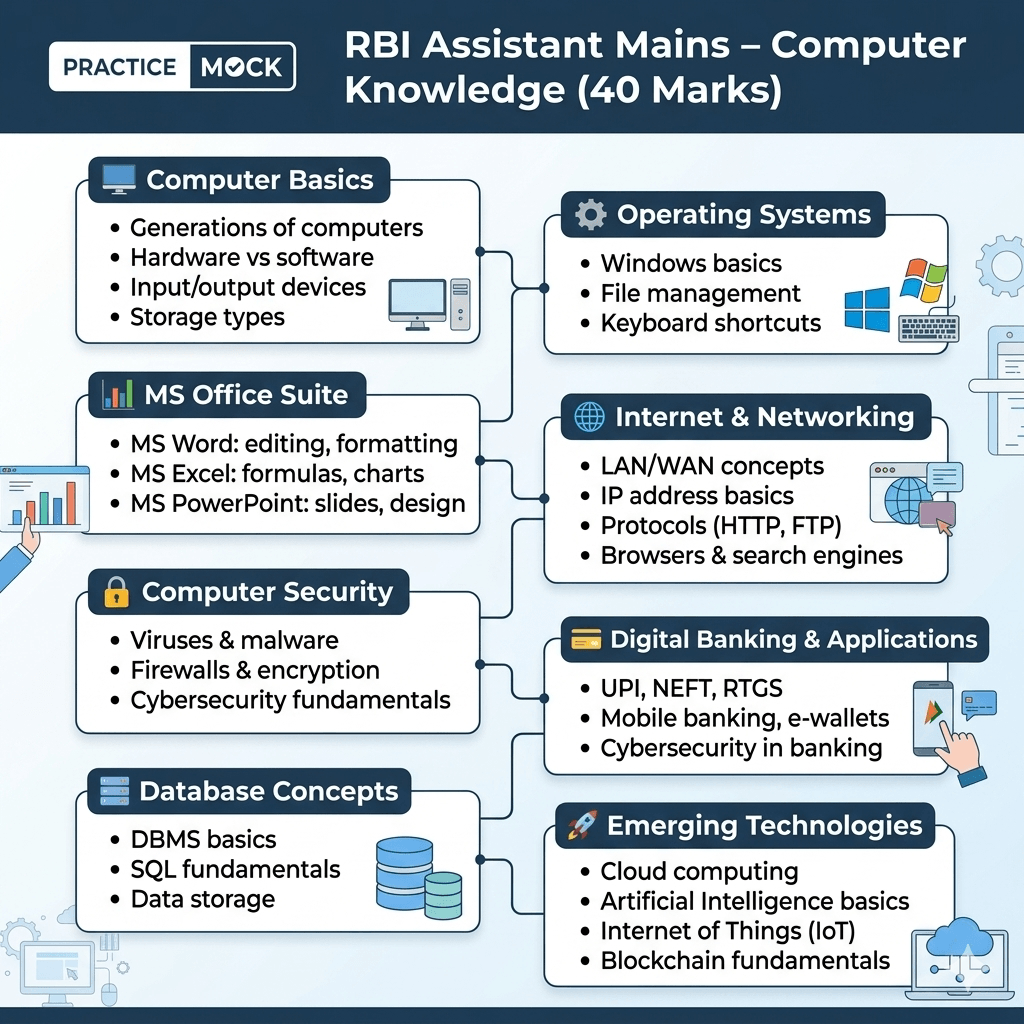
RBI Assistant Computer Knowledge Syllabus
The syllabus covers fundamentals of computers, office applications, internet, networking, and digital banking. It is designed to test whether aspirants can handle basic computer operations relevant to RBI’s work environment. A clear understanding of these topics ensures aspirants can attempt most questions confidently.
| Topic Area | Details Covered |
| Computer Basics | History, generations, hardware vs software, input/output devices, storage types |
| Operating Systems | Windows basics, functions, file management, shortcuts |
| MS Office Suite | MS Word (editing, formatting), MS Excel (formulas, charts), MS PowerPoint (slides) |
| Internet & Networking | LAN/WAN, IP address, protocols, browsers, search engines |
| Computer Security | Viruses, firewalls, encryption, cyber security basics |
| Digital Banking & Applications | UPI, NEFT/RTGS, mobile banking, e‑wallets, cybersecurity in banking |
| Database Concepts | DBMS basics, SQL fundamentals, data storage |
| Emerging Technologies | Cloud computing, AI basics, IoT, blockchain fundamentals |
Important Topics to Prioritize
Not all topics carry equal weight. Some areas are repeatedly tested and offer quick scoring opportunities. Prioritizing these ensures aspirants maximize efficiency and accuracy during the exam.
1. MS Office Applications
MS Word, Excel, and PowerPoint are practical tools used in RBI offices. Questions often test shortcuts, formulas, and formatting. Regular practice ensures aspirants can answer confidently and secure easy marks.
2. Computer Security & Banking Tech
Cybersecurity and digital banking concepts are crucial. Expect questions on firewalls, phishing, encryption, and secure transaction methods like UPI, NEFT, and RTGS. These topics reflect RBI’s focus on secure digital operations.
3. Operating Systems & Shortcuts
Windows basics, file management, and keyboard shortcuts are common. Questions like “Ctrl + C” or “Alt + Tab” are straightforward but require familiarity. These are quick scoring areas if practiced daily.
4. Networking & Internet Concepts
LAN/WAN, IP addresses, protocols (HTTP, FTP), and browsers are recurring topics. These test fundamental understanding of connectivity and communication, which is essential for modern banking systems.
5. Database & Emerging Tech
Basic DBMS concepts, SQL queries, and awareness of cloud computing, AI, IoT, and blockchain are increasingly relevant. RBI’s digital modernization makes these topics important for aspirants to understand.
Preparation Strategy
Preparation for Computer Knowledge requires consistency rather than long hours. A daily routine of short study sessions combined with practical exposure ensures aspirants retain concepts effectively.
Spend 30 minutes daily revising one topic. Attempt weekly quizzes to test recall. Use MS Office regularly to reinforce shortcuts and formulas. Read RBI circulars on digital banking for context. Maintain a glossary of terms like protocols, commands, and shortcuts for quick revision.
Candidates preparing beyond RBI Assistant Mains and targeting officer-level regulatory exams can also attempt the RBI Grade B Mock Test to practice GA, Finance, ESI, and exam-level questions.
Common Mistakes to Avoid
Many aspirants lose marks by neglecting this section or assuming it is too easy. Identifying common mistakes helps avoid pitfalls.
- Ignoring MS Office practicals.
- Overlooking digital banking concepts.
- Memorizing shortcuts without practice.
- Neglecting cybersecurity basics.
Final Word
The Computer Knowledge section in RBI Assistant Mains is a high‑scoring opportunity. With 25–30 correct answers, aspirants can secure 30+ marks easily. Focus on MS Office, digital banking, and cybersecurity while revising basics of OS, networking, and emerging technologies. Smart preparation ensures this section boosts your overall score and confidence. Start your banking exam preparation with PracticeMock, one of the Best Banking Mock Test Platform in India, designed to help aspirants practice smarter, improve accuracy, and build exam-ready confidence.
FAQs
It is only part of the Mains exam, carrying 40 marks with 40 objective questions.
MS Office, Operating Systems, Internet & Networking, Computer Security, and Digital Banking are the most scoring topics.
Spend 30 minutes daily revising one topic, practice MS Office shortcuts, attempt weekly quizzes, and maintain a glossary of computer terms.
Yes. UPI, NEFT, RTGS, mobile banking, e‑wallets, and cybersecurity in banking are officially part of the syllabus.
No. It is easy to moderate, and with consistent practice, aspirants can score 30+ marks easily.
- Sign Up on Practicemock for Updated Current Affairs, Topic Tests and Mini Mocks
- Sign Up Here to Download Free Study Material
Free Mock Tests for the Upcoming Exams
- IBPS PO Free Mock Test
- RBI Grade B Free Mock Test
- IBPS SO Free Mock Test
- NABARD Grade A Free Mock Test
- SSC CGL Free Mock Test
- IBPS Clerk Free Mock Test
- IBPS RRB PO Free Mock Test
- IBPS RRB Clerk Free Mock Test
- RRB NTPC Free Mock Test
- SSC MTS Free Mock Test
- SSC Stenographer Free Mock Test
- GATE Mechanical Free Mock Test
- GATE Civil Free Mock Test
- RRB ALP Free Mock Test
- SSC CPO Free Mock Test
- AFCAT Free Mock Test
- SEBI Grade A Free Mock Test
- IFSCA Grade A Free Mock Test
- RRB JE Free Mock Test
- Free Banking Live Test
- Free SSC Live Test