


Is IBPS PO a Government Job? This is one of the most frequently asked questions among banking aspirants before they begin their preparation. While many people consider an IBPS Probationary Officer a government employee, others believe it is a private-sector banking job. The reality lies somewhere in between, and understanding the distinction is important before choosing this career path.
In this article, you’ll get the complete answer to whether an IBPS PO is a government job, how Public Sector Banks differ from Central Government departments, who pays an IBPS PO’s salary, what job security and benefits you receive, and why this role continues to be one of India’s most sought-after careers in the public banking sector.

Key Highlights: Is IBPS PO a Government Job?
- IBPS PO is a Public Sector Undertaking (PSU) job, not a direct Central Government job, but it offers government-backed stability, benefits, and career growth.
- Candidates selected through IBPS PO 2026 are appointed to one of the 11 participating Public Sector Banks, all of which are majority-owned by the Government of India.
- An IBPS PO is not a Gazetted Officer or a Central Government servant, but the role enjoys high social respect, structured promotions, and excellent job security.
- The salary is paid by the allotted Public Sector Bank and follows the 12th Bipartite Settlement, not the Central Pay Commission.
- An IBPS PO receives a basic pay of ₹48,480, along with allowances, medical benefits, leave benefits, concessional loans, and retirement benefits under the National Pension System (NPS).
- After completing the 2-year probation period, an IBPS PO becomes a permanent officer and is protected by structured service rules and disciplinary procedures.
- This article explains the legal status of an IBPS PO, compares it with a Central Government job, and clarifies why the role is widely regarded as a government job despite its PSU classification.
Is IBPS PO a Government Job or Private?
Is IBPS PO a government job or private is the exact question most aspirants search for, and the honest answer sits in the middle. It’s neither a private-sector role nor a direct central civil service post; it’s a Public Sector Undertaking (PSU) job.

When you clear the IBPS PO exam, you’re appointed as a Probationary Officer/Management Trainee in one of 11 Public Sector Banks, all majority-owned by the Government of India. That government ownership is exactly why the job carries the security, stability, and prestige people associate with Sarkari Naukri, even though the legal employer is the bank itself, not the Union government.
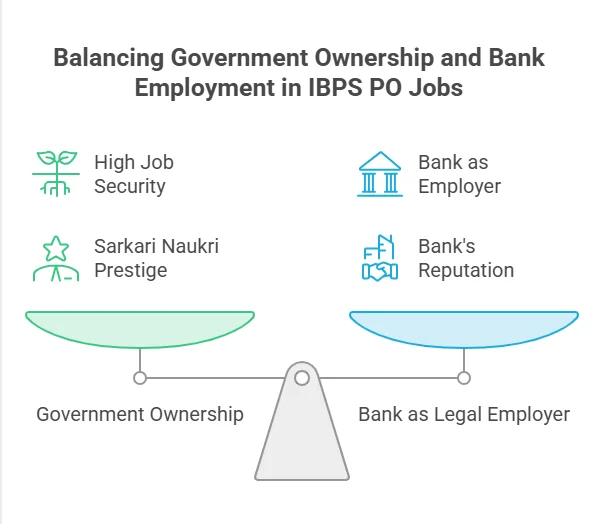
Is Bank PO a Government Job: Public Sector Bank vs Central Government Job
Whether bank PO is a government job in the strictest legal sense depends on how you define “government employee,” and the technical answer differs from the popular perception. Here’s a two-line summary before the comparison: an IBPS PO is a public servant working in a government-owned corporate entity, not a government servant under Central Civil Service rules.
| Parameter | Central Government Job (SSC CGL, UPSC) | IBPS PO (Public Sector Bank) |
| Employer status | Direct employee of Union Ministries | Employee of an autonomous PSB |
| Salary authority | Central Pay Commission | Bipartite Settlement (IBA–unions) |
| Legal classification | “Government Servant” under CCS Rules | “Public Servant” under Banking Regulation Act |
| Gazetted status | Often Gazetted (Group A/B) | Non-gazetted, Scale-I officer |
| Pension | Old/New Pension Scheme variants | National Pension System (NPS) |
IBPS PO Job Security and Benefits
The IBPS PO job security and benefits package is what makes this role feel indistinguishable from a core government job in everyday life. Once you clear your two-year probation and get confirmed as a Scale-I officer, your position becomes fully permanent, with layoffs virtually unheard of regardless of market conditions.
Here’s what comes with the confirmed role:
- Pay scale: Basic pay of ₹48,480 under the 12th Bipartite Settlement, with in-hand salary of roughly ₹74,000–₹76,500 per month
Also read : Check Latest IBPS PO Salary Slip 2026
- Allowances: Dearness Allowance (revised quarterly), House Rent Allowance or leased accommodation, City Compensatory Allowance
- Retirement benefits: National Pension System (NPS) contribution and gratuity
- Welfare perks: Concessional loans for housing, vehicles, and personal needs at below-market interest rates
- Leave benefits: Leave Travel Concession (LTC) and medical coverage for self and dependents
Is a Bank Employee a Government Servant? Legal Reality
Is a bank employee a government servant is a question with a precise legal answer, and it’s worth knowing before you walk into an interview and get asked this directly. Under Indian law, a Public Sector Bank employee is classified as a “public servant” under the Prevention of Corruption Act and Banking Regulation Act, not a “government servant” governed by the Central Civil Services (Conduct) Rules that apply to IAS, IPS, or SSC-recruited officers.
This distinction matters for a few practical reasons:
- IBPS PO is not a Gazetted Officer post, unlike many Group A/B central government roles
- The 7th Pay Commission does not apply to bank employees; salary revisions instead follow periodic Bipartite Settlements between the IBA and bank employee unions
- Disciplinary and service matters are governed by bank-specific regulations, not the CCS (Conduct) Rules
List of Participating Banks Under IBPS PO 2026
The IBPS PO 2026 recruitment cycle continues to place candidates across the same 11 government-owned banks that have participated in previous years, reinforcing the PSU nature of the role. Knowing this list helps you understand exactly which “government” institution you could be posted to.
| S.No. | Participating Bank |
| 1 | Bank of Baroda |
| 2 | Bank of India |
| 3 | Bank of Maharashtra |
| 4 | Canara Bank |
| 5 | Central Bank of India |
| 6 | Indian Bank |
| 7 | Indian Overseas Bank |
| 8 | Punjab National Bank |
| 9 | Punjab & Sind Bank |
| 10 | UCO Bank |
| 11 | Union Bank of India |
Why People Still Call IBPS PO a Government Job
Despite the technical distinctions, people continue to call IBPS PO a government job, and honestly, that perception isn’t wrong in spirit; it’s just imprecise in legal terminology.
- In semi-urban and rural India especially, a Public Sector Bank officer commands the same social respect, trust, and authority as any central government officer.
- Add to that the fact that promotions happen through structured internal exams, and salaries are protected from market swings.
- There’s no threat of sudden layoffs, and you get a role that delivers every practical benefit of a government job, wrapped in a PSU legal structure.
Who Pays the Salary of an IBPS PO: the Government or the Bank?
This is one of the most practical questions aspirants ask, and the answer clears up a lot of confusion: the salary of an IBPS PO is paid by the allotted Public Sector Bank, not directly by the Union Government treasury.
Here’s how it actually works:
- Each participating bank pays its officers from its own operating revenue and reserves, just like any corporate entity would.
- The pay structure itself, however, isn’t decided by the individual bank; it’s fixed uniformly across all 11 banks through the Bipartite Settlement between the Indian Banks’ Association (IBA) and officer/employee unions.
- Since the Government of India holds majority ownership in these banks, it indirectly influences policy and capital, but the actual monthly disbursal comes from the bank’s own payroll system.
So while the money in your account every month comes from the bank, the framework deciding how much you get is shaped by a government-linked, union-negotiated settlement, which is exactly why the line between “government job” and “PSU job” feels so blurry to most aspirants.
Final Word on IBPS PO Job
So, is IBPS PO a government job? Yes, functionally and in every practical sense, job security, government-backed pay, pension, and social standing all say so. Technically, it’s a Public Sector Undertaking role rather than a direct Central Government post, but for lakhs of aspirants chasing stability every year, that distinction rarely matters once the offer letter arrives.
FAQs on Is IBPS PO a Government Job
Q1. Does IBPS PO come under the Central Government?
No, IBPS PO does not come under the Central Government directly. It’s a Public Sector Bank role, government-owned but administratively separate from central ministries, governed instead by the Bipartite Settlement and bank-specific service rules.
Q2. Are Public Sector Bank employees considered government employees?
Yes, in common usage, but not legally identical. PSB employees are “public servants” under the Banking Regulation Act, enjoying government-like job security and benefits, though they aren’t “government servants” under Central Civil Service Rules.
Q3. Does the 7th Pay Commission apply to IBPS PO?
No, the 7th Pay Commission doesn’t apply to IBPS PO or any Public Sector Bank employee. Salary revisions instead follow the Bipartite Settlement, negotiated periodically between the Indian Banks’ Association and employee unions.
Q4. Is IBPS PO a Group A or Group B gazetted officer post?
No, IBPS PO is not a Gazetted Officer post. It’s classified as a Junior Management Grade Scale-I (JMGS-I) officer role within the Public Sector Bank hierarchy, distinct from Gazetted Group A/B central posts.
Q5. Is IBPS PO safe from privatization?
Currently, IBPS PO recruits for government-owned banks, so existing employees retain PSU protections. However, government policy on bank privatization can evolve, so candidates should track official announcements from the Ministry of Finance for updates.
- Sign Up on Practicemock for Updated Current Affairs, Topic Tests and Mini Mocks
- Sign Up Here to Download Free Study Material
Free Mock Tests for the Upcoming Exams
- IBPS PO Free Mock Test
- RBI Grade B Free Mock Test
- IBPS SO Free Mock Test
- NABARD Grade A Free Mock Test
- SSC CGL Free Mock Test
- IBPS Clerk Free Mock Test
- IBPS RRB PO Free Mock Test
- IBPS RRB Clerk Free Mock Test
- RRB NTPC Free Mock Test
- SSC MTS Free Mock Test
- SSC Stenographer Free Mock Test
- GATE Mechanical Free Mock Test
- GATE Civil Free Mock Test
- RRB ALP Free Mock Test
- SSC CPO Free Mock Test
- AFCAT Free Mock Test
- SEBI Grade A Free Mock Test
- IFSCA Grade A Free Mock Test
- RRB JE Free Mock Test
- Free Banking Live Test
- Free SSC Live Test