


Preparing for RBI Grade B FM Preparation 2026 is a crucial part of Phase 2 preparation. As Finance & Management (FM) forms an important component of the RBI Grade B syllabus, candidates must understand its key topics and exam requirements thoroughly. Unlike ESI and English, FM is more structured and predictable, making it one of the most scoring papers in the exam. Since it carries 100 marks out of 300 in Phase 2, a strong performance can significantly boost your overall score and improve your chances of final selection.
What is FM in the RBI Grade B exam?
FM in the RBI Grade B exam refers to the Finance & Management paper conducted in Phase 2 of the selection process. As per the RBI Grade B exam pattern, this paper evaluates a candidate’s understanding of finance-related concepts, banking systems, management principles, and their ability to present ideas effectively in descriptive answers.

The exam consists of both objective and descriptive sections, testing conceptual clarity as well as analytical writing skills. Through this paper, RBI assesses whether candidates possess the knowledge required to understand financial systems, management practices, and real-world banking operations.
| Section | Details |
| Paper Name | Finance & Management (FM) |
| Exam Stage | RBI Grade B Phase 2 |
| Question Type | Objective (MCQ) + Descriptive |
| Total Questions | 30 MCQs + 6 Descriptive |
| Total Marks | 100 Marks |
| Duration | 120 Minutes (30 min MCQ + 90 min Descriptive) |
| Focus Areas | Finance concepts, Banking system, Management principles |
What is the ideal target score for FM in the RBI Grade B exam?
The ideal target score for FM in the RBI Grade B exam depends on your overall RBI Grade B preparation level and selection strategy. However, candidates aiming for a competitive Phase 2 score should focus on performing consistently in both the objective and descriptive sections.
A balanced preparation strategy across Finance and Management helps maximize marks and improves your position in the final merit list. Most successful candidates target a score that provides a comfortable cushion above the expected RBI Grade B cutoff.
| Subject | Objective Target | Descriptive Target | Expected Total Score |
| Finance | 15+ Marks | 15+ Marks | 30-35 Marks |
| Management | 20+ Marks | 20+ Marks | 40-45 Marks |
| Overall FM | Balanced attempt | Strong answers | 70-75 Marks (Ideal Target) |
FM Syllabus for RBI Grade B
The FM Syllabus for RBI Grade B covers a wide range of topics related to finance, banking, management, financial institutions, and economic developments. Understanding the syllabus thoroughly is the first step toward building an effective preparation strategy.
Candidates should divide the syllabus into Finance and Management segments and prepare each topic systematically. The complete syllabus is provided below:
FM Syllabus for RBI Grade B
Check out the syllabus below:
Financial System
Structure and Functions of Financial Institutions, Functions of the Reserve Bank of India, Banking System in India – Structure and Developments, Financial Institutions – SIDBI, EXIM Bank, NABARD, NHB, NaBFID, etc., Recent Developments in Global Financial System and its Impact on Indian Financial System, Role of Information Technology in Banking and Finance, Non-Banking System, Developments in Digital Payments.
Financial Markets
Primary and Secondary Markets (Forex, Money, Bond, Equity, etc.), functions, instruments, and recent developments.
General Topics
Financial Risk Management, Basics of Derivatives, Global Financial Markets & International Banking – broad trends and latest developments, Financial Inclusion, Alternate Sources of Finance, Private & Social Cost-Benefit, Public Private Partnership, Corporate Governance in Banking Sector, The Union Budget – concepts, approach and broad trends, Basics of Accounting & Financial Statements – Balance Sheet, Profit & Loss, Cash Flow Statements, Ratio Analysis (Debt to Equity, Debtor Days, Creditor Days, Inventory Turnover, Return on Assets, Return on Equity, etc.), Inflation – definition, trends, estimates, consequences, and remedies; WPI-CPI components and trends; balancing inflation and growth through monetary and fiscal policies.
Management
Fundamentals of Management, Organizational Behaviour, Ethics at the Workplace, and Corporate Governance in detail.
How should you prepare for FM in the RBI Grade B Exam?
FM in the RBI Grade B Exam can become one of your highest-scoring papers if approached strategically. Rather than attempting to cover every available resource, candidates should focus on high-yield topics, understand question trends, and regularly practice descriptive answers.
A smart preparation strategy involves building conceptual clarity, strengthening static topics, staying updated with financial developments, and continuously evaluating performance through quizzes and mock tests. This selective and exam-oriented approach can help maximize scores in both sections of the paper.
How can PYPs and practice quiz improve your FM preparation?
PYPs and practice quiz improve your FM preparation by helping you understand the actual exam pattern, recurring themes, and topic-wise weightage. Previous Year Papers provide valuable insights into the nature of questions asked and the level of preparation required.
Regular practice also improves accuracy, confidence, and familiarity with the examination format.
- Understand Exam Pattern: Learn the structure of objective and descriptive questions.
- Identify Important Topics: Recognize chapters that are frequently tested.
- Track Changing Trends: Observe how question priorities change over the years.
- Assess Preparation Level: Evaluate whether your preparation aligns with exam requirements.
- Improve Question-Solving Skills: Build confidence through consistent practice.
Which topics should you prioritize for FM preparation?
The most effective FM preparation strategy involves prioritizing topics that have consistently appeared in previous years. Focusing on high-weightage areas can improve both efficiency and overall scores.
Important Finance Topics
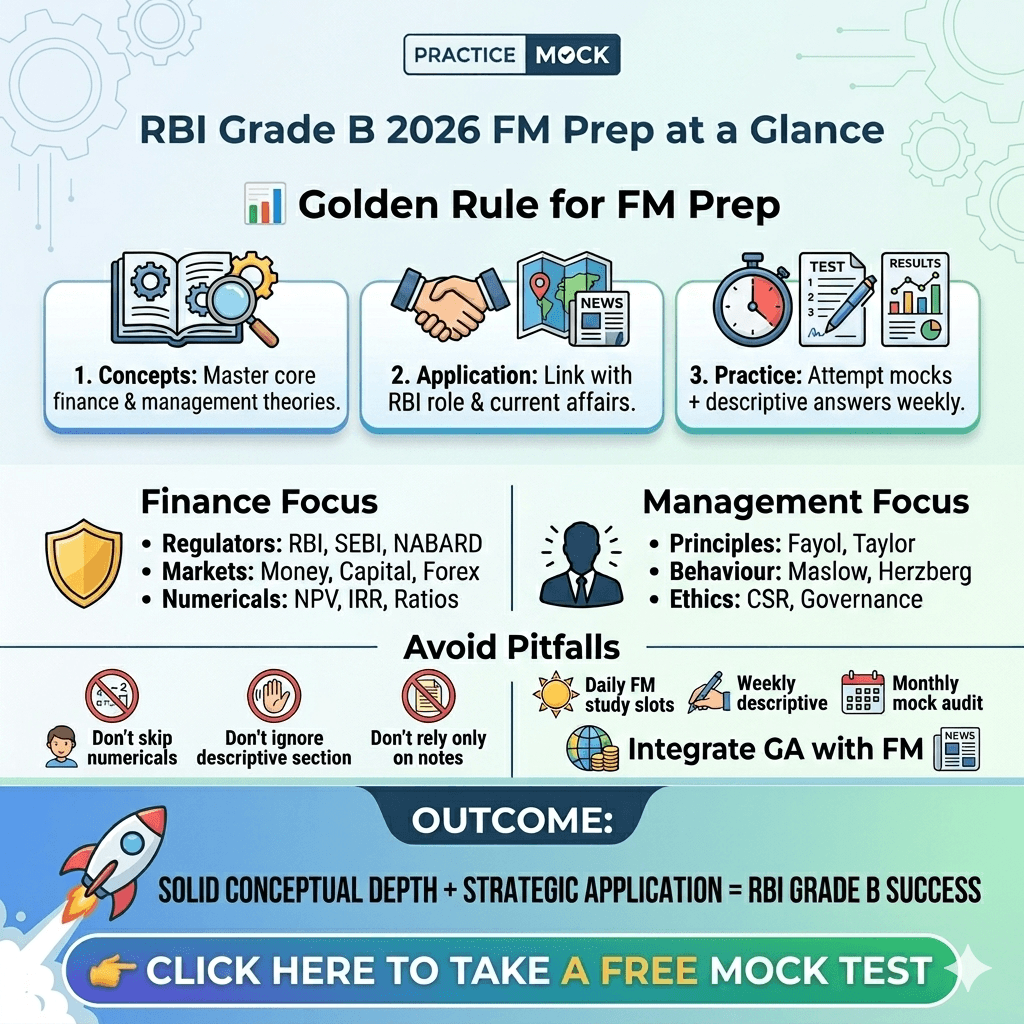
- Financial Regulatory Bodies: RBI, SEBI, NABARD, SIDBI and their functions.
- Banking System in India: Structure, functions, and banking reforms.
- Financial Sector Reforms: Major reforms and policy changes.
- Global Financial Crisis (2007–08): Causes, impact, and lessons.
- Primary and Secondary Markets: Equity, debt, and market operations.
- Risk Management: Credit, market, and operational risk concepts.
- Derivatives: Basics of futures, options, and swaps.
- Alternative Sources of Finance: Venture capital, crowdfunding, and private equity.
- Inflation: Types, causes, and economic impact.
Important Management Topics
- General Management: Planning, organizing, staffing, directing, and controlling.
- Leadership: Leadership styles and theories.
- Communication: Communication process and barriers.
- Corporate Governance: Transparency, accountability, and ethics.
- Organizational Behavior: Employee behavior and workplace dynamics.
- Organizational Change: Managing change effectively.
- Emotional Intelligence: Self-awareness and relationship management.
- Interpersonal Relationships: Teamwork and conflict management.
- Nudge Theory: Behavioral decision-making concepts.
- Workplace Ethics: Ethical practices and professional conduct.
Why is conceptual understanding more important than memorization?
Conceptual understanding is more important than memorization in the FM paper because many Management topics are interconnected and often appear similar at first glance. Simply memorizing definitions may help in recalling information, but it often creates confusion when applying concepts to practical situations or descriptive answers.
A strong conceptual foundation enables candidates to interpret questions correctly, apply theories effectively, and write well-structured answers in both objective and descriptive sections.
- Leadership Theories: Focus on real-world applications rather than merely remembering definitions.
- Communication Models: Understand how communication functions within organizations.
- Corporate Governance: Relate governance principles to practical business scenarios.
- Conflict Management: Learn different methods of resolving workplace conflicts.
- Ethics and Values: Connect ethical principles with professional situations.
- Emotional Intelligence: Understand how EI influences leadership and decision-making.
Which static topics can help you score higher in FM paper?
Static topics in FM paper contribute significantly to the overall score because a substantial portion of questions are asked from core finance and management concepts. Candidates should master these fundamentals before shifting their focus to current affairs and recent developments.
A strong grip on static topics improves accuracy and helps build a solid foundation for understanding dynamic concepts as well.
- Financial Institutions: RBI, NABARD, SIDBI, EXIM Bank, and other key institutions.
- Functions of RBI: Monetary policy, regulation, currency management, and supervision.
- Financial Markets: Money, bond, equity, and debt markets.
- Fiscal Policy: Government expenditure, taxation, and budgetary concepts.
- Derivatives: Fundamental derivative instruments and their applications.
- International Organizations: IMF, World Bank, UN, UNICEF, and related institutions.
- Risk Management: Identification, assessment, and control of banking risks.
- Cash Flow Analysis: Understanding cash inflows and outflows.
- Financial Statements: Basics of Balance Sheet, Profit & Loss Statement, and related concepts.
Know How to Make Notes for RBI Grade B Exam
How can the right study material improve your FM preparation?
The right study material improve your FM preparation by helping you cover the syllabus efficiently without wasting time on unnecessary resources. Since the FM syllabus is extensive, relying on expert-curated study material allows candidates to focus on exam-relevant topics and revise effectively.
Well-structured resources also improve conceptual clarity and make descriptive preparation more manageable.
- Complete Syllabus Coverage: Covers both Finance and Management comprehensively.
- Exam-Focused Content: Emphasizes important concepts and frequently tested topics.
- Updated Information: Includes the latest financial and regulatory developments.
- Practice Questions: Strengthens application and retention of concepts.
- Descriptive Guidance: Assists candidates in developing effective answer-writing skills.
Why are Mock Tests important for RBI Grade B FM preparation?
Mock Tests are important for RBI Grade B FM preparation because they provide a realistic exam experience and help candidates evaluate their readiness before the actual examination. Regular mock test practice enhances speed, accuracy, confidence, and time management skills.
Additionally, mock tests offer valuable performance insights, helping candidates identify weak areas and improve strategically.
- Identify Strengths and Weaknesses: Understand areas that require improvement.
- Improve Speed: Learn to solve questions within the prescribed time.
- Increase Accuracy: Minimize errors through regular practice.
- Build Exam Temperament: Become comfortable with actual exam conditions.
- Track Progress: Measure improvement and preparation levels over time.
Also read: RBI Grade B Preparation Roadmap for Beginners
Which books and sources should you follow for FM preparation?
The best books and sources for FM preparation are those that provide comprehensive syllabus coverage while remaining easy to understand and exam-oriented. Instead of referring to numerous resources, candidates should stick to a few trusted sources and revise them multiple times.
The following books and resources are widely recommended for RBI Grade B FM preparation:
- Indian Economy by Puri & Misra: Useful for understanding economy and financial system concepts.
- Principles and Practice of Management by L.M. Prasad: Covers essential management theories.
- Organizational Behaviour by L.M. Prasad: Helps build understanding of leadership and workplace behavior.
- Business Ethics & Corporate Governance by B.N. Ghosh: Covers ethics and governance comprehensively.
- NCERT Business Studies Part II: Useful for basic management concepts.
- RBI Bulletins and Reports: Important for banking and finance-related updates.
- Current Affairs Capsules: Helpful for quick revision of relevant developments.
- FAQs of NABARD, SIDBI, RBI: Valuable sources for static and institutional information.
What is the best approach for the FM descriptive paper?
The best approach for the FM descriptive paper is to combine conceptual clarity with structured answer writing. Since the descriptive section evaluates both knowledge and presentation, candidates must learn to organize their thoughts effectively and write concise, relevant answers.
A systematic preparation strategy can significantly improve descriptive scores.
Step 1 – Start with Management
Begin with Management topics because they are largely static and easier to master. Build a strong understanding of theories, concepts, and practical applications.
Step 2 – Note Important Keywords
Prepare chapter-wise notes containing important terms, definitions, and recurring concepts. These keywords can enhance answer quality and presentation.
Step 3 – Prepare Finance Topics
Create separate notes for static finance concepts and current financial developments. This makes revision more efficient closer to the exam.
Step 4 – Use Keywords in Answers
Incorporate relevant terminology naturally in your answers to demonstrate conceptual understanding and improve answer quality.
Step 5 – Practice Answer Writing
Write at least 12–15 descriptive answers before the exam. Regular practice improves structure, clarity, and writing speed.
Step 6 – Improve Presentation
Use headings, subheadings, bullet points, and examples wherever appropriate. A well-presented answer is easier for evaluators to assess.
Step 7 – Revise Regularly
Consistent revision helps reinforce important concepts, keywords, and examples, ensuring better retention before the examination.
Check out how to Mastering Answer Writing for RBI Grade B Descriptive Paper
What are some important tips to score well in RBI Grade B FM?
Important tips to score well in RBI Grade B FM include following a smart exam strategy, prioritizing high-yield topics, and revising consistently. Success in FM depends not only on knowledge but also on how effectively candidates utilize their preparation during the examination.
By focusing on accuracy, conceptual clarity, and regular revision, candidates can significantly improve their Phase 2 performance.
| Tips for RBI Grade B FM Preparation | Details |
| Follow a smart exam attempt strategy | • Attempt easy and moderate questions first. • Focus on accuracy rather than guessing. • Manage your time wisely during the exam. • Return to difficult questions after completing easier ones. |
| Make the most of the Management section | • Focus on Management as it is generally more scoring. • Prepare static topics such as Leadership, Communication, Ethics, and Corporate Governance. • Aim to maximize marks in this section. |
| Revise important facts and figures regularly | • Learn key banking rates such as Repo Rate, CRR, SLR, and Bank Rate. • Memorize important policy dates and financial events. • Remember management thinkers, economists, and important committees. • Prepare for direct factual questions. |
| Strengthen your Finance preparation | • Cover important static topics like Banking System, Financial Markets, Inflation, and Risk Management. • Connect current affairs with FM concepts. • Revise important updates and reports released by the Reserve Bank of India. |
| Practice and revise consistently | • Solve mock tests regularly to improve speed and accuracy. • Analyze previous year papers to understand exam trends. • Prepare short notes for quick revision. • Revise frequently to improve retention and recall. |
Also Read: Important topics for RBI Grade B Phase 1 exam
FAQs
How do I score more in the FM section of RBI Grade B?
Focus on Management concepts, strengthen the static FM portion, and analyze previous years’ papers to understand important topics and question trends.
How many months of preparation is needed for FM in RBI Grade B?
With a focused strategy, quality study material, and regular revision, most candidates can complete FM preparation effectively in 15–20 days.
What are the best RBI Grade B FM preparation books?
L.M. Prasad’s Principles and Practice of Management, Organizational Behaviour, and B.N. Ghosh’s Business Ethics & Corporate Governance are highly recommended.
How will FM mock tests help me prepare for the RBI Grade B exam?
Mock tests improve speed, accuracy, time management, and exam temperament while helping candidates identify strengths and areas needing improvement.
Do I need a finance background to score high in RBI Grade B FM?
No. The FM paper mainly covers basic finance and management concepts, making it manageable for candidates from both finance and non-finance backgrounds.
Also, go through RBI Grade B ESI Preparation Strategy
Related Posts:
FAQs
What is the weightage of FM in RBI Grade B 2026?
FM carries 100 marks in Phase II, split between objective and descriptive questions. It is one of the most decisive papers for selection.
Which topics are most important in Finance?
Focus on the Indian financial system, regulators (RBI, SEBI, NABARD, SIDBI), markets (money, capital, forex), instruments (bonds, derivatives, mutual funds), and risk management (Basel norms). Practice numericals like NPV, IRR, and ratio analysis.
How should I prepare for Management?
Cover principles of management (Fayol, Taylor), organizational behaviour (Maslow, Herzberg), HRM, communication models, and ethics/corporate governance. Link theories to RBI’s organizational context and practice descriptive answers.
What resources are best for FM preparation?
Use RBI official website, NCERT Economics (XI & XII), Prasanna Chandra for finance numericals, Robbins’ Organizational Behaviour, Prasad & Gulshan’s Management Principles, and exam‑oriented capsules like PracticeMock FM summaries.
How can I balance objective and descriptive preparation?
Attempt weekly sectional tests for objective practice and write 200‑word descriptive answers on key topics (e.g., Basel III, Maslow’s hierarchy). Always analyze mocks to identify weak areas and improve answer structure.
- Sign Up on Practicemock for Updated Current Affairs, Topic Tests and Mini Mocks
- Sign Up Here to Download Free Study Material
Free Mock Tests for the Upcoming Exams
- IBPS PO Free Mock Test
- RBI Grade B Free Mock Test
- IBPS SO Free Mock Test
- NABARD Grade A Free Mock Test
- SSC CGL Free Mock Test
- IBPS Clerk Free Mock Test
- IBPS RRB PO Free Mock Test
- IBPS RRB Clerk Free Mock Test
- RRB NTPC Free Mock Test
- SSC MTS Free Mock Test
- SSC Stenographer Free Mock Test
- GATE Mechanical Free Mock Test
- GATE Civil Free Mock Test
- RRB ALP Free Mock Test
- SSC CPO Free Mock Test
- AFCAT Free Mock Test
- SEBI Grade A Free Mock Test
- IFSCA Grade A Free Mock Test
- RRB JE Free Mock Test
- Free Banking Live Test
- Free SSC Live Test