


Which Banking Exam is Easy to Crack in 2026 is one of the most common questions asked by banking aspirants before starting their preparation. Every banking exam has a different difficulty level, selection process, and competition. While some exams require advanced reasoning and descriptive writing, others have a simpler pattern and higher vacancies. Choosing the right exam based on your strengths can improve your chances of success. In this guideblog, you’ll learn which banking exams are easiest to crack in 2026, compare their difficulty levels, and discover the best preparation strategy.
Banking Exams 2026 Overview
Every year, several public sector banks recruit candidates for Clerk, Probationary Officer (PO), and Officer Scale posts. To understand which banking exam is easy to crack in 2026, it is important to compare their syllabus, competition, vacancies, and selection process, as these factors vary from one exam to another.

| Exam | Conducting Body | Post | Difficulty |
| IBPS RRB Clerk | IBPS | Office Assistant | Easy |
| IBPS Clerk | IBPS | Clerk | Easy |
| SBI Clerk | SBI | Junior Associate | Moderate |
| IBPS PO | IBPS | Probationary Officer | Moderate to Difficult |
| SBI PO | SBI | Probationary Officer | Difficult |
| RBI Grade B | RBI | Grade B Officer | Very Difficult |
Which Banking Exam is Easy to Crack in 2026?
Every year, several public sector banks recruit candidates for Clerk, Probationary Officer (PO), and Officer Scale posts. If you’re trying to decide which banking exam is easy to crack in 2026, comparing their syllabus, competition, vacancies, and selection process will help you make the right choice.
For most beginners, IBPS RRB Clerk is considered the easiest banking exam because of its simple exam pattern, high number of vacancies, and the absence of English in the Preliminary Examination.
Banking Exams Ranked by Difficulty
| Rank | Banking Exam | Difficulty Level |
| 1 | IBPS RRB Clerk | Easiest |
| 2 | IBPS Clerk | Easy |
| 3 | SBI Clerk | Moderate |
| 4 | IBPS RRB PO | Moderate |
| 5 | IBPS PO | Difficult |
| 6 | SBI PO | Very Difficult |
| 7 | RBI Grade B | Toughest |
Why is IBPS RRB Clerk the Easiest Banking Exam?
Most experts recommend IBPS RRB Clerk as the best starting point for beginners. The exam focuses on basic aptitude and reasoning skills and has a relatively predictable question pattern. This makes it an excellent option for fresh graduates and candidates preparing for banking exams for the first time.
Why Candidates Prefer IBPS RRB Clerk
- No English Language section in the Preliminary Examination
- More than 10,000 vacancies in many recruitment cycles
- Moderate level Reasoning and Quantitative Aptitude questions
- No interview round
- Lower cut-offs compared to PO examinations
- Faster preparation because the syllabus is smaller
IBPS Clerk – The Second Easiest Banking Exam
If you are comfortable with English, IBPS Clerk is another excellent option. If you’re still deciding which banking exam is easy to crack in 2026, IBPS Clerk is a strong choice because it follows a predictable exam pattern every year, making preparation easier despite slightly higher competition than RRB Clerk. Many candidates also prepare for IBPS Clerk alongside SBI Clerk and RRB Clerk, as the syllabus overlaps significantly.
Why IBPS Clerk is Beginner-Friendly
- Simple and consistent syllabus
- Thousands of vacancies every year
- No interview stage
- Easy-to-moderate difficulty level
- Good starting salary with career growth opportunities
SBI Clerk – Slightly More Competitive
Among clerical banking exams, SBI Clerk is considered slightly more difficult than IBPS Clerk. The question pattern is more unpredictable, and the cut-offs are usually higher because of the large number of applicants. However, candidates preparing for IBPS Clerk can easily prepare for SBI Clerk with a few additional mock tests and puzzle practice.
Why SBI Clerk is More Challenging
- Tougher Reasoning puzzles
- Slightly difficult English section
- Higher competition
- Better salary and allowances
- Large applicant pool
Which Banking Exam is Best for Beginners?
Choosing which banking exam is easy to crack in 2026 depends on your strengths, preparation level, and career goals. Instead of targeting the toughest exam immediately, many successful candidates first secure a clerical position and then prepare for officer-level examinations.
| If You Are… | Best Banking Exam |
| Weak in English | IBPS RRB Clerk |
| Looking for a quick government job | IBPS Clerk |
| Comfortable with all subjects | SBI Clerk |
| Targeting an officer post | IBPS RRB PO |
| Preparing for top banking jobs | SBI PO / IBPS PO |
Why Are Some Banking Exams Easier Than Others?
Many candidates believe that all banking exams follow the same difficulty level because the syllabus is similar. However, that is not true. The difficulty of an exam depends on several factors, including the number of vacancies, competition, question pattern, and selection process.
For example, IBPS RRB Clerk is considered easier because it has no English section in the Preliminary Exam and does not include an interview. On the other hand, SBI PO and RBI Grade B involve multiple selection stages and a much tougher question level.
Some of the major factors include:
- Number of vacancies announced every year
- Level of competition
- Presence of English in the Preliminary Exam
- Interview requirement
- Difficulty of the question paper
- Cut-off trends
- Number of selection stages
Banking Exam Comparison 2026
If you’re wondering which banking exam is easy to crack in 2026, comparing the major banking exams side by side can help you make an informed decision. The table below highlights the most popular banking exams based on their difficulty level, vacancies, salary, interview process, and recommended preparation time.
| Exam | Difficulty | English in Prelims | Interview | Approx. In-Hand Salary | Preparation Time |
| IBPS RRB Clerk | Easy | No | No | ₹40,000–₹42,000 | 3–4 Months |
| IBPS Clerk | Easy | Yes | No | ₹40,000–₹42,000 | 3–4 Months |
| SBI Clerk | Moderate | Yes | No | ₹42,000–₹45,000 | 4–5 Months |
| IBPS RRB PO | Moderate | No | Yes | ₹74,000–₹80,000 | 5–6 Months |
| IBPS PO | Difficult | Yes | Yes | ₹75,000+ | 6–8 Months |
| SBI PO | Very Difficult | Yes | Yes | ₹85,000+ | 6–8 Months |
| RBI Grade B | Very Difficult | Yes | Yes | ₹1,10,000+ | 8–10 Months |
Which Banking Exam Should You Choose?
The answer depends on your preparation level, strengths, and career goals. There is no single easiest banking exam for every candidate because each exam has a different difficulty level, competition, and selection process. Before choosing an exam, compare the syllabus, vacancies, salary, and career growth opportunities to find the one that best matches your preparation.
Choose IBPS RRB Clerk if you:
- Are preparing for banking exams for the first time
- Find English difficult
- Want a government job quickly
- Prefer an exam with a simple pattern
Choose IBPS Clerk if you:
- Are comfortable with English
- Want to join a public sector bank
- Prefer a predictable exam pattern
Choose SBI Clerk if you:
- Want better salary and allowances
- Can solve moderate-level reasoning questions
- Are preparing for SBI PO later
Choose IBPS PO or SBI PO if you:
- Want an officer-level position
- Aim for faster promotions
- Are ready to prepare for descriptive writing and interviews
Smart Preparation Strategy for Banking Exams 2026
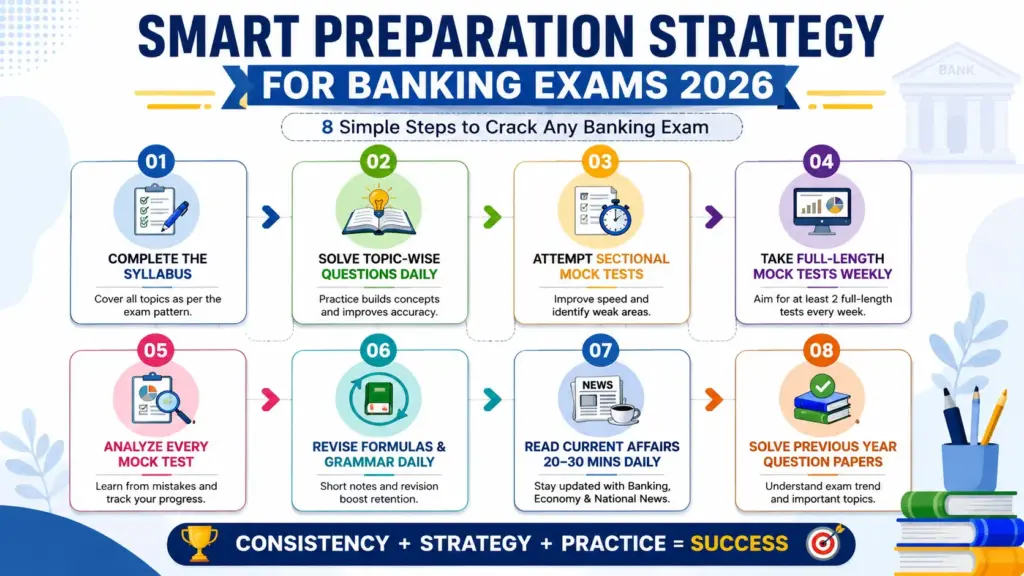
Once you decide which banking exam is easy to crack in 2026, the next step is to follow a smart preparation strategy. No matter which banking exam you choose, nearly 80–90% of the syllabus overlaps, so a single study plan can help you prepare for multiple exams at the same time.
Daily Study Plan for Banking Exams
A consistent study schedule helps candidates improve speed and accuracy. Even 5–6 hours of focused study every day is enough if you remain consistent.
| Subject | Recommended Study Time |
| Quantitative Aptitude | 2 Hours |
| Reasoning Ability | 2 Hours |
| English Language | 1 Hour |
| General Awareness | 45 Minutes |
| Mock Test & Analysis | 1–2 Hours |
Common Mistakes to Avoid in Banking Exams
Many candidates fail because of poor strategy rather than lack of preparation. Even after deciding which banking exam is easy to crack in 2026, simple mistakes during preparation can reduce your chances of success. Avoiding these common errors will help you improve your accuracy, manage time better, and perform confidently in the actual exam.
Avoid these mistakes:
- Preparing for too many exams separately
- Ignoring mock test analysis
- Studying new topics every day without revision
- Not solving previous year papers
- Guessing answers during the exam
- Ignoring current affairs
- Practising without following sectional timings
Final Thoughts
Choosing which banking exam is easy to crack in 2026 depends on your strengths, preparation level, and career goals. For most beginners, IBPS RRB Clerk is the easiest banking exam because of its simple pattern, high vacancies, and the absence of English in the Preliminary Examination. Candidates who are comfortable with English can also target IBPS Clerk and SBI Clerk for faster entry into the banking sector. If your long-term goal is to become a Probationary Officer, you can begin with an easier exam while preparing for SBI PO or IBPS PO simultaneously. A smart study plan, regular mock tests, and consistent revision are the keys to success in every banking examination.
Related Blogs on Banking
FAQs
1. Which banking exam is easy to crack in 2026?
For most beginners, IBPS RRB Clerk is considered the easiest banking exam to crack in 2026 because it has no English section in the Preliminary Examination, moderate difficulty, and no interview stage.
2. Is IBPS Clerk easier than SBI Clerk?
Yes. IBPS Clerk is generally considered easier because the question pattern is more predictable and the competition is slightly lower than SBI Clerk.
3. Which banking exam has the highest vacancies?
IBPS RRB Clerk usually announces the highest number of vacancies, making it one of the best choices for beginners.
4. Can I prepare for SBI, IBPS, and RRB exams together?
Yes. Around 80–90% of the syllabus is common across these exams, so candidates can prepare for multiple banking exams simultaneously with one study plan.
5. Is coaching necessary to crack banking exams?
No. Many candidates clear banking exams through self-study by following a structured study plan, practising mock tests, and solving previous year question papers.
6. Which banking exam offers the highest salary?
Among the major banking examinations, RBI Grade B offers the highest salary, followed by SBI PO and IBPS PO.
7. How many months are enough to prepare for banking exams?
The preparation time depends on which banking exam is easy to crack in 2026 and the level of the exam you choose. For clerk-level exams, 3–4 months of dedicated preparation is usually sufficient, while officer-level exams like SBI PO and IBPS PO generally require 6–8 months of consistent study and practice.
- Sign Up on Practicemock for Updated Current Affairs, Topic Tests and Mini Mocks
- Sign Up Here to Download Free Study Material
Free Mock Tests for the Upcoming Exams
- IBPS PO Free Mock Test
- RBI Grade B Free Mock Test
- IBPS SO Free Mock Test
- NABARD Grade A Free Mock Test
- SSC CGL Free Mock Test
- IBPS Clerk Free Mock Test
- IBPS RRB PO Free Mock Test
- IBPS RRB Clerk Free Mock Test
- RRB NTPC Free Mock Test
- SSC MTS Free Mock Test
- SSC Stenographer Free Mock Test
- GATE Mechanical Free Mock Test
- GATE Civil Free Mock Test
- RRB ALP Free Mock Test
- SSC CPO Free Mock Test
- AFCAT Free Mock Test
- SEBI Grade A Free Mock Test
- IFSCA Grade A Free Mock Test
- RRB JE Free Mock Test
- Free Banking Live Test
- Free SSC Live Test