


Quantitative Aptitude section forms an integral part of almost every banking exam. Also, it requires rigorous practice as it involves lot of calculations thus, this makes it quite an important topic. This section carries good weightage and can fetch you good marks easily. In this article we are guiding the aspirants about different types of Data Interpretation questions that all candidates preparing for the upcoming IBPS RRB Prelims 2023 exams must practice. For those who have difficulty in quant section, we have free topic wise quant quizzes available for the candidates to practice. Aspirants those who have quant as their weak section must take up these quizzes and mini mocks and practice these regularly. Before, moving onto the types of questions let us first have a look at the IBPS RRB PO and IBPS RRB Clerk Prelims exam patterns and also the latest IBPS RRB PO and IBPS RRB Clerk 2023 exam dates.
IBPS RRB PO Prelims 2023 Exam Pattern
| S. No. | Section | Language | No. of Questions | Maximum Marks | Duration |
| 1 | Reasoning | Hindi/English | 40 | 40 | Composite Time of 45 minutes |
| 2 | Quantitataive Aptitude | Hindi/English | 40 | 40 | |
| Total | 80 | 80 | 45 minutes |
NOTE: The RRB PO 2023 Notification is not out yet, therefore this exam pattern is based on previous year’s notification.

Types of DI
There are different types of DI which a candidate may encounter in the RRB PO and RRB Clerk exams. Some of these types are mentioned below:
Line Graphs
This is the type which candidates usually find confusing and requires lot of attention in order to understand the data given. The data is usually given in the form of slope which is formed by joining the two dots on the line graph that either indicates decline or growth.
Bar Graphs
It is a form of DI in which typically different size of bars are used to represent the data.
Tabular DI
Pie Charts
This one type can be time consuming and in order to solve this type of DI a candidate have to be really good at degree and percentage. Quaick calculations are required in this.
Mixed Graphs
Paragraph/Caselet
Data Sufficiency
IBPS RRB PO 2023 Prelims free mock test – Attempt Now
Directions: Answer the questions based on the information given below.
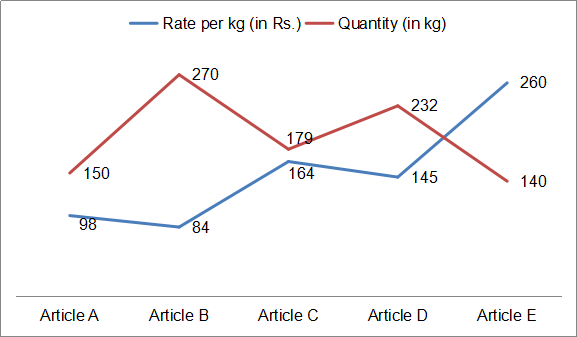
Sapna buys five articles. The quantity (in kg) of each article and the rate per kg (in Rs.) of each article has been given in the line chart.
1. The amount incurred for buying article C is how much less or more than the amount incurred for buying article D?
a.Rs. 3978
b.Rs. 4386
c.Rs. 4182
d.Rs. 4080
e.Rs. 4284
Ans: e
Solution:
Total amount incurred for buying article C = 164 × 179 = Rs. 29356
Total amount incurred for buying article D = 145 × 232 = Rs. 33640
So, the amount incurred for buying article C is Rs. (33640 – 29356) = Rs. 4284 less than the amount incurred for buying article D.
Hence, option e.
2. Sapna sold 30% of article E at the rate of Rs. 264 per kg. He sold (4/7)th of the rest at Rs. 273 per kg. If he sold the remaining article E at 252 per kg, then how much profit is earned by Sapna?
a.Rs. 550
b.Rs. 570
c.Rs. 610
d.Rs. 560
e.Rs. 520
Ans: d
Solution:
The amount of article E sold at Rs. 264 per kg = 30% of 140 = 42 kg
The amount of article E sold at Rs. 273 per kg = 4/7 × 98 = 56 kg
The amount of article E sold at Rs. 252 per kg = (140 – 56 – 42) = 42 kg
Total amount earned by Sapna after selling 140 kg of article E = 42 × 264 + 56 × 273 + 42 × 252
= 11088 + 15288 + 10584 = Rs. 36960
Total amount incurred for buying 140 kg of article E = 260 × 140 = Rs. 36400
Required profit = 36960 – 36400 = Rs. 560
Hence, option d.
3. What is the ratio of the amount incurred for buying article A to the amount incurred for buying article B?
a.35:54
b.28:47
c.32:51
d.39:62
e.42:67
Ans: a
Solution:
Total amount incurred for buying article A = 98 × 150 = Rs. 14700
Total amount incurred for buying article B = 84 × 270 = Rs. 22680
Required ratio = 14700:22680 = 35:54
Hence, option a.
4. What is the total quantity of articles bought by Sapna?
a.984 kg
b.927 kg
c.906 kg
d.971 kg
e.932 kg
Ans: d
Solution:
The total quantity of articles bought by Sapna = 150 + 270 + 179 + 232 + 140 = 971 kg
Hence, option d.
5. Price per kg of article F is 25% more than the price per kg of article B, and the quantity of article F bought by Sapna is 30% more than quantity of article E bought by Sapna. Find the cost incurred for buying article F by Sapna.
a.Rs. 18470
b.Rs. 19870
c.Rs. 18760
d.Rs. 19110
e.Rs. 21540
Ans: d
Solution:
Required cost incurred = 84 × 1.25 × 140 × 1.3 = Rs. 19110
Hence, option d.
Disclaimer: The content provided in the PracticeMock blog article “RRB PO – Different Types of DI Questions to Practice” is intended purely for educational and practice purposes. It is not affiliated with, endorsed by, or representative of the official Institute of Banking Personnel Selection (IBPS) or its examination authorities. The practice questions, explanations, and exam patterns mentioned are based on prior notifications and general preparation strategies, and they may differ from the actual exam format or difficulty level. Candidates should always refer to the official IBPS notifications, syllabus, and guidelines for accurate and up-to-date information.
- Sign Up on Practicemock for Updated Current Affairs, Topic Tests and Mini Mocks
- Sign Up Here to Download Free Study Material
Free Mock Tests for the Upcoming Exams
- IBPS PO Free Mock Test
- RBI Grade B Free Mock Test
- IBPS SO Free Mock Test
- NABARD Grade A Free Mock Test
- SSC CGL Free Mock Test
- IBPS Clerk Free Mock Test
- IBPS RRB PO Free Mock Test
- IBPS RRB Clerk Free Mock Test
- RRB NTPC Free Mock Test
- SSC MTS Free Mock Test
- SSC Stenographer Free Mock Test
- GATE Mechanical Free Mock Test
- GATE Civil Free Mock Test
- RRB ALP Free Mock Test
- SSC CPO Free Mock Test
- AFCAT Free Mock Test
- SEBI Grade A Free Mock Test
- IFSCA Grade A Free Mock Test
- RRB JE Free Mock Test
- Free Banking Live Test
- Free SSC Live Test