


For aspirants preparing for RBI, SEBI, NABARD, or regulatory exams, understanding India’s evolving climate and energy frameworks is as crucial as monetary policy. The April 2026 draft of CAFE III norms introduces a global‑first mechanism—allowing automakers to buy credits directly from the Bureau of Energy Efficiency (BEE) instead of facing fines. This isn’t just a compliance tweak; it’s a structural shift that blends engineering, economics, and regulatory risk. In this Vishleshan, we decode how the credit‑purchase system works, why it matters for India’s climate transition, and the exam‑relevant implications for regulatory design and enforcement.
CAFE III norms: Govt proposes credit-buying system as a remedy against fines
Context: Every time an Indian automaker rolls a car off the assembly line, it is implicitly making a bet on whether that vehicle’s fuel efficiency will keep the company on the right side of the law. The Corporate Average Fuel Efficiency (CAFE) norms — India’s primary regulatory tool for curbing vehicular emissions — are about to get significantly stricter. This Mint article examines how the government is proposing a globally unprecedented credit-purchase mechanism to soften the blow for automakers who miss their targets under CAFE III. The credit-purchase window is not a coincidence — it is a mirror of the pressure India’s auto sector is under right now
Link to the Article: Mint
The Regulator Between the Road and the Climate
BEE Overview
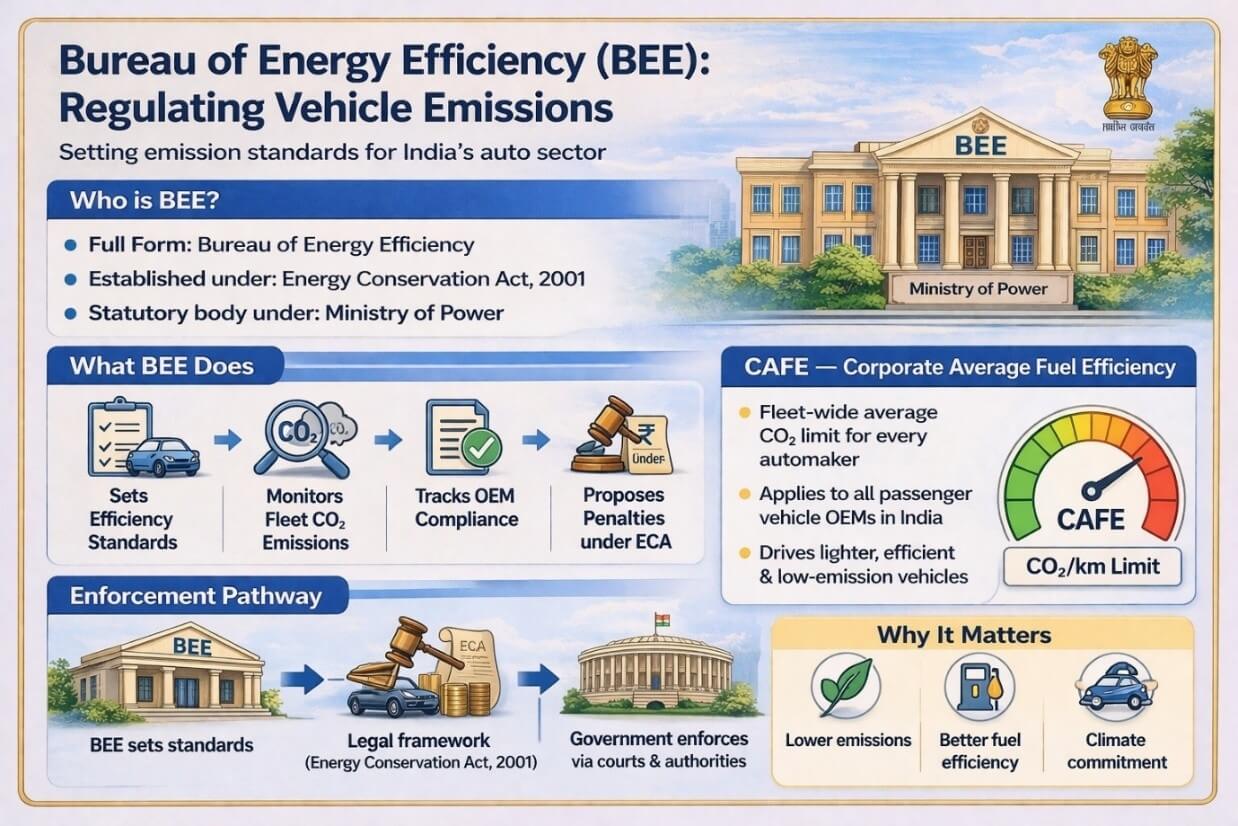
BEE is a statutory body under the Ministry of Power, established under the Energy Conservation Act, 2001. Unlike RBI and SEBI, it carries no quasi-judicial authority — it sets standards and proposes penalties, but enforcement runs through the legal framework. This matters: a single legal challenge can freeze enforcement mid-cycle, which is exactly the risk the credit-purchase mechanism now faces.
Corporate Average Fuel Efficiency (CAFE) Norms
Emission Cap Setting
- The system establishes the maximum permissible fleet-average CO₂ emission level (measured in gCO₂/km) for each manufacturer. These limits are not uniform across the industry. They are tailored to individual manufacturers.
- The caps are calibrated based on the average kerb weight of a manufacturer’s vehicle portfolio. Manufacturers with heavier fleets are allowed relatively higher limits, reflecting the engineering constraints associated with larger vehicles.
Credit–Debit Accounting
- The regulatory framework operates through a passbook-based accounting system, with a separate ledger maintained for each manufacturer for every financial year.
- Credits are generated when a manufacturer’s fleet emissions fall below the prescribed cap, indicating over-compliance. Debits arise when emissions exceed the assigned limit. Both credits and debits are quantified in gCO₂/km.
- These balances are carried forward cumulatively across each block period. The passbook serves as the principal record for assessing compliance and forms the basis for penalty determination at the end of the block period.
Penalty Imposition
- Penalties under the CAFE framework are not imposed on an annual basis. They are assessed at the conclusion of defined block periods.
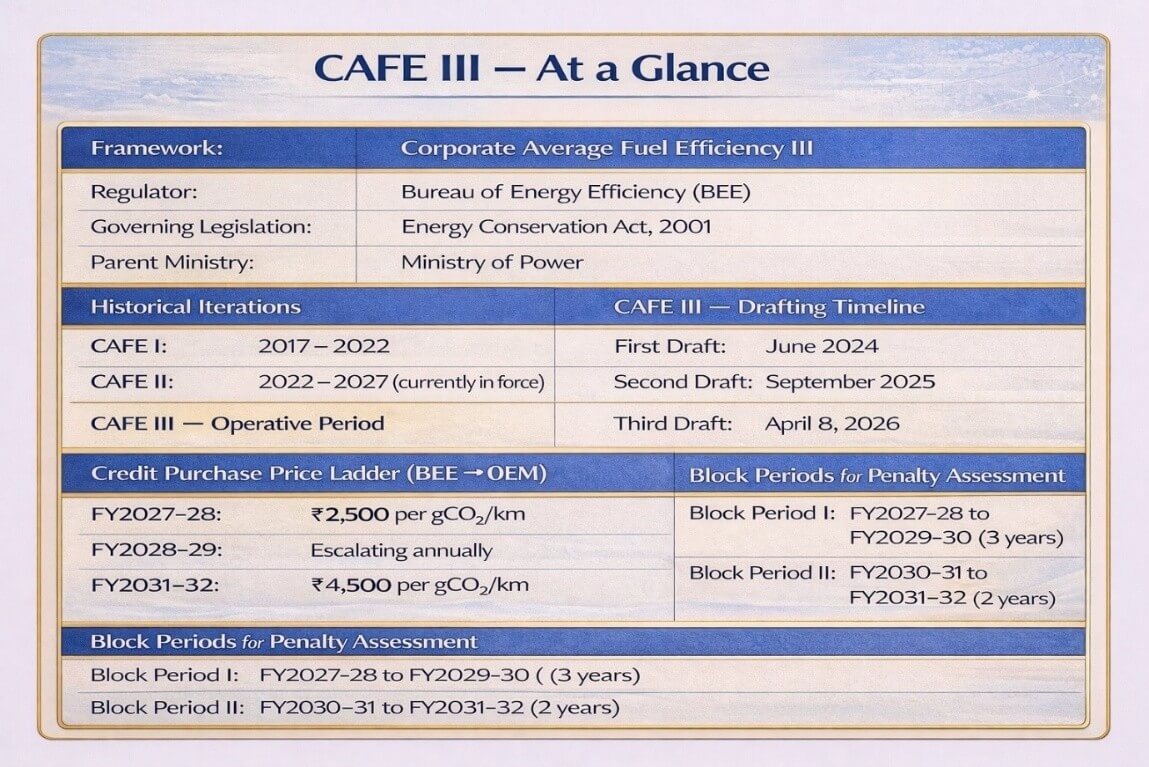
Block Period I spans FY2027–28 to FY2029–30 (three years)
Block Period II covers FY2030–31 to FY2031–32 (two years).
- At the end of each block, the Bureau of Energy Efficiency (BEE) evaluates the net debit balance, and any unresolved deficit attracts financial penalties. This structure provides manufacturers with a multi-year window to correct performance.
- It also introduces a structural risk, as firms may delay corrective action, allowing deficits to accumulate without immediate penalty exposure.
Credit Trading
- The framework permits inter-manufacturer credit trading, allowing manufacturers with surplus credits to sell them to those with deficits.
- It is consistent with international practices, such as credit trading in California and compliance pooling in the European Union.
- It rewards technologically advanced manufacturers while offering flexibility to those facing structural constraints.
The CAFE III Innovation — A Global First
- A distinctive feature of CAFE III is the provision allowing manufacturers with debit balances to purchase credits directly from BEE.
- Credit prices are fixed annually for the period FY2028–FY2032 and follow a graduated price path, designed to make such purchases increasingly expensive over time and thereby encourage genuine efficiency improvements.
- In contrast, jurisdictions such as California and the European Union do not permit direct credit purchases from the regulator. This provision effectively positions BEE as an active participant in the compliance market.
- It also introduces a critical risk: if the cost of purchasing credits remains lower than the cost of technological upgrades, manufacturers may prefer to buy credits rather than invest in efficiency, potentially undermining the long-term objectives of the framework.
- Credits are priced at ₹2,500/gCO₂/km in FY2028 rising to ₹4,500 in FY2032. Intermediate values have not been disclosed by BEE. If this price falls below the cost of genuine engineering improvements, the mechanism becomes a fee-for-pollution, not a transition tool.
Decoding the Article – Analysis and What’s Next
| Aspect | What It Really Means | Key Risk |
| Passbook = Political Settlement | Credit-purchase window reflects 37 million jobs worth of political pressure — not neutral regulatory design | Becomes a permanent bypass if credit prices are set too low |
| Block-Period = Accountability Gap | A 3-year penalty deferral window with no intermediate trigger is structurally identical to a deferral incentive | Manufacturers rationally accumulate debits and bulk-purchase credits at block close |
| Small vs. Heavy = Social Policy | Easing small-car targets is framed as compromise — it is a question of who subsidises India’s climate transition | If engineering costs pass to sticker prices, first-time buyers bear the transition cost |
What’s Next — The Road to Notification
BEE must notify the final framework before October 2026 to give automakers a minimum six-month planning runway. Four variables will determine whether CAFE III succeeds: automatic credit price escalation beyond ₹4,500 post-FY32, legal clarification of BEE’s credit-selling authority under the Energy Conservation Act, finalisation of the hybrid super-credit multiplier below 1.6x, and tiered compliance provisions for smaller OEMs and new entrants. Until notification, every number in the April 8 draft remains subject to revision through a lobbying process that is intense and largely opaque.
- Sign Up on Practicemock for Updated Current Affairs, Topic Tests and Mini Mocks
- Sign Up Here to Download Free Study Material
Free Mock Tests for the Upcoming Exams
- IBPS PO Free Mock Test
- RBI Grade B Free Mock Test
- IBPS SO Free Mock Test
- NABARD Grade A Free Mock Test
- SSC CGL Free Mock Test
- IBPS Clerk Free Mock Test
- IBPS RRB PO Free Mock Test
- IBPS RRB Clerk Free Mock Test
- RRB NTPC Free Mock Test
- SSC MTS Free Mock Test
- SSC Stenographer Free Mock Test
- GATE Mechanical Free Mock Test
- GATE Civil Free Mock Test
- RRB ALP Free Mock Test
- SSC CPO Free Mock Test
- AFCAT Free Mock Test
- SEBI Grade A Free Mock Test
- IFSCA Grade A Free Mock Test
- RRB JE Free Mock Test
- Free Banking Live Test
- Free SSC Live Test