


Staying updated on economic and regulatory issues is non-negotiable for exams like RBI, SEBI, or NABARD. Every topic matters. Every update can turn into a question. In today’s Vishleshan, we focus on ”The Green Hydrogen Race: Why India Is Poised to Finish in Front” This issue is timely. Its relevance is growing. And its impact is deeply linked with policy and regulation. Understanding it now will not just help in exams but also sharpen your perspective.
Take a Free RBI Grade B Mock Test & Know How to Boost Your Prep like a Topper!
The Green Hydrogen Race: Why India Is Poised to Finish in Front
Context: The global race for green hydrogen is on, and India has a unique edge. Amitabh Kant explores how low-cost renewables, strong policy, and domestic demand position India to not just compete, but win the race to lead the world.
Link to the Article: Business Standard
The article, written by former NITI Aayog CEO Amitabh Kant, makes a powerful case for India’s potential to become the world’s pre-eminent hub for green hydrogen. It argues that India possesses a unique combination of strengths—including the world’s cheapest renewable energy, ambitious government policy, a strong industrial base, and large domestic demand—that positions it to lead the global race. The piece highlights the tangible momentum through recent tenders and projects and lays out five key priorities that India must act on to seize this transformative economic and industrial opportunity.
An Overview of Hydrogen Fuel:
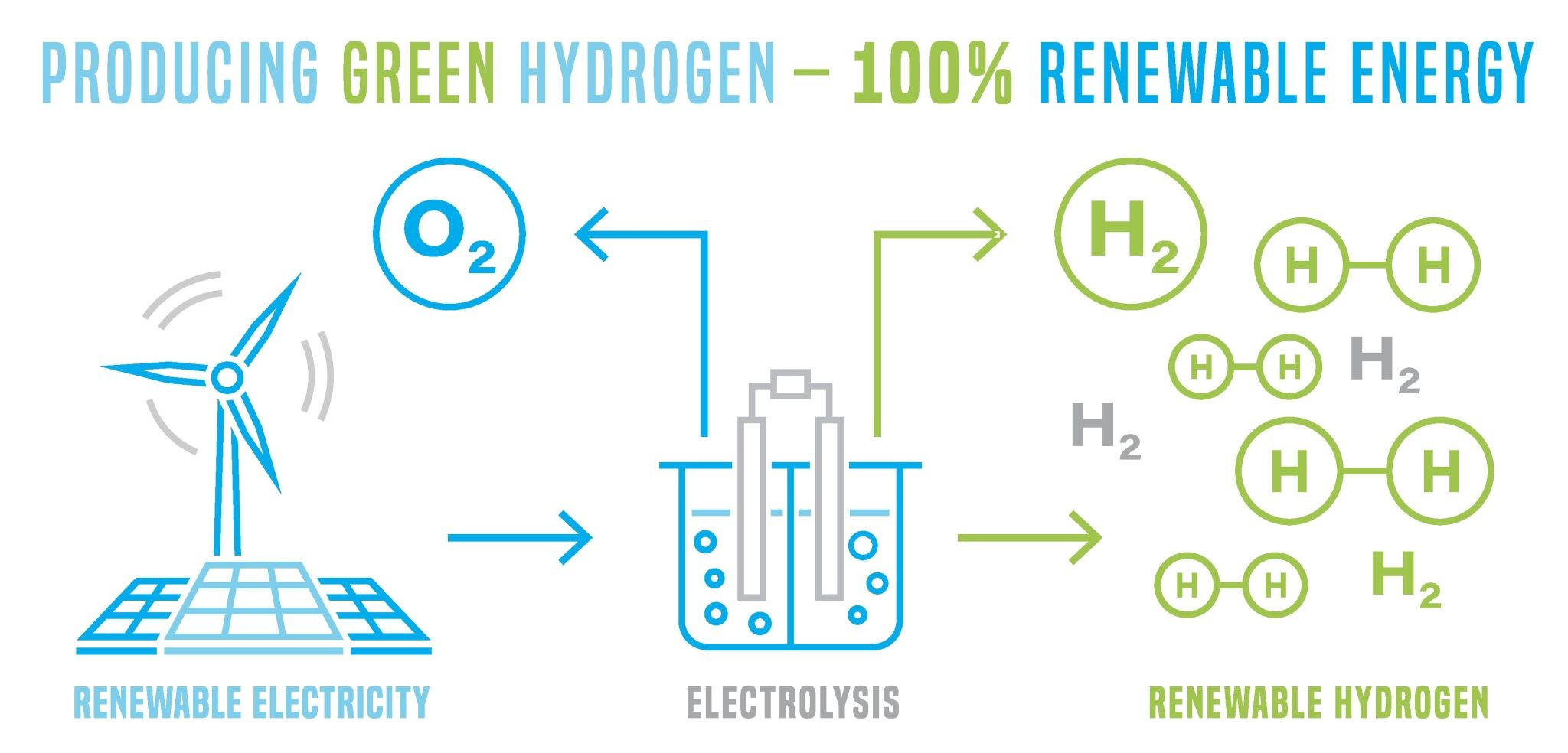
Hydrogen is the most abundant element in the universe, but it rarely exists in its pure form (H₂). It must be extracted from compounds like water (H₂O) or hydrocarbons (like methane, CH₄). The method of extraction determines its “colour” and its environmental impact.
Credit: Getty Images
- Black/Brown Hydrogen: Produced using coal or lignite through a process called gasification. This is the most polluting method, releasing significant amounts of CO₂.
- Grey Hydrogen: This is the most common form today. It is produced from natural gas (methane) via a process called steam methane reforming (SMR). This process also releases a large amount of CO₂ into the atmosphere.
- Blue Hydrogen: This is essentially grey hydrogen, but with a key difference: the CO₂ emissions generated during the SMR process are captured and stored underground through Carbon Capture, Utilisation, and Storage (CCUS) technology. It is a low-carbon, but not zero-carbon, solution.
- Yellow Hydrogen: A newer term, this refers to hydrogen produced through electrolysis powered solely by solar energy.
- Green Hydrogen: This is the ultimate clean energy carrier. It is produced using electrolysis, a process that splits water (H₂O) into hydrogen and oxygen, with the electricity for the electrolyser coming from renewable energy sources like solar, wind, or hydro. It has zero carbon emissions throughout its production lifecycle.
Why is Green Hydrogen the Fuel of the Future?
Green hydrogen is seen as a critical tool to decarbonise the global economy, especially in sectors where direct electrification is difficult.
- Zero Emissions: When used in a fuel cell, hydrogen combines with oxygen to produce electricity, with only water and heat as by-products. This makes it a completely clean fuel at the point of use.
- Energy Storage: It can be produced during times of excess renewable energy generation (e.g., peak solar hours) and stored for later use, acting like a giant battery to stabilise the power grid.
- Versatility: It can be used in a wide range of applications:
- Industry: To produce green steel, green ammonia for fertilisers, and in refineries.
- Transport: To power fuel-cell electric vehicles (FCEVs), especially for long-haul trucks, buses, ships, and potentially aircraft.
- Power Generation: It can be burned in gas turbines to generate electricity during peak demand.
- Energy Security: For a country like India, which imports over 85% of its oil, producing hydrogen domestically from renewable sources significantly enhances energy independence.
India’s National Green Hydrogen Mission (NGHM):
The Union Cabinet, led by Prime Minister Narendra Modi, approved the National Green Hydrogen Mission on January 4, 2023.
- Purpose: The overarching goal is to make India a global hub for the production, utilisation, and export of Green Hydrogen and its derivatives. It aims to create a comprehensive ecosystem to foster this new industry.
- Key Targets by 2030:
- To develop Green Hydrogen production capacity of at least 5 Million Metric Tonnes (MMT) per annum.
- To add about 125 GW of renewable energy capacity.
- To attract over ₹8 lakh crore in total investments.
- To create over 6 lakh jobs.
- To achieve a cumulative reduction in fossil fuel imports of over ₹1 lakh crore.
- To abate nearly 50 MMT of annual greenhouse gas emissions.
Components of the Mission
The mission is a multi-pronged strategy with several key components:
- SIGHT Programme (Strategic Interventions for Green Hydrogen Transition): This is the mission’s flagship financial support mechanism. It has two main components:
- Incentives for domestic manufacturing of electrolysers.
- Incentives for the production of green hydrogen.
- Pilot Projects: To support the deployment of green hydrogen in hard-to-abate sectors like steel, transport, and shipping.
- Green Hydrogen Hubs: To identify and develop regions capable of large-scale production and/or utilisation of hydrogen as large-scale industrial hubs.
- R&D and Skill Development: To foster a robust research and development framework and to build a skilled workforce for the new industry.
India’s Competitive Edge
India is considered a frontrunner in the global green hydrogen race due to several unique advantages, which are also highlighted in the provided PIB links:
- Abundant Low-Cost Renewables: India has one of the world’s lowest costs for generating solar and wind power, which is the single biggest input cost for green hydrogen production.
- Strong Government Backing: The NGHM provides a clear, ambitious, and supportive policy framework, giving investors the confidence to make long-term commitments.
- Large Domestic Market: India is a major consumer of grey hydrogen in sectors like fertilisers and refining. This creates a large, built-in demand that can be switched to green hydrogen, ensuring offtake.
Decoding the Article: An Analysis
Amitabh Kant’s article builds on these foundational strengths to paint a highly optimistic picture of India’s green hydrogen future.
India’s “Five Decisive Strengths”
The author crystallises India’s advantage into five key points, which align perfectly with the mission’s foundations:
- Unmatched Renewable Energy Rates: Citing prices of ₹4.60 to ₹5 per kWh for round-the-clock renewables, he establishes India’s core cost competitiveness.
- Consistent and Ambitious Policy: The National Green Hydrogen Mission is praised for providing clear targets and regulatory certainty.
- Strong Industrial Base: India’s existing ecosystem of engineering, pipelines, and ports means it doesn’t have to build everything from scratch.
- Large Domestic Demand: The fertiliser, refining, and steel sectors provide a captive market, reducing reliance solely on exports.
- Immense Export Opportunity: Countries like Europe and Japan are actively looking for clean hydrogen imports, and India is perfectly placed to supply them.
Making Sense of the Numbers: From Ambition to Action
The article provides concrete evidence that the mission is already translating into action on the ground:
- SECI Tenders: The Solar Energy Corporation of India (SECI) has already awarded contracts for 450,000 tonnes/annum of green hydrogen and 724,000 tonnes of green ammonia, showing significant scale.
- Record-Low Price: The green ammonia tender achieved a price of ₹55.75 per kilogram, proving India’s global cost leadership.
- IOCL Panipat Project: A landmark 25-year contract for 10,000 tonnes/annum at an all-inclusive price of $4.5 per kilogram shows that large public sector undertakings are now making long-term commitments.
The Real Prize: Green Value-Added Products
The author rightly points out that the goal isn’t just to produce and export raw hydrogen. The real economic opportunity lies in using cheap green hydrogen to create high-value green products:
- Green Fertilisers: To reduce import bills and enhance food security.
- Green Steel: To remain competitive globally, especially as Europe’s carbon border taxes will penalise carbon-intensive steel.
- Green Ammonia: To be used as a clean shipping fuel and as a more practical way to transport hydrogen over long distances.
The Five Priorities: A Call to Action
To secure its leadership, the author outlines a clear, five-point action plan:
- Secure G2G Agreements: Get long-term (10-15 years) offtake contracts from importing countries to de-risk investments.
- Accelerate Electrolyser Manufacturing: Build domestic capacity to reduce import dependence and costs.
- Brand “India Green Hydrogen”: Market India’s cost advantage and quality through internationally aligned certification.
- Invest in Skilling: Create a national mission to train the tens of thousands of technicians needed.
- Create an Efficient Regulatory Environment: Implement single-window clearances and predictable rules to cut delays and costs.
In conclusion, the article is not just an optimistic forecast but a strategic blueprint. It argues that while the challenges of capital, certification, and skills are real, they are surmountable. By leveraging its unique strengths and acting decisively on key priorities, India can move beyond being just a participant and become the clear winner in the global green hydrogen race.
- Sign Up on Practicemock for Updated Current Affairs, Topic Tests and Mini Mocks
- Sign Up Here to Download Free Study Material
Free Mock Tests for the Upcoming Exams
- IBPS PO Free Mock Test
- RBI Grade B Free Mock Test
- IBPS SO Free Mock Test
- NABARD Grade A Free Mock Test
- SSC CGL Free Mock Test
- IBPS Clerk Free Mock Test
- IBPS RRB PO Free Mock Test
- IBPS RRB Clerk Free Mock Test
- RRB NTPC Free Mock Test
- SSC MTS Free Mock Test
- SSC Stenographer Free Mock Test
- GATE Mechanical Free Mock Test
- GATE Civil Free Mock Test
- RRB ALP Free Mock Test
- SSC CPO Free Mock Test
- AFCAT Free Mock Test
- SEBI Grade A Free Mock Test
- IFSCA Grade A Free Mock Test
- RRB JE Free Mock Test
- Free Banking Live Test
- Free SSC Live Test