


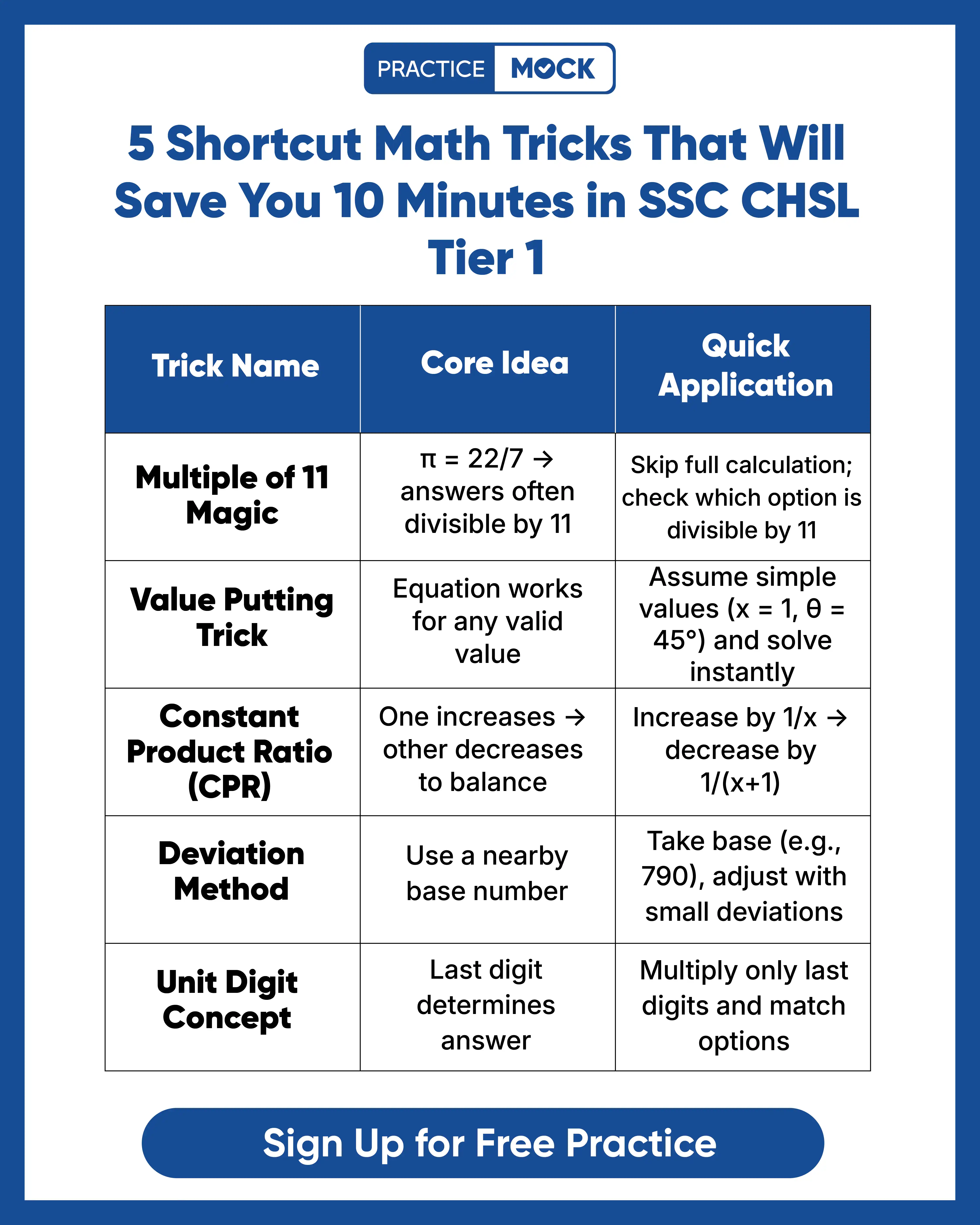
Imagine the exam clock ticking down to the last 15 minutes, and you still have 10 math questions left. Panic sets in, right? If you are wondering what the 5 shortcut math tricks are that will save you 10 minutes in the SSC CHSL Tier 1 exam, the answer lies in the Divisibility Rule of 11, the Value Putting trick, Constant Product Ratio (CPR), the Deviation Method for averages, and the Unit Digit concept. In the real exam hall, solving math using long school methods on a tiny, rough sheet will completely destroy your speed. You do not need a math degree; you just need to outsmart the four options on your screen. Read this complete blog for detailed, step-by-step shortcuts to transform your calculation speed and score high.
The Real Exam Hall Trap: The “Rough Sheet Mess”
Before we jump into the tricks, let us talk about a unique problem every SSC CHSL aspirant faces: The Rough Sheet Mess.

In the real exam, you are given a very small rough sheet. When students use traditional long math methods, they write huge numbers everywhere. In the panic of the ticking timer, they read their own handwriting wrong (reading a ‘7’ as a ‘1’) and got the wrong answer after wasting 3 minutes.
The secret to clearing SSC CHSL is not calculating faster; it is calculating less. These 5 tricks will help you solve questions by just looking at the screen, saving your rough sheet space and precious time.
Trick 1: The “Multiple of 11” Magic (Mensuration)
Mensuration (Area and Volume) questions look very scary because of heavy calculations involving circles, cylinders, spheres, and cones. But they are actually the easiest!
- The Logic: Any 2D or 3D formula with a circle uses the value Pi (pi), which is 22/7.
- The Trick: Because 22 is a multiple of 11, the final correct answer option MUST also be perfectly divisible by 11.
- How to use it: Do not calculate the whole volume. Just look at the four options and check which number is divisible by 11. (Rule of 11: Add alternate digits and subtract them. If the difference is 0 or 11, it is divisible).
| Traditional Method | Shortcut Method | Time Saved |
| Writing formula -> Cutting numbers -> Long multiplication. | Check options: A) 1432, B) 1540. Option B: (1+4) – (5+0) = 0. Answer is B! | 45 Seconds |
Trick 2: The “Value Putting” Secret (Algebra & Trigonometry)
Do you hate finding the value of ‘x’ or solving huge Sin2θ equations? The examiner does not care about your steps; they only care about the final click.
- The Logic: If an algebraic equation has variables (like a, b, c) in the question and numbers in the options, the equation is true for ANY value of that variable.
- The Trick: Assume the value of the variable yourself! Put x = 1, or a = 0 (avoid making the denominator zero). For Trigonometry, put θ = 45° or 90°.
- Example: If x + y = 5 and you need to find a huge equation, just assume x = 5 and y = 0. Put these simple numbers in the equation, and it will solve in 5 seconds.
[Attempt Free Topic Tests Here]: Did you just learn the Value Putting trick? Give a quick 10-minute topic test right now to see this magic work on real previous year questions!
Trick 3: Constant Product Ratio (CPR) for Percentages
This trick is a lifesaver for Percentage, Profit & Loss, and Time-Speed-Distance chapters.
- The Logic: If two things multiply to make a constant result (like Price x Consumption = Expenditure), and one goes up, the other MUST go down.
- The Trick: If a value increases by 1/x, the other value must decrease by 1/(x+1) to keep the balance.
- Example Application: * Question: Sugar price increases by 25% (which is 1/4). By how much should a family reduce consumption so the budget does not change?
- Shortcut Answer: Price went UP by 1/4. So, consumption must go DOWN by 1/(4+1) = 1/5. And 1/5 is exactly 20%. Solved without a pen!
Trick 4: The Deviation Method (Averages)
If you get a question to find the average of big numbers like 785, 792, 788, and 795, adding them all up will waste your entire minute.
- The Trick: Choose a “Base Number” from your mind that is close to all these numbers (Let’s take 790).
- The Step: Now, just write down how far each number is from 790:
- 785 is -5
- 792 is +2
- 788 is -2
- 795 is +5
- The Result: Add these small deviations (-5 + 2 – 2 + 5 = 0). Since the deviation is zero, your average is exactly 790.
[Take a Free Full-Length Mock Test]: Are you ready to use the Deviation trick under pressure? Sit in a quiet room and take our free 60-minute mock test to check your real speed!
Trick 5: The “Unit Digit” Rescue (Simplification)
Never multiply big numbers before checking the four options.
- The Logic: The last digit of a massive multiplication depends purely on the last digits of the numbers being multiplied.
- The Trick: If the question is 456 x 783, do not multiply the whole thing. Just multiply the last digits: 6 x 3 = 18. The final answer MUST end with an 8. Look at your options; mostly, only one option will end with an 8. Click it and move on!
Conclusion
These 5 shortcut math tricks for the SSC CHSL Tier 1 exam are not magic; they are pure logic. However, you cannot learn them just by reading. You must practice them daily. Make a separate thin notebook only for “Tricks.” Keep your rough sheet clean, avoid doing manual long division, and always look at the four options before holding your pen. Use these shortcuts in your daily mock tests, and you will easily save 10 to 12 minutes in the real exam hall. Good luck, future officers.
Join our exclusive Telegram group for expert guidance, personalized tips, and real-time solutions to boost your SSC exam prep. [Click here to join now!]
| Other Related Article SSC CHSL | |
| SSC CHSL Notification | SSC CHSL Study Plan |
| SSC CHSL Previous Year Question Paper | SSC CHSL Salary |
| SSC CHSL Cut Off | SSC CHSL Selection Process |
| SSC CHSL Syllabus | |
Frequently Asked Questions (FAQs)
Yes! These tricks (like Divisibility of 11, CPR, and Value Putting) work beautifully for SSC CGL, SSC CHSL, SSC MTS, and even Railway exams.
You can use it in 90% of questions. Just remember one golden rule: never assume a value that makes the bottom part (denominator) of an equation zero, as that makes the math invalid.
Ideally, you should try to solve easy math questions in 30 seconds and medium ones in under 1 minute. If a question takes more than 1.5 minutes, skip it immediately.
No. The examiner actually tests your smartness, not your hard labor. Almost every long question has a hidden shortcut or an option elimination trick.
You can easily apply and practice these exact methods by taking our free daily topic tests and full-length mock tests linked in the blog above.
- Sign Up on Practicemock for Updated Current Affairs, Topic Tests and Mini Mocks
- Sign Up Here to Download Free Study Material
Free Mock Tests for the Upcoming Exams
- IBPS PO Free Mock Test
- RBI Grade B Free Mock Test
- IBPS SO Free Mock Test
- NABARD Grade A Free Mock Test
- SSC CGL Free Mock Test
- IBPS Clerk Free Mock Test
- IBPS RRB PO Free Mock Test
- IBPS RRB Clerk Free Mock Test
- RRB NTPC Free Mock Test
- SSC MTS Free Mock Test
- SSC Stenographer Free Mock Test
- GATE Mechanical Free Mock Test
- GATE Civil Free Mock Test
- RRB ALP Free Mock Test
- SSC CPO Free Mock Test
- AFCAT Free Mock Test
- SEBI Grade A Free Mock Test
- IFSCA Grade A Free Mock Test
- RRB JE Free Mock Test
- Free Banking Live Test
- Free SSC Live Test