


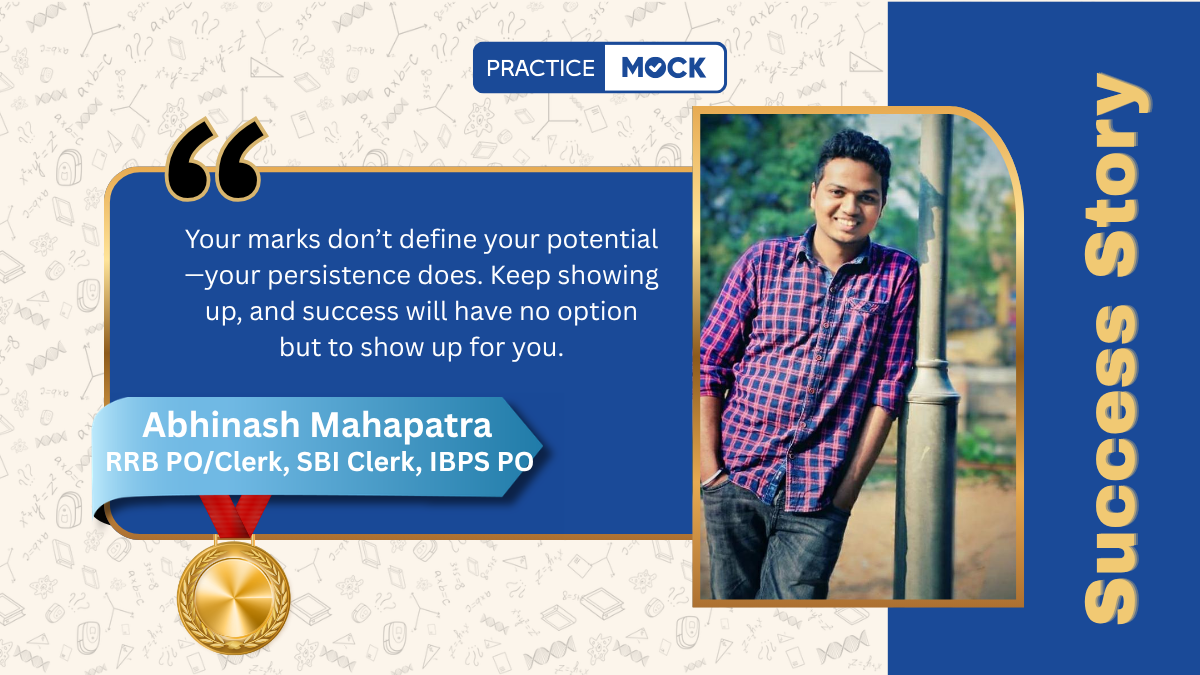
Abinash Mahapatra started his banking exam preparation in May 2018 after completing his graduation. Like many aspirants, his initial phase of preparation lacked direction, which resulted in failure in several preliminary exams.
In 2018, he appeared for exams like RRB Clerk, IBPS PO, IBPS Clerk, and Canara PGDBF, but unfortunately, he could not clear even the prelims stage. However, instead of giving up, he analyzed his mistakes and came back with a stronger and smarter strategy in 2019.

His hard work paid off when he cleared multiple exams, including:
- SBI Clerk (currently working)
- RRB PO
- RRB Clerk
- IBPS PO (selected in UCO Bank)
Q1. When did you start your preparation and how was your initial phase?
Abinash:
I started my preparation in May 2018 after graduation. Initially, my preparation was directionless, and I failed in all prelims exams that year. However, from January 2019, I started serious preparation with a proper strategy, which changed everything.
Q2. How did you prepare for the English section?
Abinash:
English plays a very important role, just like a catalyst in a chemical reaction. I was average in English, so I focused on improving my reading speed and basic grammar.
I did not follow any special strategy. I mainly relied on mock tests and their analysis. I made a habit of reading English daily through newspapers, blogs, and other sources.
In exams, I attempted all questions except Reading Comprehension first, and then dedicated the last few minutes to RC. This helped me manage time effectively.
Q3. What was your strategy for Quantitative Aptitude?
Abinash:
Quant is the backbone of my success. I focused heavily on strengthening my fundamentals in the first 4–5 months through YouTube, PDFs, and quizzes.
In prelims, most questions come from Simplification and Data Interpretation, so I worked a lot on calculation speed. I used to attempt 4 prelim mocks and 1 mains mock daily, which significantly improved my speed.
I also practiced different types of one-liner questions from topics like Time & Work, Ratio, and Probability. Covering all types helped me score consistently well.
Q4. How did you prepare for Reasoning Ability?
Abinash:
Reasoning is one of the most scoring sections. Around 70–80% of questions are puzzle-based, so I focused a lot on puzzles.
Initially, I worked on basic concepts and then started solving different types of puzzles daily. I also learned how to manage multiple possibilities while solving puzzles.
For mains, the key is to select the right questions because the level is quite difficult. Regular mock test practice helped me stay updated with changing patterns.
Q5. What was your approach to General Awareness?
Abinash:
General Awareness can make or break your selection. I focused mainly on last 6 months’ current affairs.
Before mains, I studied current affairs for 20–25 days from multiple sources like monthly PDFs and quizzes. This helped me score well in this section.
Q6. How important were mock tests in your preparation?
Abinash:
Mock tests played a crucial role in my success. I attempted multiple mocks daily and analyzed them thoroughly.
Mock tests helped me:
- Improve speed and accuracy
- Understand exam patterns
- Identify weak areas
Practicing exam-level questions made me confident during the actual exam.
Q7. Did you face any challenges during your preparation?
Abinash:
Yes, I felt very frustrated after failing IBPS Clerk 2018 prelims, especially due to low marks in Reasoning. But that phase was short-lived. I learned from my mistakes and stayed focused.
Q8. What was your overall preparation strategy?
Abinash:
My strategy was simple — focus on clearing the cutoff rather than aiming for top ranks.
I was strong in Quant but weak in English, so I worked on improving English to an average level while making Quant my strongest section.
Smart preparation is the key to success in banking exams.
Key Takeaways from His Journey
- Start with clear fundamentals
- Practice mock tests regularly
- Focus on your weak areas
- Improve calculation speed for Quant
- Build reading habits for English
- Practice puzzles daily for Reasoning
- Prepare current affairs for the last 6 months
Conclusion
The success story of Abinash Mahapatra clearly shows that failure is not the end but the beginning of improvement. With the right strategy, consistent practice, and proper analysis, anyone can crack banking exams.
His journey teaches us that smart preparation, not just hard work, is the key to success. Instead of trying to master everything, focus on clearing the cutoff and strengthening your strong areas.
As Abinash rightly says:
“Current struggle will reflect on the result page — whether it is ‘Congratulations’ or ‘Thank You’. So practice as much as you can.”
Stay consistent, keep practicing, and success will follow.
Start Your Preparation Today by Taking the Best, Exam-level, and Affordable Banking Preparation Subscription – Click Below and Enroll Now
- Sign Up on Practicemock for Updated Current Affairs, Topic Tests and Mini Mocks
- Sign Up Here to Download Free Study Material
Free Mock Tests for the Upcoming Exams
- IBPS PO Free Mock Test
- RBI Grade B Free Mock Test
- IBPS SO Free Mock Test
- NABARD Grade A Free Mock Test
- SSC CGL Free Mock Test
- IBPS Clerk Free Mock Test
- IBPS RRB PO Free Mock Test
- IBPS RRB Clerk Free Mock Test
- RRB NTPC Free Mock Test
- SSC MTS Free Mock Test
- SSC Stenographer Free Mock Test
- GATE Mechanical Free Mock Test
- GATE Civil Free Mock Test
- RRB ALP Free Mock Test
- SSC CPO Free Mock Test
- AFCAT Free Mock Test
- SEBI Grade A Free Mock Test
- IFSCA Grade A Free Mock Test
- RRB JE Free Mock Test
- Free Banking Live Test
- Free SSC Live Test