


When students start SEBI Grade A preparation, Accounts looks simple from the outside. But once the syllabus opens up, and you see how every topic quietly connects with a dozen others, the real seriousness of this paper hits you. And if you’re not careful, Accounts can silently eat most of your preparation time. That’s why today’s blog is all about clarity, straightforward, chapter-wise clarity, so you know exactly what to study, why to study it, and how to combine all sources into one clean strategy. And wherever I feel a particular resource can genuinely reduce your burden, I’ll mention it honestly, because for SEBI, the right notes and the right mock tests matter more than the number of hours you study.
Accounts Syllabus for SEBI Grade A Exam 2025
The Accounts syllabus is not long for the sake of being long. It’s long because it builds one idea over another, layer after layer. Accounting is not one chapter; it’s a system. A full, functional system of principles, numerical logic, statutory rules, and real corporate practices.

And for 2025, nothing new has been added. But the weightage has quietly increased. Especially in Phase 2, where the number of questions has almost doubled.
This means your seriousness has to double too. And your strategy has to get tighter and cleaner.
For the basics and chapter-by-chapter clarity, you can use SEBI Revision Notes, which simplify the entire structure exactly the way SEBI tends to test it.
The Main Areas You Must Master
These are not optional. Not skippable. Not “I’ll check later” topics. These are the pillars of the Accounts section.
1. Basics of Accounting
This is the foundation. The spine. The actual strength builder. Every student who scores well has strong basics, journal entries, ledger posting, trial balance, errors, P&L, balance sheet formats, and reconciliation.
You will see 2 to 4 questions in both phases, consistently. If your basics are weak, nothing else works.
For clean fundamentals, the SEBI Study Notes are particularly helpful because they break down even the smallest concepts without overcomplicating anything.
2. Ratio Analysis
One of the highest-return chapters in the syllabus. In Phase 1, you get conceptual questions—definition, meaning, interpretation. In Phase 2, expect numerical questions.
The good part? The formulas are fixed. The logic is fixed. The examiner’s thinking is fixed.
If you solve a good set of numerical tests, this chapter becomes a scorer.
To practice exactly what SEBI asks, try Mock Test 1, which has multiple ratio-based numericals.
3. Accounting for Share Capital
Probably the most unpredictable area, not because it’s tough, but because the examiner doesn’t stick to basic textbook-style questions.
They go wide:
- Share issue
- Re-issue
- Buyback
- Bonus issue
- Right shares
- Forfeiture
- Premium and discount
- ESOP
- Reserves
This entire zone requires concept clarity plus numerical comfort. This is where SEBI Notes – Chapterwise Tests help, because every micro-topic has individual practice.
4. Company Final Accounts
Even though SEBI syllabus mentions “Company Accounts,” the examiners also quietly include:
- Proprietorship accounts
- Partnership accounts
- Adjustments
- Profit-sharing ratios
- Manager’s commission
- Final statements
These have appeared for years. If you miss them, it hurts your score unnecessarily.
A great way to lock this chapter is to use SEBI Paper 2 – CA Tests, because they include current financial updates plus practical adjustments.
5. Accounting Standards (Indian AS)
Don’t touch all standards. Just the ones mentioned in the SEBI notification.
There is always one conceptual question, testing your understanding of:
- Recognition
- Measurement
- Disclosure
- Principles
For Standards, the crisp summaries inside SEBI Revision Notes are more than enough.
6. Awareness-Based Accounting (GST + Tally + Reforms)
In the past few years, these questions have appeared unexpectedly.
Small, light, concept-based, but they require awareness:
- GST accounting entries
- Tally fundamentals
- Input/output tax
- Basic reforms in accounting systems
This is where students lose marks because they consider this area “extra.” But SEBI considers it basic awareness.
7. Debentures, Bonds, Shares (Overlap Zone)
Not fully finance, not fully accounts. A hybrid chapter. You’ll get both conceptual and numerical questions. Expect 1 to 2 questions in both phases.
Practice this through Mock Test 3, which mixes finance + accounts numericals exactly as SEBI does.
Analysis of Numerical Questions
Here is a clear view of where numericals mostly come from:
| Numerical Area | Examples | Importance |
| Inventory Valuation | FIFO, LIFO, weighted average | Very frequent |
| Ratio Analysis | Profitability, liquidity, solvency ratios | Consistent |
| Depreciation | Straight-line, WDV, change in method | Very high |
| Share Valuation | Basic valuation methods | Common |
| Cash Flow Statements | Operating, investing, financing flows | Medium |
| Journal–Ledger–Trial Balance | Error rectification, balancing | Regular |
If you want real exam-like numerical pressure, Mock Test 4 is the best choice because it matches Phase 2 difficulty.
Topic-Wise Weightage Table
| Topic | Importance | Question Type | Notes |
| Basics of Accounting | Very High | Conceptual + Numerical | The backbone |
| Ratio Analysis | High | Mostly numerical | Consistent scorer |
| Share Capital | High | Mixed | Broad and unpredictable |
| Company Final Accounts | High | Mixed | Includes proprietorship + partnership |
| Accounting Standards | Medium | Conceptual | Only specified standards |
| GST & Tally Awareness | Medium | Conceptual | Seen in recent years |
| Debentures/Bonds | Medium | Mixed | Requires basic clarity |
| Numerical Areas | High | Numerical | Needs daily practice |
Why the Syllabus Feels Long but Is Actually Manageable
SEBI hasn’t added anything new. They’ve only increased the number of questions from the same topics.
This automatically increases the value of:
- Conceptual clarity
- Revision cycles
- Numerical practice
To keep everything under control, Sampoorna – Paper 2 Current Affairs helps in combining current business updates with static accounting knowledge, which SEBI loves testing indirectly.
How to Study Accounts for SEBI Grade A (2025)
Here’s a clean, no-confusion strategy to master accounts:
Step 1: Build Strong Basics First
Your syllabus moves in circles—everything comes back to basics. Invest 10–15 days purely in accounting fundamentals. Use SEBI Study Notes + SEBI Revision Notes to build clarity.
Step 2: Solve Numericals Every Day
Even 30 minutes daily will take you far.
Rotate between:
- Ratio numericals
- Depreciation
- Inventory
- Share valuation
- Cash flow
Use Mock Test 5 for mixed numericals. It is fast, sharp, and exam-level.
Step 3: Keep Revising Accounting Standards
Don’t memorize. Understand the intent. Solve a few questions from standards mentioned in the official syllabus only.
Step 4: Don’t Ignore Company Final Accounts
Students assume “it’s too big.” But the logic stays the same across entities. Once you understand company statements, partnership adjustments become easier.
Step 5: Use Mocks Like the Actual Exam
SEBI mocks require:
- Speed
- Accuracy
- Numerical stamina
- Conceptual recall
Complete all 5 mocks in proper order:
- Mock Test 1 – Warm-up
- Mock Test 2 – Concept-heavy
- Mock Test 3 – Numerical-focused
- Mock Test 4 – Phase-2 difficulty
- Mock Test 5 – Final exam match
Final Insights
- The real difficulty is not the syllabus.
- The difficulty is the unstructured nature of the syllabus.
- If you rearrange topics properly and revise them regularly, scoring becomes natural.
The combination of:
- SEBI Study Notes,
- SEBI Revision Notes,
- Sampoorna CA, and
- All 5 Mock Tests
creates the exact preparation loop SEBI demands.
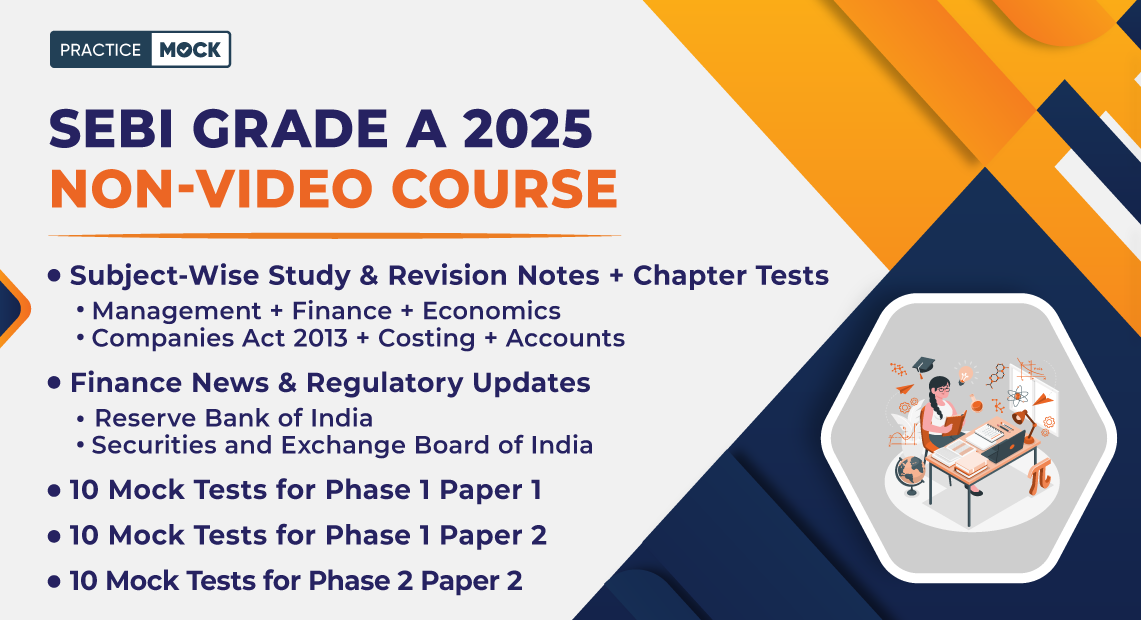
Conclusion
Accounts is not a tough subject for SEBI Grade A. It only feels tough when you study it randomly. Once you see the syllabus like a proper system, basics, ratios, share capital, standards, company accounts, numericals, everything quietly becomes easier.
And with consistent practice, especially through the Mock Tests and structured SEBI Notes, your confidence starts rising without you even noticing it.
If you stay patient, revise often, and solve mixed numericals daily, this paper becomes one of the highest-scoring parts of SEBI Grade A 2025.
- Sign Up on Practicemock for Updated Current Affairs, Topic Tests and Mini Mocks
- Sign Up Here to Download Free Study Material
Free Mock Tests for the Upcoming Exams
- IBPS PO Free Mock Test
- RBI Grade B Free Mock Test
- IBPS SO Free Mock Test
- NABARD Grade A Free Mock Test
- SSC CGL Free Mock Test
- IBPS Clerk Free Mock Test
- IBPS RRB PO Free Mock Test
- IBPS RRB Clerk Free Mock Test
- RRB NTPC Free Mock Test
- SSC MTS Free Mock Test
- SSC Stenographer Free Mock Test
- GATE Mechanical Free Mock Test
- GATE Civil Free Mock Test
- RRB ALP Free Mock Test
- SSC CPO Free Mock Test
- AFCAT Free Mock Test
- SEBI Grade A Free Mock Test
- IFSCA Grade A Free Mock Test
- RRB JE Free Mock Test
- Free Banking Live Test
- Free SSC Live Test