


Blood Relation questions are an important part of the Reasoning Ability section in the RRB PO Mains exams. These questions are asked every year in the exam in multiple formats, like puzzles or coded blood relations. These questions test your ability to interpret and analyse family relationships based on given statements. Mastering blood relation questions requires daily practice with a strong hold on the basic concepts. This blog covers the concept explanation of solving these types of questions, along with examples and tips to solve them quickly in the RRB PO exam.
What is the Blood Relation Concept?
These questions involve identifying the relationship between two individuals based on a series of statements. The relationships may be direct (mother, brother) or indirect (aunt’s son, paternal grandfather).

Basic Family Relationship Terms used in Blood Relation Questions:
| Term | Relation |
|---|---|
| Father’s/Mother’s Father | Grandfather |
| Father’s/Mother’s Mother | Grandmother |
| Brother’s Son/Daughter | Nephew/Niece |
| Sister’s Husband | Brother-in-law |
| Husband’s/Wife’s Sister | Sister-in-law |
Types of Blood Relation Questions Asked in RRB PO Exam
The different types of blood relation questions that usually come in the RRB PO exam are direct blood relation, indirect blood relation, coded blood relation, and puzzle-based blood relation.
Direct Blood Relations
These are straight-forward relationships:
- Father, Mother, Brother, Sister
- Son, Daughter, Husband, Wife
- Uncle, Aunt, Nephew, Niece
- Grandfather, Grandmother, etc.
Example:
“A is the mother of B.” → Direct relation.
Indirect/Nested Relations
These require logical linking of multiple relations:
- Use substitution and step-wise analysis.
Example:
“A is the brother of B. B is the mother of C. How is A related to C?”
- A is the maternal uncle of C.
Coded Blood Relations
In these questions, symbols represent family relations.
Common symbols used:
| Symbol | Meaning |
|---|---|
| A + B | A is the father of B |
| A – B | A is the mother of B |
| A * B | A is the sister of B |
| A / B | A is the brother of B |
Example:
If A + B – C, what is A’s relation to C?
- A is the father of B, B is the mother of C → A is maternal grandfather of C.
Puzzle-based Blood Relations
These involve 3–4 statements and require drawing a family tree to decode.
These involve multiple family members and layered statements. Drawing a family tree is the best approach.
Example:
“There are 6 members in a family: A, B, C, D, E, and F. A is the father of B. D is the sister of E. F is the mother of D. C is the son of A. E is the son of F.”
Solve step-by-step and create a family tree.
What is a Family Tree?
A family tree is a diagram that shows the relationship between different members of a family.
The family tree helps in solving the questions related to the blood relation.
The following points help in drawing a family tree.
1. All the female members of the family are represented with a ‘–’ sign with their name.
2. All the male members of the family are represented a ‘+’ sign with their name.
3. The relation between two members of the family is shown by connecting a line.
5. All the family members of the same generation are represented together. Ex: brothers, Sisters, cousins, wife, husband, etc.
6. All the family members of the next generation are represented below in the family tree. Ex: grandparents are represented above the parents, who are represented above their child and so on.
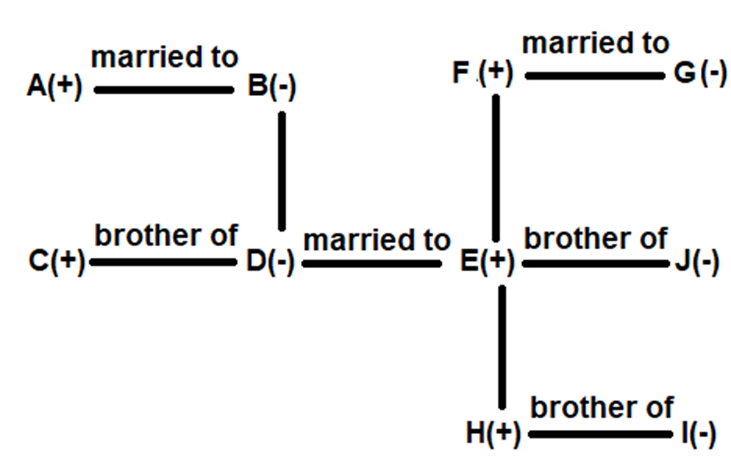
Observation:
- A is husband of B.
- D is the daughter of A.
- C is the brother of D
- G is wife of E.
- C is the brother-in-law of E.
- D is sister-in-law of J.
- E is father of H.
- D is mother of H.
- H is grandson of F.
- I is granddaughter of F.
- F is paternal grandfather of H
- G is paternal grandmother of H.
- A is maternal grandfather of H.
- B is maternal grandmother of H.
Below is a family tree table based on the above diagram that you can refer to:
| Person | Relation | Related To | Additional Info |
|---|---|---|---|
| A | Husband | B | A is male |
| B | Wife | A | B is female |
| D | Daughter | A & B | D is female |
| C | Brother | D | C is male |
| C | Brother-in-law | E | C’s sister (D) is E’s wife |
| G | Wife | E | G is female |
| D | Sister-in-law | J | D is married to J’s brother |
| E | Father | H | E is male |
| D | Mother | H | D is female |
| H | Grandson | F | H is male |
| I | Granddaughter | F | I is female |
| F | Paternal Grandfather | H | F is E’s father |
| G | Paternal Grandmother | H | G is E’s wife |
| A | Maternal Grandfather | H | A is D’s father |
| B | Maternal Grandmother | H | B is D’s mother |
Example of Coded and Direct Blood Relation Questions With Solution
Below, we have provided an example of coded blood relation and direct blood relation questions with an explanation.
Example 1: (Direct)
Q: Pointing to a woman, Ravi said, “She is the daughter of the only son of my father.”
A: The woman is Ravi’s daughter.
Explanation:
- “Only son of my father” → Ravi himself
- “She is the daughter of Ravi” → So she is Ravi’s daughter.
Example 2: (Coded)
Q: If A + B means A is the father of B, A – B means A is the sister of B, A * B means A is the mother of B, and A ÷ B means A is the brother of B, then what does P * Q + R mean?
A: P is the mother of Q, Q is the father of R → So, P is the grandmother of R
Tips to Speed up Solving Blood Relation Questions
Follow the tips provided below to solve the blood relation questions quickly:
Tip 1: Step-by-step analysis – Don’t jump to conclusions.
Tip 2: Draw diagrams/family trees – Especially helpful in puzzles.
Tip 3: Identify gender from clues.
Tip 4: Practice coded patterns for speed.
Disclaimer: This blog provides practice blood relation questions for RRB PO preparation. Content is illustrative, not official. Candidates must consult RRB PO exam notices for authentic details. Use these examples to strengthen reasoning skills, not as guaranteed exam material.
Join our exclusive Telegram group where our experts are ready to answer all your queries, guide you in banking exam preparation, and give personalised tips to boost your success. Get access to real-time solutions, expert advice, and valuable resources to improve your study journey. [Click here to join now!]
Also Read
Start Preparing for Banking Exam Today with our Expertly Crafted Banking Preparation Package!
RRB PO Blood Relations 2025: FAQs
To draw a family tree of all the blood relations and family generations given in the question is the easiest way to solve the problem.
Blood relation is one of the trickiest topics in reasoning, but with the habit of practicing a few questions daily, one can easily solve it in exam.
To quickly solve blood relation problems, visualize family relationships with diagrams, note down the generations, and use symbols like “+” for male and “-” for female. Focus on identifying direct relationships and working step-by-step from the information given.
- Sign Up on Practicemock for Updated Current Affairs, Topic Tests and Mini Mocks
- Sign Up Here to Download Free Study Material
Free Mock Tests for the Upcoming Exams
- IBPS PO Free Mock Test
- RBI Grade B Free Mock Test
- IBPS SO Free Mock Test
- NABARD Grade A Free Mock Test
- SSC CGL Free Mock Test
- IBPS Clerk Free Mock Test
- IBPS RRB PO Free Mock Test
- IBPS RRB Clerk Free Mock Test
- RRB NTPC Free Mock Test
- SSC MTS Free Mock Test
- SSC Stenographer Free Mock Test
- GATE Mechanical Free Mock Test
- GATE Civil Free Mock Test
- RRB ALP Free Mock Test
- SSC CPO Free Mock Test
- AFCAT Free Mock Test
- SEBI Grade A Free Mock Test
- IFSCA Grade A Free Mock Test
- RRB JE Free Mock Test
- Free Banking Live Test
- Free SSC Live Test