


The RBI Assistant Mains Exam 2026 is scheduled for May 4, 2026, and aspirants across the country are in full preparation mode. One of the most powerful tools in this journey is solving Previous Years’ Questions (PYQs). Yet, many students unknowingly make mistakes while using these papers, which reduces their effectiveness. Avoiding these mistakes is crucial because PYQs are not just practice material—they are a mirror of the exam’s difficulty, structure, and evolving trends. This blog will guide you through the common mistakes students make while solving PYQs and provide practical strategies to avoid them, backed by expert tips and insights from toppers’ interviews. Read on carefully, because understanding these pitfalls can help you maximize your score and stay ahead of the rising competition.
Mistake 1: Treating PYQs as Just Practice, Not Analysis
Many aspirants solve PYQs like ordinary mock papers—attempting them, checking answers, and moving on. This approach misses the real value of PYQs. According to toppers, the true strength of PYQs lies in analysis. You must ask:

- Why was this question asked?
- Which concept does it test?
- How does it connect to the syllabus?
- What shortcuts or smarter approaches could have saved time?
Avoidance Strategy: After solving each PYQ, spend at least 30 minutes analyzing the paper. Note recurring topics, difficulty levels, and question formats. Create a “PYQ Insights Notebook” where you record patterns. This transforms passive practice into active learning.
Mistake 2: Ignoring Updated Exam Trends
The RBI Assistant Mains exam evolves every year. For example, in recent years, the Data Interpretation (DI) section has become more calculation‑intensive, while General Awareness has shifted towards current banking and economic developments. Students who rely only on older PYQs without cross‑checking with recent exam trends risk under‑preparing.
Avoidance Strategy: Use PYQs as a foundation but supplement them with the latest mock tests and current affairs. Experts recommend balancing PYQ practice with at least 30% focus on new question types introduced in the last two years.
Mistake 3: Not Timing Yourself
Solving PYQs without a timer is a common error. The RBI Assistant Mains exam is not just about accuracy—it’s about speed under pressure. Toppers consistently highlight that practicing without time limits creates a false sense of confidence.
Avoidance Strategy: Always solve PYQs in exam‑like conditions. Set a timer for the exact sectional and overall duration. This helps you identify which sections consume more time and where you need speed training.
Mistake 4: Overlooking Sectional Balance
Some aspirants focus heavily on Quantitative Aptitude and Reasoning because they find them more “scorable,” while neglecting English and General Awareness. This imbalance can be disastrous because the cut‑off is sectional as well as overall.
Avoidance Strategy: After solving PYQs, calculate your sectional scores. If one section consistently drags you down, dedicate extra practice to it. Remember, toppers clear the exam by maintaining balance across all sections, not by excelling in just one.
Mistake 5: Copying Solutions Without Understanding
Another mistake is checking the answer key and memorizing solutions without understanding the logic. This creates superficial learning. In interviews, toppers emphasize that understanding the “why” behind each solution is what builds exam‑ready confidence.
Avoidance Strategy: For every question you get wrong, write down the step‑by‑step solution in your own words. This active recall method ensures you internalize the concept instead of passively memorizing.
Mistake 6: Neglecting Revision of PYQs
Students often solve PYQs once and never revisit them. This is ineffective because retention fades over time.
Avoidance Strategy: Create a revision cycle. For example, if you solved a PYQ set today, revisit it after 10 days, then after 30 days. This spaced repetition technique, recommended by learning experts, ensures long‑term retention.
Mistake 7: Not Comparing Performance with Rising Cut‑Offs
How This Year’s Exam Can Be Tougher
The RBI Assistant Mains 2026 is expected to be tougher than last year’s exam. Why? Because more candidates are pouring in, increasing competition. As a result, the cut‑off is likely to rise. If you practice PYQs without keeping this in mind, you may feel satisfied with an average score that won’t clear the cut‑off.
Avoidance Strategy: While solving PYQs, set your target score at least 10–15 marks above last year’s cut‑off. This cushions you against rising competition. Always benchmark your performance against the expected cut‑off, not just the raw score.
Mistake 8: Skipping Mock Tests After PYQs
Why Mock Tests Are Essential After PYQs
Solving PYQs alone is not enough. You must test your speed and adaptability in a simulated environment. Toppers recommend a golden rule: “One PYQ, one mock test.”
Here’s how it works:
- Solve one PYQ paper.
- Immediately take a mock test.
- Compare your performance.
- In the next PYQ, aim to improve speed and accuracy based on the mock test insights.
This cycle ensures continuous improvement. Mock tests help you judge whether you can apply PYQ learnings under time pressure.
Avoidance Strategy: Schedule your preparation so that every PYQ session is followed by a mock test. Track your progress in a performance log. Over time, you’ll see measurable improvement in both speed and accuracy.
Mistake 9: Ignoring Expert and Toppers’ Insights
Many students rely solely on self‑practice. But toppers’ interviews reveal invaluable strategies—like prioritizing high‑weightage topics, using elimination techniques in reasoning, and focusing on banking awareness in GA. Ignoring these insights is a missed opportunity.
Avoidance Strategy: Read toppers’ interviews and expert columns regularly. Incorporate their strategies into your PYQ practice. For example, if a topper highlights that “simplification questions in Quant are always high‑scoring,” make sure you master that area.
Mistake 10: Lack of Reflection After Each Paper
Finally, students often fail to reflect after solving PYQs. They move to the next paper without asking: “What did I learn? What should I improve?”
Avoidance Strategy: After each PYQ, write a short reflection:
- Which section was strongest?
- Which section consumed the most time?
- What mistakes were repeated?
- What improvement target should I set for the next paper?
This reflection habit, endorsed by learning psychologists, accelerates growth.
Conclusion
The RBI Assistant Mains Exam 2026 (May 4, 2026) is around the corner, and PYQs are your most reliable preparation tool. But using them incorrectly can waste precious effort. By avoiding the mistakes outlined above—treating PYQs as analysis, timing yourself, balancing sections, revising regularly, benchmarking against rising cut‑offs, and integrating mock tests—you can transform PYQs into a powerful weapon.
Remember, toppers don’t just solve PYQs—they strategize, analyze, and reflect. If you adopt these habits, you’ll not only avoid common pitfalls but also position yourself ahead of the competition.
So, aspirants, take this blog seriously. Read it again, note down the strategies, and apply them in your daily practice. The exam is near, the competition is rising, and every mark counts. Use PYQs wisely, and success will follow.
FAQs
PYQs mirror the real exam pattern, difficulty level, and question trends. They help aspirants understand topic weightage, recurring formats, and time management challenges. Toppers treat PYQs as both practice and analysis tools, making them essential for exam readiness.
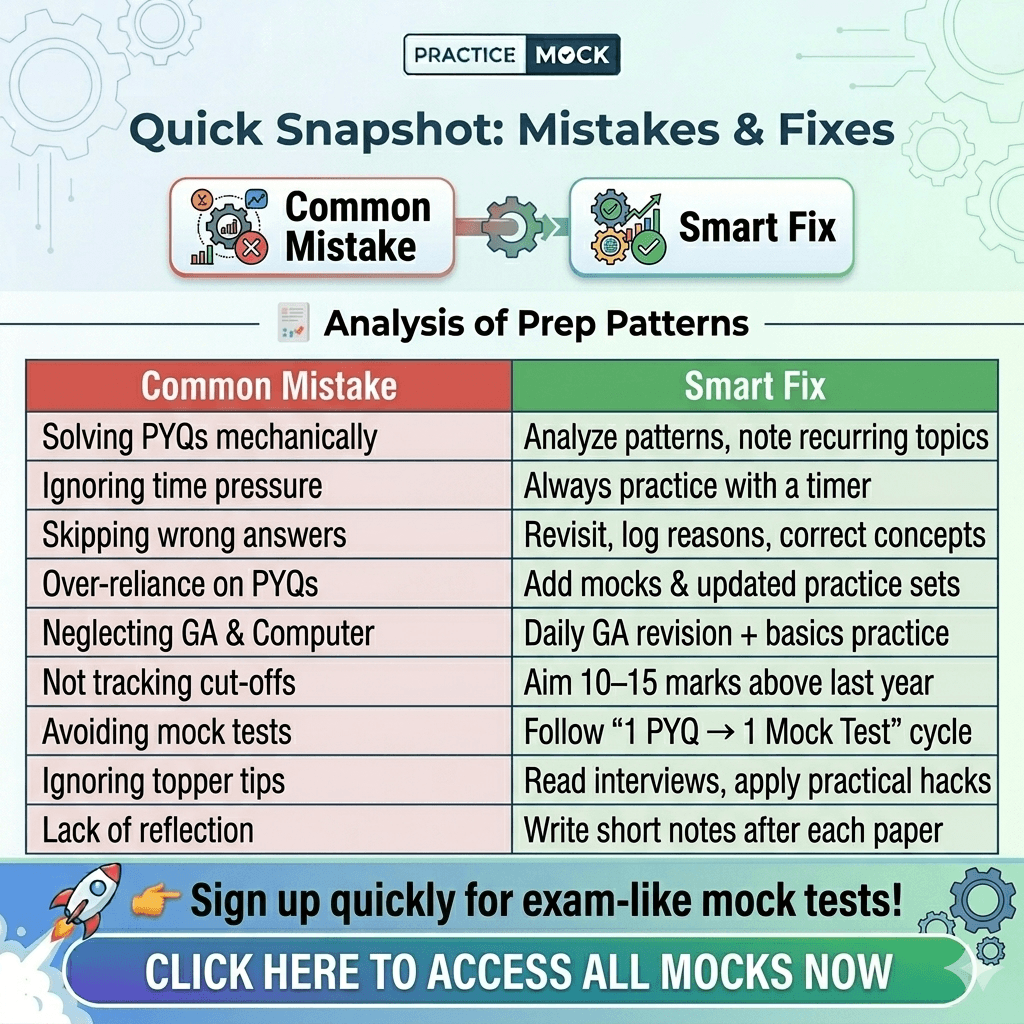
Common mistakes include: Solving mechanically without analysis. Ignoring time pressure, not revisiting wrong answers. Over‑relying on PYQs alone, neglecting GA and Computer sections, and failing to track rising cut‑offs. These reduce the effectiveness of practice and limit improvement. Read the blog above to know the mistakes in detail.
Mock tests simulate the exam environment, testing speed, accuracy, and stamina. Experts recommend a cycle: solve one PYQ → take one mock test → analyze performance → improve in the next round. This ensures steady progress and helps aspirants apply PYQ learnings under time pressure.
Yes, experts predict a higher cut‑off in 2026 due to increased competition and more candidates appearing. Aspirants should aim 10–15 marks above last year’s cut‑off while practicing PYQs to stay safe and competitive.
After solving a PYQ, don’t just check answers and move on—spend time on error analysis. See if your mistakes were due to concepts, calculations, or misreading the question. Note them down in a “mistake logbook,” revise weak areas, and re‑attempt similar problems. Also, reflect on how much time each section took. This simple routine ensures you don’t repeat the same mistakes in the actual exam.
- Sign Up on Practicemock for Updated Current Affairs, Topic Tests and Mini Mocks
- Sign Up Here to Download Free Study Material
Free Mock Tests for the Upcoming Exams
- IBPS PO Free Mock Test
- RBI Grade B Free Mock Test
- IBPS SO Free Mock Test
- NABARD Grade A Free Mock Test
- SSC CGL Free Mock Test
- IBPS Clerk Free Mock Test
- IBPS RRB PO Free Mock Test
- IBPS RRB Clerk Free Mock Test
- RRB NTPC Free Mock Test
- SSC MTS Free Mock Test
- SSC Stenographer Free Mock Test
- GATE Mechanical Free Mock Test
- GATE Civil Free Mock Test
- RRB ALP Free Mock Test
- SSC CPO Free Mock Test
- AFCAT Free Mock Test
- SEBI Grade A Free Mock Test
- IFSCA Grade A Free Mock Test
- RRB JE Free Mock Test
- Free Banking Live Test
- Free SSC Live Test