


The SEBI Grade A 2025 Exam is one of the most prestigious banking and finance recruitment exams in India. The Quantitative Aptitude section plays a major role in both Phase 1 and Paper 1 exams. Among all the important topics, the Quadratic Equation is one of the most scoring and time-efficient chapters, provided you understand the concept well. In this article, we’ll cover the key concepts, formulas, question patterns, and preparation strategy to help you master Quadratic Equations for SEBI Grade A 2025.
What is a Quadratic Equation?
A Quadratic Equation is a polynomial equation of degree 2, generally represented as:

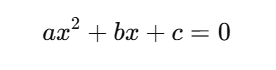
where,
- ( a, b, c ) are constants, and
- ( a ≠ 0 ).
The variable ( x ) is the unknown, and the goal is to find its roots or solutions.
Standard Form & Components
- Standard form → ( ax^2 + bx + c = 0 )
- Coefficient of ( x^2 ) → ( a )
- Coefficient of ( x ) → ( b )
- Constant term → ( c )
The solutions of this equation are called roots of the quadratic equation.
Quadratic Equation Questions PDF Link with Detailed Solution
Download the Quadratic Equation Questions PDF with detailed solutions to practice important questions easily.
This PDF helps you understand each step clearly, learn quick tricks, and improve your speed and accuracy for the exam.
Quadratic Equation Questions PDF Link with Detailed Solution
Types of Questions Asked in SEBI Grade A Exam
In the SEBI Grade A Quant Section, questions on Quadratic Equations usually appear in the comparison-based format, where you have to compare the values of two variables ( x ) and ( y ).
Example Type 1:
Solve the following and find the relation between ( x ) and ( y ).
- ( x^2 + 5x + 6 = 0 )
- ( y^2 + 7y + 10 = 0 )
Step 1: Solve for ( x ):
( x^2 + 5x + 6 = 0 ) → ( (x + 2)(x + 3) = 0 )
⟹ ( x = -2, -3 )
Step 2: Solve for ( y ):
( y^2 + 7y + 10 = 0 ) → ( (y + 2)(y + 5) = 0 )
⟹ ( y = -2, -5 )
Step 3: Compare:
For both roots, ( x ≥ y )
Answer: x ≥ y
Example Type 2:
Find the nature of the roots of ( 2x^2 + 4x + 2 = 0 ).
Here, ( a = 2, b = 4, c = 2 )
( D = b^2 – 4ac = 16 – 16 = 0 )
Roots are real and equal.
Common Tricks for Fast Solving
- Factorisation Method:
Split the middle term for faster root calculation (ideal for simple numbers). - Sign Pattern Recognition:
If both signs before ( x ) and the constant term are positive, both roots are negative, and vice versa. - Use Substitution Technique:
When coefficients are not simple, divide the equation by ( a ) to simplify. - Eliminate Options Smartly:
In comparison-based questions, find approximate roots using basic estimation to save time. - Avoid Square Root Errors:
Always check the discriminant ( D ) carefully to prevent calculation mistakes.
Strategy to Solve Quadratic Equation Questions Fast
When it comes to Quadratic Equation questions in the SEBI Grade A exam, my main focus is on speed and accuracy. Here’s exactly how I solve them step by step
- First, I quickly identify the coefficients (a, b, c) from both equations.
Example: For ( x^2 + 5x + 6 = 0 ), I note down ( a = 1, b = 5, c = 6 ). - Then, I do mental factorisation — I split the middle term into two numbers whose product equals ( a × c ).
For example, ( x^2 + 5x + 6 = 0 ) → ( (x + 2)(x + 3) = 0 )
So, the roots are x = -2 and -3.
I apply the same logic for the second equation and get both roots instantly. - Next, I compare both roots directly.
- If both x-roots are greater → ( x > y )
- If both are smaller → ( x < y )
- If one is greater and one smaller, Relationship cannot be established.
- If the equation looks difficult to factorise, I don’t waste time.
I quickly use the quadratic formula ( x = \frac{-b \pm \sqrt{b^2 – 4ac}}{2a} ) just to get an idea of the approximate roots — enough to compare and mark the right option. - I also use sign patterns to save time:
- If all signs are positive → both roots are negative.
- If the last term is positive and the middle term is negative, both roots are positive.
- If the last term is negative, the roots are of opposite signs.
- If all signs are positive → both roots are negative.
- I simplify equations when needed by dividing all terms by ( a ) if ( a ≠ 1 ). It makes factorisation easier.
- I practice 10–15 quadratic questions daily using a timer (about 30 seconds per question). This helps me stay quick and confident in the exam.
- I double-check signs instead of recalculating everything — that avoids silly mistakes.
Final Words
The Quadratic Equation topic is a must-master chapter for the SEBI Grade A 2025 Exam. It not only tests your conceptual clarity but also helps you score quickly. By practicing regularly, revising formulas, and solving mock tests, you can easily secure 4–5 marks within 3 minutes in this topic.
Join our unique Telegram group immediately to skyrocket your preparation for Regulatory exams via expert guidance, top tips, perfect feedback, and much more!
[ Click Here to join the PracticeMock Telegram Group! ]
[ Click Here to join the PracticeMock Telegram Discussion Group Link! ]
SEBI Grade A Other Article
| SEBI Grade A Syllabus 2025 | SEBI Grade Salary 2025 |
| SEBI Grade A Cut Off 2025 | SEBI Grade A Study Plan 2025 |

- Sign Up on Practicemock for Updated Current Affairs, Topic Tests and Mini Mocks
- Sign Up Here to Download Free Study Material
Free Mock Tests for the Upcoming Exams
- IBPS PO Free Mock Test
- RBI Grade B Free Mock Test
- IBPS SO Free Mock Test
- NABARD Grade A Free Mock Test
- SSC CGL Free Mock Test
- IBPS Clerk Free Mock Test
- IBPS RRB PO Free Mock Test
- IBPS RRB Clerk Free Mock Test
- RRB NTPC Free Mock Test
- SSC MTS Free Mock Test
- SSC Stenographer Free Mock Test
- GATE Mechanical Free Mock Test
- GATE Civil Free Mock Test
- RRB ALP Free Mock Test
- SSC CPO Free Mock Test
- AFCAT Free Mock Test
- SEBI Grade A Free Mock Test
- IFSCA Grade A Free Mock Test
- RRB JE Free Mock Test
- Free Banking Live Test
- Free SSC Live Test