


Many banking aspirants wonder how difficult is the SBI PO compared to the IBPS PO before deciding which exam to prepare for. While both exams recruit Probationary Officers, SBI PO is generally considered more challenging due to its higher competition, unpredictable question patterns, tougher Mains exam, and multi-stage selection process. However, with the right preparation strategy, candidates can crack either exam. In this blog, we’ll compare SBI PO and IBPS PO based on difficulty level, exam pattern, competition, cut-offs, and preparation strategy to help you choose the right exam.
SBI PO vs IBPS PO: Quick Comparison
Many candidates compare these exams because both recruit Probationary Officers in public sector banks. However, the level of competition, question difficulty, and selection process are different. To understand how difficult is the SBI PO compared to the IBPS PO, it is important to compare each stage of the recruitment process.

| Feature | SBI PO | IBPS PO |
| Difficulty Level | High | Moderate to High |
| Competition | Very High | High |
| Prelims | Moderate to Difficult | Moderate |
| Mains | Difficult | Moderate to Difficult |
| Final Selection | Psychometric Test + Group Exercise + Interview | Interview |
| Question Pattern | Frequently changes | More predictable |
| Vacancies | Usually fewer | Usually higher |
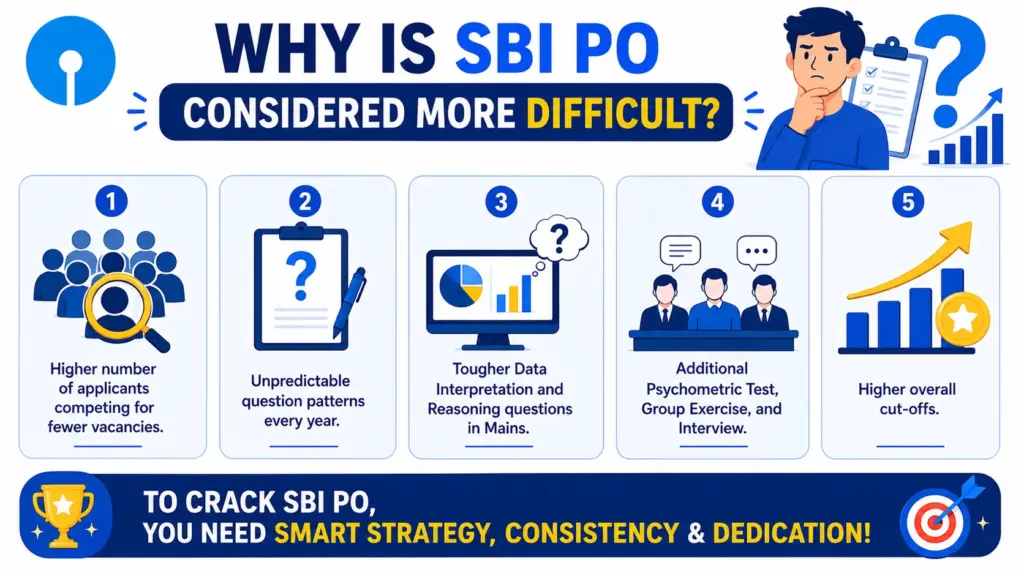
Why is SBI PO Considered More Difficult?
The biggest reason many aspirants ask “How difficult is the SBI PO compared to the IBPS PO?” is because SBI follows a more competitive recruitment process. Apart from testing concepts, SBI also evaluates speed, analytical thinking, decision-making, and leadership skills.
SBI PO vs IBPS PO Prelims Difficulty
The SBI PO and IBPS PO Prelims syllabus of both exams is almost the same. Candidates answer questions from English Language, Quantitative Aptitude, and Reasoning Ability. However, the difficulty level differs in several ways.
English Language
English Language is another section where candidates notice a difference between SBI PO and IBPS PO. Candidates who regularly read newspapers and practise grammar and vocabulary usually perform well in both exams.
SBI PO usually includes
- Lengthy Reading Comprehension passages
- Vocabulary-based questions
- Inference and tone-based questions
- Slightly higher difficulty level
IBPS PO generally focuses on:
- Standard Reading Comprehension
- Cloze Test
- Error Detection
- Para Jumbles and Fill in the Blanks
Quantitative Aptitude
Quantitative Aptitude is one of the sections where candidates notice the biggest difference. Candidates with strong calculation speed usually perform better in both exams.
SBI PO usually includes:
- Lengthier Data Interpretation sets
- Tricky Arithmetic questions
- Calculation-intensive problems
- Slightly higher difficulty level
IBPS PO generally focuses on:
- Standard Arithmetic
- Number Series
- Simplification
- Moderate Data Interpretation
Reasoning Ability
Reasoning Ability is one of the sections where candidates experience the biggest difference between SBI PO and IBPS PO. Candidates who practise puzzles daily and strengthen their logical thinking usually perform well in both exams.
SBI PO usually includes:
- Complex Seating Arrangements
- Multi-variable Puzzles
- Analytical Reasoning
- Unpredictable question patterns
IBPS PO generally focuses on:
- Standard Seating Arrangements
- Familiar Puzzle formats
- Coding-Decoding
- Syllogism and Inequalities
SBI PO vs IBPS PO Mains Difficulty
If someone asks, “How difficult is the SBI PO compared to the IBPS PO?”, the biggest difference becomes clear in the Mains examination.
SBI PO Mains focuses more on analytical thinking than direct problem-solving. Candidates often face lengthy Data Interpretation sets, advanced reasoning questions, and changing exam patterns that require both speed and accuracy.
IBPS PO Mains is also challenging but generally follows a more predictable pattern from previous years.
Data Interpretation
Data Interpretation is one of the major reasons why many candidates believe SBI PO Mains is more challenging than IBPS PO Mains. Unlike IBPS PO, SBI often introduces lengthy and analytical DI sets that require both calculation speed and logical thinking. If you are wondering how difficult is the SBI PO compared to the IBPS PO, the level of Data Interpretation is one of the biggest differences.
SBI PO usually includes:
- Caselet DI
- Paragraph-based DI
- Missing Data DI
- Mixed Graph DI
IBPS PO generally focuses on:
- Standard Bar Graphs
- Line Graphs
- Pie Charts
- Moderate-level Tabular DI
Candidates should regularly practise different DI formats to improve speed, accuracy, and calculation skills for both exams.
Reasoning & Computer Aptitude
The Reasoning & Computer Aptitude section in the SBI PO Mains exam is designed to test analytical ability and decision-making skills. The questions are often more complex and require candidates to think logically under time pressure. Compared to IBPS PO, SBI introduces more unpredictable question patterns in this section.
SBI PO Mains usually includes:
- Advanced Puzzles
- Critical Reasoning
- Logical Reasoning
- Machine Input-Output
IBPS PO generally focuses on:
- Standard Puzzle Sets
- Seating Arrangement
- Logical Reasoning
- Computer Aptitude Basics
Strong puzzle-solving skills and regular mock test practice can help candidates perform well in both exams.
Descriptive Test
Both SBI PO and IBPS PO include a Descriptive Test to assess a candidate’s writing and communication skills. However, the evaluation standard in SBI PO is generally considered more competitive, as candidates are expected to present clear, well-structured, and analytical responses.
SBI PO Descriptive Test usually includes:
- Email Writing
- Situation Analysis
- Report Writing or Precis Writing
- Greater focus on analytical thinking and professional communication
IBPS PO Descriptive Test generally includes:
- Essay Writing
- Letter Writing
- Simple and structured communication-based topics
Reading newspapers regularly and practising writing on current topics can significantly improve performance in the descriptive paper of both exams.
SBI PO vs IBPS PO Selection Process
Another important factor when comparing how difficult is the SBI PO compared to the IBPS PO is the selection process. While both exams have Prelims and Mains stages, SBI PO selection process includes additional assessments before the final selection. The additional Psychometric Test and Group Exercise make the SBI PO recruitment process more comprehensive and competitive.
| Stage | SBI PO | IBPS PO |
| Prelims | Qualifying | Qualifying |
| Mains | Objective + Descriptive | Objective + Descriptive |
| Psychometric Test | ✔ Yes | ✘ No |
| Group Exercise | ✔ Yes | ✘ No |
| Personal Interview | ✔ Yes | ✔ Yes |
Competition, Vacancies, and Cut-Off: How Difficult Is the SBI PO Compared to the IBPS PO?
Competition also plays a major role in deciding how difficult is the SBI PO compared to the IBPS PO. SBI PO generally receives a larger number of applications for comparatively fewer vacancies. As a result, candidates need to score higher marks to qualify for each stage.
SBI PO
- Higher number of applicants
- Fewer vacancies
- Higher cut-offs
- Intense competition
IBPS PO
- Large number of vacancies across multiple public sector banks
- Relatively lower cut-offs
- High competition, but comparatively easier than SBI PO
Although both exams are competitive, SBI PO usually demands better accuracy and overall performance.
Which Exam is Better: SBI PO or IBPS PO?
Many aspirants prepare for both exams together because the syllabus is largely similar. Choosing between SBI PO and IBPS PO depends on your career goals, preparation level, and the type of challenges you are ready to face. If you are wondering how difficult is the SBI PO compared to the IBPS PO, understanding the differences in career opportunities, competition, and exam pattern can help you make the right choice.
Choose SBI PO if you:
- Want to work in India’s largest public sector bank.
- Are comfortable with a challenging exam.
- Want faster career growth opportunities.
- Are willing to prepare for an unpredictable exam pattern.
Choose IBPS PO if you:
- Prefer a comparatively predictable exam pattern.
- Want opportunities across multiple public sector banks.
- Are looking for a slightly less demanding selection process.
Difficulty Comparison: SBI PO vs IBPS PO
If you are still wondering how difficult is the SBI PO compared to the IBPS PO, the comparison table below provides a quick overview of the key differences in difficulty level, exam pattern, competition, cut-offs, and the final selection process.
| Parameter | SBI PO | IBPS PO |
| Overall Difficulty | High | Moderate to High |
| Question Pattern | Unpredictable | More Predictable |
| Reasoning Level | Difficult | Moderate |
| Data Interpretation | Advanced | Moderate |
| Competition | Very High | High |
| Cut-Off | Higher | Moderate |
| Final Selection | More Comprehensive | Simpler |
How to Prepare for Both SBI PO and IBPS PO Together
Since nearly 80–90% of the syllabus is common, candidates can prepare for both exams simultaneously. A smart bank PO preparation strategy helps you cover common topics while making small adjustments for each exam’s unique pattern. Regular mock tests, previous year papers, and revision will strengthen your SBI PO and IBPS PO preparation and improve your overall performance.
Step 1: Build Strong Basics
Complete the syllabus for:
- Quantitative Aptitude
- Reasoning Ability
- English Language
Step 2: Practice Daily
Regular practice improves speed and accuracy.
- Solve Topic-wise questions
- Sectional tests
- Previous Year Papers
Step 3: Attempt Mock Tests
Take full-length mock tests every week. Mock analysis is one of the most important parts of banking exam preparation.
After each mock:
- Analyse mistakes.
- Identify weak topics.
- Improve time management.
- Revise difficult concepts.
Common Myths About SBI PO and IBPS PO
Many candidates have misconceptions about these exams. Knowing the facts helps you prepare with the right mindset. Understanding how difficult is the SBI PO compared to the IBPS PO can help you avoid common myths and focus on the right preparation strategy instead of assumptions.
Myth 1: SBI PO is impossible to crack.
Reality: SBI PO is challenging, but thousands of candidates clear it every year with consistent preparation and regular mock practice. A well-planned study schedule and strong time management can significantly improve your chances of success.
Myth 2: IBPS PO is an easy exam.
Reality: BPS PO is also highly competitive and requires thorough preparation across all subjects. Ignoring the exam because it seems easier can reduce your chances of clearing the cut-off.
Myth 3: You need separate preparation for both exams.
Reality: Most of the syllabus is common. Candidates can prepare for both exams together with a few exam-specific adjustments. Regular mock tests help you understand the unique question patterns of each exam.
Myth 4: Only coaching students clear SBI PO.
Reality: Many aspirants crack SBI PO through self-study by following a structured study plan and practising consistently. Using quality study resources and analysing mock tests regularly can be just as effective as classroom coaching.
Do’s and Don’ts While Preparing for SBI PO and IBPS PO
Preparing smartly is more important than studying for long hours. Following the right strategy, practising regularly, and analysing your performance can help you perform well in both exams and improve your overall score.
| Do’s | Don’ts |
| Complete the syllabus first. | Skip basic concepts. |
| Practise mock tests regularly. | Ignore mock analysis. |
| Improve calculation speed. | Spend too much time on one question. |
| Revise every week. | Learn shortcuts without understanding concepts. |
| Solve previous year papers. | Compare your preparation with others. |
Final Thoughts
After comparing every stage, the answer to how difficult is the SBI PO compared to the IBPS PO is clear. SBI PO is generally considered more challenging because of its unpredictable paper pattern, tougher Mains exam, higher competition, and additional selection stages. However, both exams require strong conceptual knowledge, regular practice, and effective time management.
Candidates should not focus only on the difficulty level. Instead, they should build a strong foundation, practise mock tests, and revise consistently. With the right preparation strategy, clearing both SBI PO and IBPS PO is completely achievable.
Related Blogs
| Related PracticeMock Blog | |
| SBI PO Exam Pattern 2026: From Prelims to Interview | SBI PO Exam Pattern 2026: From Prelims to Interview |
| SBI PO Selection Process 2026 | SBI PO Selection Process 2026 |
| SBI PO Preparation Strategy Without Coaching for Prelims 2026 | SBI PO Preparation Strategy Without Coaching for Prelims 2026 |
| Topics for Reasoning to Maximise Your SBI PO Score 2026 | Topics for Reasoning to Maximise Your SBI PO Score 2026 |
| SBI PO Mock Test Attempt Order Strategy 2026 | SBI PO Mock Test Attempt Order Strategy 2026 |
| SBI PO Mock Question Selection Strategy 2026 | SBI PO Mock Question Selection Strategy 2026 |
| SBI PO Previous Year Question Papers | SBI PO Previous Year Question Papers |
| SBI PO Mock Test | SBI PO Mock Test |
FAQs
1. How difficult is the SBI PO compared to the IBPS PO?
SBI PO is generally considered more difficult than IBPS PO because of its higher competition, tougher Mains exam, unpredictable question patterns, and additional selection stages.
2. Is SBI PO tougher than IBPS PO Mains?
Yes. SBI PO Mains usually includes more analytical Data Interpretation, advanced Reasoning questions, and changing question patterns, making it comparatively tougher.
3. Can I prepare for SBI PO and IBPS PO together?
Yes. Around 80–90% of the syllabus is common. With a smart study plan, candidates can prepare for both exams simultaneously.
4. Which exam has higher competition, SBI PO or IBPS PO?
SBI PO generally has higher competition because it attracts more applicants while offering comparatively fewer vacancies.
5. Is the SBI PO interview tougher than the IBPS PO interview?
SBI PO has a more comprehensive final selection process that includes a Psychometric Test, Group Exercise, and Personal Interview, making it more challenging than the IBPS PO interview.
6. Should I choose SBI PO or IBPS PO?
If you are aiming for faster career growth and are comfortable with a challenging selection process, SBI PO is a great choice. However, preparing for both exams together gives you more opportunities to secure a Probationary Officer position.
7. Which pays more, SBI PO or IBPS PO?
SBI PO generally offers a higher overall salary package, better allowances, and faster career growth opportunities than IBPS PO. However, both jobs provide attractive pay, job security, and promotion prospects in the banking sector.
8. Which bank PO exam is the toughest?
SBI PO is widely considered the toughest bank PO exam in India because of its unpredictable question pattern, higher competition, challenging Mains exam, and multi-stage selection process. IBPS PO is also competitive but follows a comparatively more predictable exam pattern.
9. Can SBI PO earn ₹2 lakh per month?
Yes. An SBI PO can earn around ₹2 lakh per month after several promotions and by reaching senior management positions. The starting salary is much lower, but it increases steadily with experience, promotions, and additional allowances.
- Sign Up on Practicemock for Updated Current Affairs, Topic Tests and Mini Mocks
- Sign Up Here to Download Free Study Material
Free Mock Tests for the Upcoming Exams
- IBPS PO Free Mock Test
- RBI Grade B Free Mock Test
- IBPS SO Free Mock Test
- NABARD Grade A Free Mock Test
- SSC CGL Free Mock Test
- IBPS Clerk Free Mock Test
- IBPS RRB PO Free Mock Test
- IBPS RRB Clerk Free Mock Test
- RRB NTPC Free Mock Test
- SSC MTS Free Mock Test
- SSC Stenographer Free Mock Test
- GATE Mechanical Free Mock Test
- GATE Civil Free Mock Test
- RRB ALP Free Mock Test
- SSC CPO Free Mock Test
- AFCAT Free Mock Test
- SEBI Grade A Free Mock Test
- IFSCA Grade A Free Mock Test
- RRB JE Free Mock Test
- Free Banking Live Test
- Free SSC Live Test