


The RBI Assistant Exam 2026 is just a few days away! While Prelims test English, Quantitative Aptitude, and Reasoning, the General Awareness (GA) section in Mains often becomes the deciding factor. GA in Mains exam carries the highest weightage, and aspirants who master it gain a clear edge over competitors. In the RBI Assistant Mains exam, the General Awareness (GA) section carries about 40 marks, and Current Affairs alone accounts for nearly half of it—roughly 15–20 questions (40–50% weightage).GA requires consistent preparation, revision, and awareness of current events. This blog provides a detailed roadmap to prepare GA strategically, using PYQ insights, exam trends, and smart study techniques.
Importance of General Awareness Section
GA is not just another section. It is the game‑changer in the RBI Assistant Mains exam. PYQ analysis shows GA contributes 35–40% of the total marks, making it the most scoring section if prepared well. Unlike puzzles or DI, GA questions are straightforward: either you know the answer or you don’t. This binary nature makes GA a high‑risk, high‑reward section.

Aspirants who neglect GA often struggle to clear cut‑offs, while those who prepare systematically can secure a comfortable margin. With the exam dates fixed, GA preparation must begin immediately and continue consistently until Mains.
Syllabus Coverage for GA
The GA syllabus for RBI Assistant is broad but predictable. PYQs reveal recurring themes every year.
Key Areas to Cover:
- Current Affairs (6–8 months before exam)
- National & International events
- Sports, awards, appointments, summits
- Government schemes & policies
- Banking Awareness
- RBI functions, monetary policy, financial inclusion
- Banking terms, digital banking, UPI, NEFT, RTGS
- Static GK
- Capitals, currencies, national parks, dams, important days
- Economy & Finance
- Budget highlights, economic survey, inflation trends
- RBI Updates
- Circulars, reports, committees, new initiatives
PYQs confirm that current affairs + banking awareness dominate GA.
Section‑Wise GA Weightage (RBI Assistant 2026 Mains)
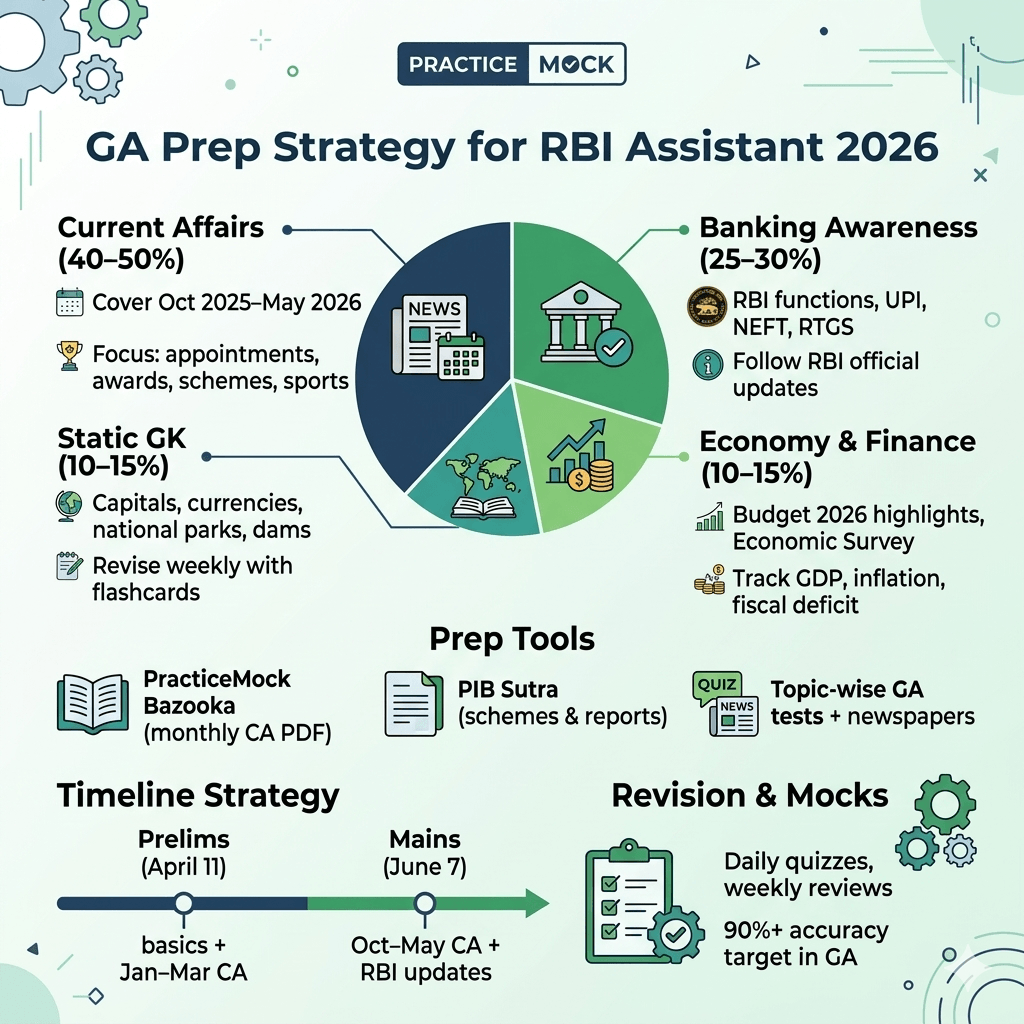
Understanding the distribution of GA topics helps aspirants prioritize preparation. By knowing which areas carry more marks, students can allocate study time effectively, focus on high‑yield sections, and maximize scoring potential in the Mains exam.
| GA Component | Approx. Weightage | Typical Question Count | Key Focus Areas |
| Current Affairs | 40–50% | 15–20 | Appointments, awards, sports, summits, schemes, international events |
| Banking Awareness | 25–30% | 10–12 | RBI functions, monetary policy, digital banking, UPI, NEFT, RTGS |
| Static GK | 10–15% | 4–6 | Capitals, currencies, national parks, dams, important days |
| Economy & Finance | 10–15% | 4–6 | Budget highlights, economic survey, GDP, inflation trends |
NOTE:
- Current Affairs dominates GA: Almost half of GA questions are from recent events.
- Coverage window: Prepare October 2025 – May 2026 current affairs for Mains.
- Banking Awareness is second most important: 25–30% weightage, often RBI‑centric.
- Static GK & Economy: Smaller share but predictable and easy to score with revision.
GA Preparation Resources
Preparing GA requires structured tools, not scattered reading. Reliable resources like Bazooka, PIB Sutra, topic‑wise tests, and newspapers ensure complete coverage, systematic revision, and exam‑oriented practice for RBI Assistant 2026 aspirants.
PracticeMock’s Bazooka: Monthly Current Affairs
Bazooka is a monthly PDF covering national/international news, awards, sports, finance, schemes, and obituaries.
Why it works: concise exam‑oriented coverage, quick multi‑month revision, free download anytime. Just 20–25 minutes daily builds retention and reduces last‑minute stress—a one‑stop Phase 1 GA solution.
GA Topic‑Wise Tests
Topic‑wise tests replicate exam GA questions and highlight strengths/weaknesses.
How to use: attempt 1–2 tests daily, cover 7 topics systematically, track improvement. Combined with Bazooka + PIB Sutra, these sharpen accuracy and speed under exam conditions.
Newspapers & Other Resources
Newspapers like The Hindu, Business Standard, Mint, and Economic Times add depth.
Focus areas: editorials for analysis, budget/finance updates, government policies. Spend 30 minutes daily, then combine with Bazooka + PIB Sutra for complete GA coverage.
Other Sources for GA Preparation
Choosing reliable sources saves time and prevents confusion. Daily capsules, monthly PDFs, RBI releases, and budget highlights provide concise, exam‑oriented material that matches PYQ trends and scoring needs.
- Daily Current Affairs Capsules
- Monthly Compilations (PDFs covering events month‑wise)
- RBI Official Website (press releases, circulars, reports)
- Economic Survey & Budget Highlights
- Static GK Notes (one‑time preparation + regular revision)
Rule: Daily + Monthly + RBI official updates = Complete GA coverage.
PYQ Insights for GA
Past papers reveal recurring GA themes. Appointments, banking terms, RBI updates, and current affairs dominate. PYQ analysis helps aspirants prioritize topics that consistently appear and carry higher weightage.
Analyzing past RBI Assistant papers reveals clear patterns:
- Appointments & Awards: 2–3 questions every year.
- Banking & RBI: 5–6 questions consistently.
- Current Affairs (last 6 months): 10–12 questions.
- Static GK: 3–4 questions.
- Economy & Finance: 2–3 questions.
This confirms that current affairs and banking awareness are the backbone of GA.
Timeline‑Based Preparation Strategy
With Prelims in April and Mains in June, GA prep must be phased. Cover basics before Prelims, then intensify revision and expand current affairs coverage during the Mains window.
Phase 1: Prelims Window (March–April)
- Build a daily habit of reading GA capsules.
- Cover January–March 2026 current affairs thoroughly.
- Revise static GK once a week.
- Start RBI & banking awareness basics.
Phase 2: Mains Window (April–June)
- Intensify GA preparation after Prelims.
- Cover October 2025–May 2026 current affairs.
- Revise banking awareness in detail.
- Focus on RBI updates, budget, and economic survey.
- Practice GA quizzes daily for speed.
By June 7, aspirants should have 6–8 months of GA fully revised.
Section‑Wise Strategy
Breaking GA into current affairs, banking awareness, static GK, and economy ensures systematic coverage. Each section requires tailored methods—daily reading, weekly revision, and focused practice for strong recall.
Current Affairs
- Read daily capsules for quick updates.
- Revise monthly PDFs for consolidation.
- Maintain a personal notebook of key facts.
- Focus on events from October 2025 onwards.
Banking Awareness
- Understand RBI’s role, monetary policy, and financial terms.
- Revise PYQs on UPI, NEFT, RTGS, and digital banking.
- Follow RBI press releases for authentic updates.
Static GK
- Prepare one‑time notes on capitals, currencies, dams, national parks.
- Revise weekly to keep facts fresh.
- Use mnemonics for memory retention.
Economy & Finance
- Focus on Budget 2026 highlights.
- Cover Economic Survey key points.
- Track inflation, GDP, and fiscal deficit trends.
Mock Test Strategy for GA
Mocks simulate exam conditions and test recall speed. Attempting quizzes daily and analyzing mistakes builds accuracy. Regular practice ensures GA becomes a scoring section rather than a weak spot.
Here’s what you need to master this section via mock tests:
- Attempt GA quizzes daily (10–15 questions).
- Take full‑length mocks weekly.
- Analyze mistakes and revise weak areas.
- Track accuracy—GA requires 90%+ accuracy.
Revision Plan
Revision keeps facts fresh and boosts confidence. Weekly reviews, monthly PDF revisions, and flashcards help aspirants retain information. Consistent revision ensures GA knowledge remains sharp until exam day.
- Revise daily notes every weekend.
- Revisit monthly PDFs at least 3 times.
- Use flashcards for static GK.
- Practice GA quizzes for recall speed.
Rule: Revise until recall feels effortless.
Common Mistakes to Avoid in GA Prep
Neglecting GA until after Prelims, skipping banking awareness, or ignoring revision are costly errors. Avoiding these mistakes ensures aspirants maximize GA scores and strengthen their overall exam performance.
- Ignoring GA until after Prelims. This wastes valuable time.
- Reading random news articles. Stick to exam‑oriented sources.
- Neglecting banking awareness. PYQs show it’s a high‑weight area.
- Skipping revision. GA is memory‑based; revision is non‑negotiable.
Final Word
The RBI Assistant 2026 Exam demands smart GA preparation. With Prelims on April 11 and Mains on June 7, aspirants must begin now. PYQ analysis proves that current affairs (6–8 months), banking awareness, and RBI updates dominate GA. By following a structured plan—daily capsules, monthly PDFs, RBI releases, and consistent revision—candidates can turn GA into their strongest section.
FAQs
GA carries the highest weightage in Mains and often decides the final selection.
At least 6–8 months before the exam, from October 2025 to May 2026.
Banking awareness, RBI updates, budget highlights, and recent appointments.
Daily capsules, monthly PDFs, RBI official website, and budget/economic survey notes.
Use weekly reviews, monthly PDF revisions, and daily quizzes for recall speed.
- Sign Up on Practicemock for Updated Current Affairs, Topic Tests and Mini Mocks
- Sign Up Here to Download Free Study Material
Free Mock Tests for the Upcoming Exams
- IBPS PO Free Mock Test
- RBI Grade B Free Mock Test
- IBPS SO Free Mock Test
- NABARD Grade A Free Mock Test
- SSC CGL Free Mock Test
- IBPS Clerk Free Mock Test
- IBPS RRB PO Free Mock Test
- IBPS RRB Clerk Free Mock Test
- RRB NTPC Free Mock Test
- SSC MTS Free Mock Test
- SSC Stenographer Free Mock Test
- GATE Mechanical Free Mock Test
- GATE Civil Free Mock Test
- RRB ALP Free Mock Test
- SSC CPO Free Mock Test
- AFCAT Free Mock Test
- SEBI Grade A Free Mock Test
- IFSCA Grade A Free Mock Test
- RRB JE Free Mock Test
- Free Banking Live Test
- Free SSC Live Test