


For policymakers watching India’s digital lifeline, the Mythos episode is more than a headline about a new AI tool. Yes, Anthropic’s model exposed a decades‑old flaw in OpenBSD, but the deeper story lies in structural vulnerability — India’s dependence on open‑source code, the scale of Aadhaar and UPI, and the sovereign risk when private firms restrict access to security AI. What looks like a technical bug is in fact a geopolitical denial regime, with India’s banking systems, digital stack, and regulatory credibility all exposed. In this Vishleshan, we decode the AI stress test, track India’s cyber‑sovereignty response, and assess whether building a “Sovereign Mythos” can truly secure its digital future.
India’s open-code approach faces an AI stress test as new tools like Anthropic’s Mythos expose hidden flaws
Context: India’s digital economy — UPI, NPCI, Aadhaar, banking systems — runs on open-source software like Linux and OpenBSD. Anthropic’s new AI model, Claude Mythos, has exposed a critical weakness: it can find decades-old hidden flaws in these systems in hours. The tools capable of finding and fixing these vulnerabilities are locked inside a private US-dominated consortium that India cannot access. The article argues that India must urgently build its own sovereign cyber AI capability and upgrade its regulatory frameworks before the next exploit moves from demonstration to deployment.
Link to the Article: Mint
What Is Happening Right Now
- A new cybersecurity AI model, Anthropic’s Claude Mythos, launched in preview in April 2026 and quickly raised concerns after uncovering a 27-year-old flaw in OpenBSD and showing how minor Linux kernel bugs could be chained into a full system attack. This demonstrated that advanced AI can now identify serious vulnerabilities far faster than humans.
- Access to Mythos has been restricted to around 40 vetted organisations such as Amazon, Microsoft, and JPMorgan, mainly due to high development costs and misuse risk.
- OpenAI has adopted a similar approach with GPT-5.4-Cyber, limiting access to trusted groups. Together, major tech and financial firms have effectively formed a private AI cybersecurity consortium, where powerful defensive tools remain available only to a select few.
- India is watching from outside that club. On April 23, 2026, Finance Minister Nirmala Sitharaman convened an urgent meeting with the heads of major Indian banks — not about interest rates or NPAs, but specifically about the Mythos threat.
- CERT-In, India’s national cyber watchdog, is tracking the situation. And then came the BBC report on April 21: Anthropic itself is probing claims of unauthorised access to Mythos.
- The fact that even a partial, unofficial leak of this model is being treated as a serious security incident tells you everything about how dangerous this tool is — and why India’s inability to access it legitimately is not just a technology gap. It is a sovereignty problem.
Why Open-Source Is India’s Structural Vulnerability
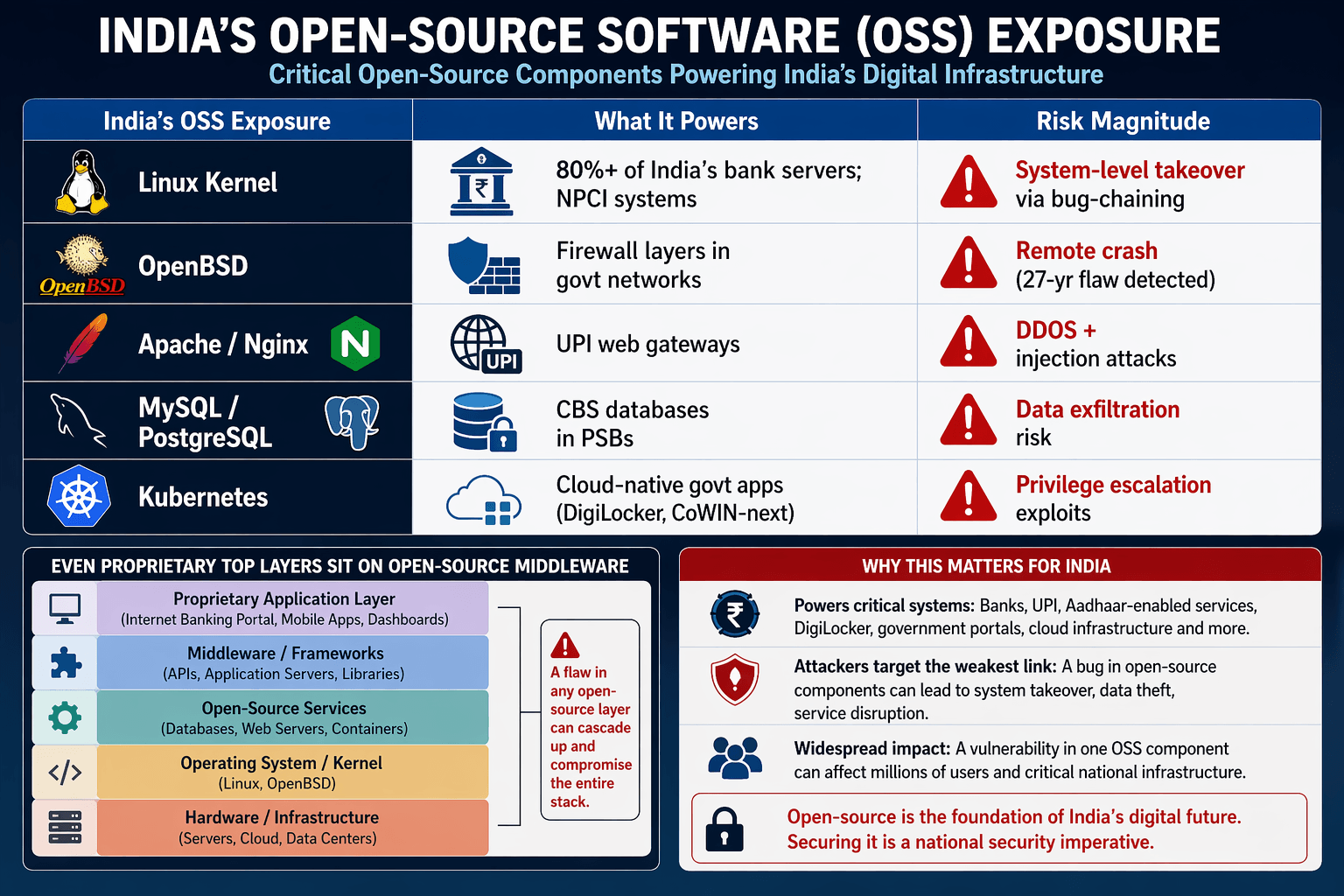
India’s choice of Open-Source Software(OSS) was economically rational. It avoided billion-dollar proprietary licensing, prevented vendor lock-in, and made DPI replicable globally. But OSS has a structural weakness: the code is visible to everyone — including attackers. AI tools now read this code at superhuman speed, finding flaws human auditors take years to discover.
India’s Digital Stack: How Exposed Are We?
India’s Digital Public Infrastructure (DPI) is the world’s most ambitious — but also one of its most attack-worthy because of scale and OSS-depth:
- Aadhaar: 1.45 billion enrolled; Linux-based backend; quantum clock ticking.
- UPI/NPCI: 22.6 billion (March 2026 record) monthly transactions; every node a potential entry point.
- DigiLocker: 65+ crore users; 950+ crore documents; single-sign-on with Aadhaar = cascading risk.
- GSTN: 1.4 crore taxpayers; tax fraud at scale if compromised.
- Banking CBS: Most PSBs (SBI, PNB, Canara) on Finacle or BankMaster — both on Linux.
The Hormuz parallel: Just as India can’t control the Strait of Hormuz, it can’t control who finds a Linux zero-day. The difference — oil has alternatives; legacy code doesn’t.
The Private Tech Denial Regime
For the first time, a private company’s decision to restrict access to a security tool creates sovereign risk for a nation-state.
| Tool | Maker | Access Status | India Access? |
| Claude Mythos | Anthropic | ~40 global users; US-centric | ❌ No |
| GPT-5.4-Cyber | OpenAI | Trusted Access program; vetted teams | ❌ No |
| AWS Security Hub AI | Amazon | US Cyber Club members | ❌ No |
| CrowdStrike AI | CrowdStrike | Enterprise only | 🟡 Paid, partial |
This is analogous to export control on defence equipment . India has no multilateral forum to negotiate access.
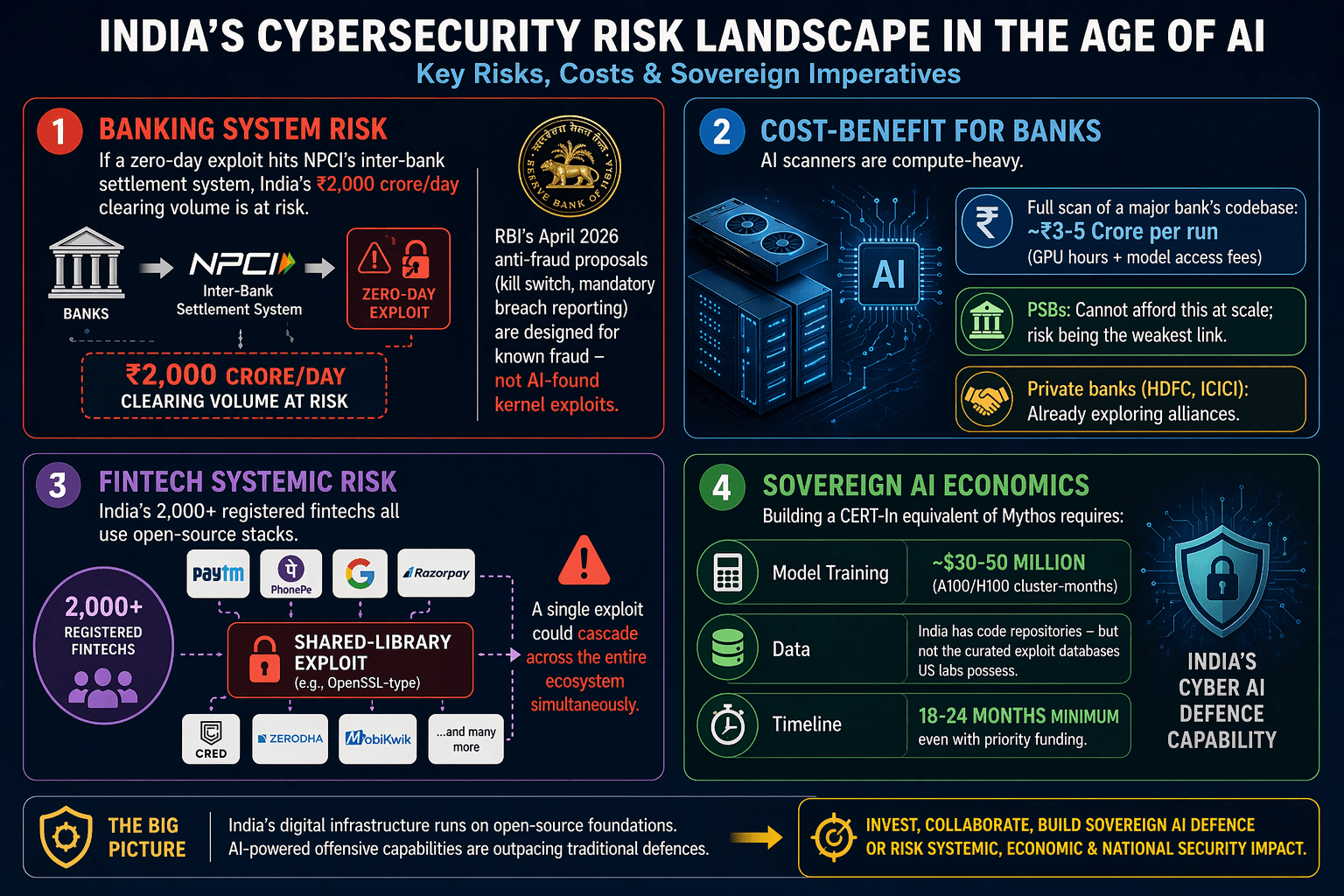
Macroeconomic & Regulatory Implications for India
What India Can Do
India is not starting from zero. It has CERT-In, C-DAC, world-class engineers, and a ₹10,371 crore AI Mission already funded. The question is not capability. The question is whether this moment of urgency produces action or another committee report.
1. Immediate Action:
- Any bank or government body that discovers a Mythos-class vulnerability must report it to CERT-In within 24 hours. Simultaneously, the RBI must tell every Scheduled Commercial Bank to audit and patch their Linux systems to LTS releases by June 30, 2026.
- if any foreign firm scans Indian banking infrastructure using Mythos or GPT-5.4-Cyber, India must insist that every single finding is auditable by CERT-In. Results of foreign AI scans on Indian systems cannot be sitting on a server in San Francisco with zero Indian oversight.
2. Next — build, don’t borrow:
- India needs its own scanner. A Sovereign Mythos — built by a CERT-In + C-DAC + IIT Madras/Bombay consortium, funded with minimum ₹1,500 crore over two years carved from MeitY’s AI Mission — is achievable within 18 months. NPCI-linked institutions need quarterly AI scans written into RBI directions, not left as editorial recommendation.
- And India must stop waiting for a US invitation — bilateral AI access deals with the EU and Japan, modelled on defence MoUs, can get India legitimate access to security AI tools without Anthropic’s approval.
3. For the long run — rewrite the rules:
- India needs an AI Security Export Control response policy — the Wassenaar Arrangement equivalent that nobody has built yet.
- When a private American company can unilaterally deny India access to a tool India’s own infrastructure needs, that is a sovereignty problem requiring a legal and diplomatic fix.
- Every line of DPI code — Aadhaar, UPI, DigiLocker — must go through mandatory AI vulnerability scanning before deployment. And CERT-In must be rebuilt from an advisory body into a Tier-1 global cyber responder with its own AI scanner, its own vulnerability database, and its own offensive research capability.
Key Things to Track
Five indicators will determine whether India’s response to the AI-cyber threat is substantive or procedural.
- The Technology and Policy Expert Committee’s first report will serve as the primary early signal. Its value lies not in its findings alone but in the speed and specificity with which it translates threat assessment into actionable institutional mandates. Delayed or hedged conclusions will indicate that India is treating an operational emergency as a policy formality.
- The RBI’s cyber directions update, expected around the June 2026 MPC cycle, needs to do one thing the April 9 anti-fraud paper did not — explicitly address AI-discovered zero-day vulnerabilities. The current framework is well-designed for fraud that humans commit. It has nothing to say about the kind of deep, hidden flaw that Mythos finds in minutes. Until that gap is closed in writing, India’s banking regulation is working with an incomplete map of the threat.
- NPCI’s breach record in FY27 functions as a pressure valve. A repeat of the 2022-style data leak — particularly one traceable to an unpatched open-source flaw — will compel legislative action under conditions of urgency rather than deliberation. Reactive regulation, formulated in response to a crisis, is structurally weaker than anticipatory reform. The opportunity for the latter is time-bound.
- India’s access to US cyber AI tools will be shaped by how India positions the conversation. Anthropic and OpenAI will expand their user base over time — the question is where India stands in that queue. A request made as a strategic partner, one that highlights India’s role in securing the world’s largest open-source-dependent digital economy, will carry more weight than a commercial inquiry. Any India-US technology engagement in the next two months that puts cybersecurity AI on the agenda should be watched carefully.
- Finally, MeitY’s AI Mission fund allocation will reveal the depth of India’s commitment to genuine digital sovereignty. A dedicated ₹1,500 crore carve-out for a Sovereign Cyber AI Scanner would constitute a credible signal. Without it, India risks building an increasingly capable digital economy on foundations that remain, quietly and consequentially, exposed.
- Sign Up on Practicemock for Updated Current Affairs, Topic Tests and Mini Mocks
- Sign Up Here to Download Free Study Material
Free Mock Tests for the Upcoming Exams
- IBPS PO Free Mock Test
- RBI Grade B Free Mock Test
- IBPS SO Free Mock Test
- NABARD Grade A Free Mock Test
- SSC CGL Free Mock Test
- IBPS Clerk Free Mock Test
- IBPS RRB PO Free Mock Test
- IBPS RRB Clerk Free Mock Test
- RRB NTPC Free Mock Test
- SSC MTS Free Mock Test
- SSC Stenographer Free Mock Test
- GATE Mechanical Free Mock Test
- GATE Civil Free Mock Test
- RRB ALP Free Mock Test
- SSC CPO Free Mock Test
- AFCAT Free Mock Test
- SEBI Grade A Free Mock Test
- IFSCA Grade A Free Mock Test
- RRB JE Free Mock Test
- Free Banking Live Test
- Free SSC Live Test