



For policymakers tracking India’s reserve strategy, RBI’s decision to bring gold back home is more than a logistics headline. Yes, vaulting 680 tonnes in Mumbai and Nagpur may look like a technical shift, but the deeper story lies in geopolitics and cost structure — the quiet exit from foreign custodians, the rising share of gold in forex reserves, and the symbolism of sovereignty in a volatile world. What looks like a storage decision is in fact a silent reset of India’s reserve philosophy, with confidence signals, cost savings, and risk trade‑offs all embedded. In this Vishleshan, we decode why gold is flowing inward, how the numbers reveal a dollar‑gold tradeoff, and what this repositioning means for India’s financial armour in 2026.
Why RBI wants to keep India’s gold at home
Context: Most Indians understand gold as a personal asset — jewellery, sovereign gold bonds, a rainy-day hedge. What is less understood is that the RBI itself is one of the world’s most active gold repatriators right now — quietly but rapidly pulling its reserves from vaults in London and Basel and locking them into domestic custody. With 77% of India’s 880-tonne gold now held at home and gold’s share of forex reserves at a record 16.7%, this is not just a logistics story. It is a signal about how India perceives global financial order, sovereign risk, and the future of reserve management.
Link to the Article: Mint
India’s Invisible Shift in Reserve Philosophy
For most of the post-liberalisation era, India parked the bulk of its gold at the Bank of England and the Bank for International Settlements — trusted custodians of the post-Bretton Woods financial architecture. As of March 2023, only 37.9% of India’s gold was held domestically. By March 2026, that number had surged to 77.2%, with 680 metric tonnes now stored within India — the largest domestic gold repositioning since 1991, though unlike that event, driven by geopolitical caution rather than financial distress. For the average Indian, this shift feels abstract — until you realise that the gold now sitting in Mumbai’s vaults is the same asset that once left Indian shores under a midnight airlift to pay our creditors.
What Are RBI’s Forex Reserves and How Are They Managed
India’s foreign exchange reserves are the external financial assets held by the RBI on behalf of the nation, used to support the rupee, manage balance of payments stress, and signal macroeconomic confidence to global investors. As of 24 April 2026, total reserves stood at $698.5 billion — among the top five largest reserve pools in the world.
The reserves have four components managed under distinct strategies.
- Foreign currency assets (FCAs) form the largest share at 79% ($552.28 billion) and are invested in three buckets:
- securities (primarily US Treasuries, bonds of AAA-rated sovereigns, and supranational bonds at $465.61 billion),
- deposits with other central banks and BIS ($46.83 billion),
- and deposits with commercial banks overseas ($39.84 billion).
- Gold now accounts for 16.7% of total reserves — up sharply from 7.8% in April 2023.
- Special Drawing Rights (SDRs), which are IMF-issued reserve assets that India holds as part of its IMF membership, form a small share.
- Reserve tranche position at the IMF — India’s paid-in quota that it can draw on unconditionally — makes up the remainder.
RBI manages these reserves through the twin objectives of safety and liquidity first, returns second — a principle enshrined in RBI’s reserve management guidelines.
This means the priority is always ensuring that India can meet any sudden external payment obligation, defend the rupee in a crisis, or absorb an external shock — not maximising yield. This is precisely why gold is rising in importance: it is the only reserve asset that is simultaneously liquid in global markets, free from counterparty risk, immune to foreign-jurisdiction control, and uncorrelated with dollar-asset volatility.
Why Gold Is Coming Home — Four Drivers
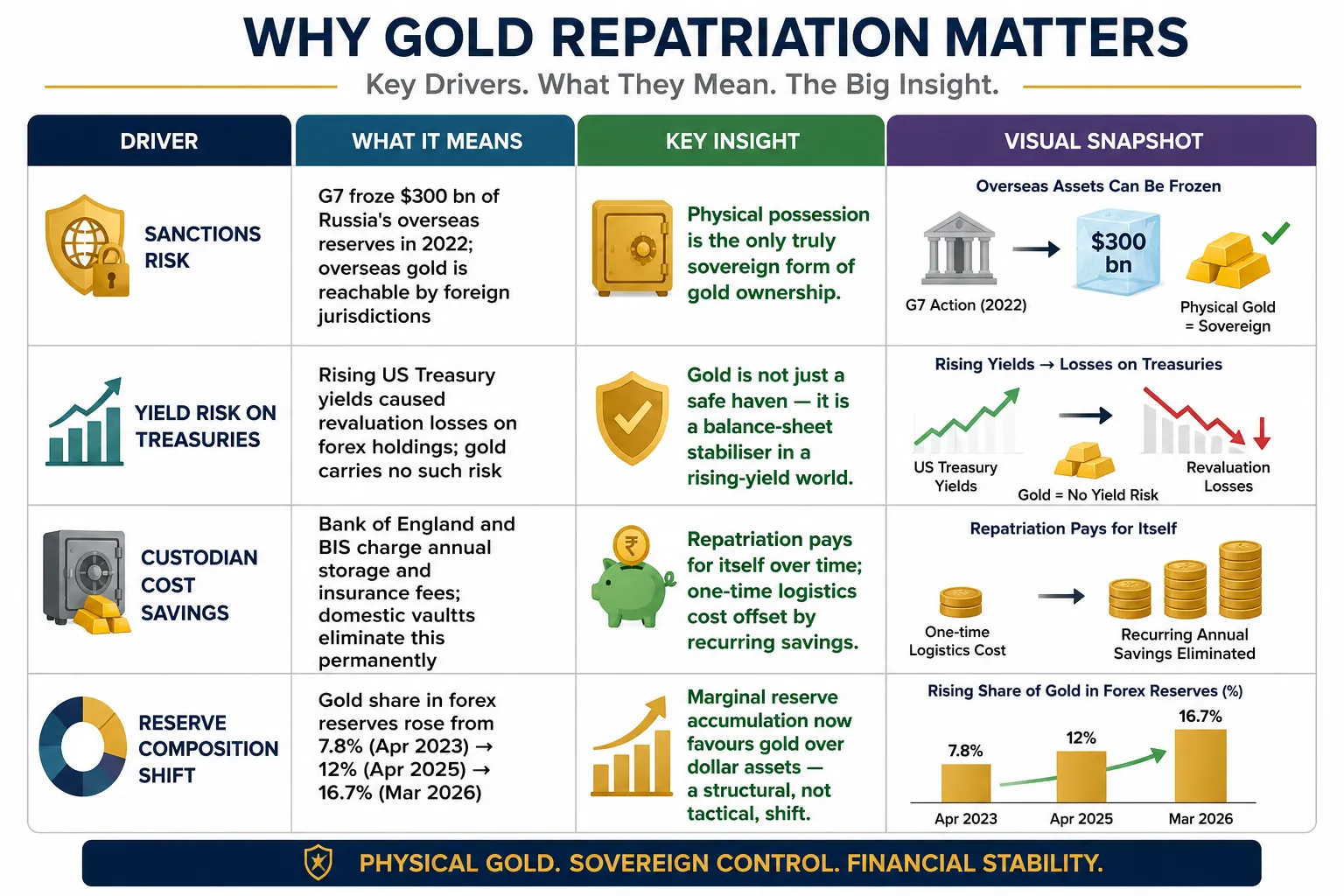
Three Layers the Headline Does Not Tell
Layer 1 — The 1991 Echo That Is Actually the Opposite
- The last time India’s gold featured prominently in national headlines was 1991, when India physically airlifted 67 tonnes of gold across two tranches — 47 tonnes to the Bank of England and Bank of Japan, and 20 tonnes to the Union Bank of Switzerland — to raise $600 million as emergency collateral.
- That was gold leaving India under financial compulsion. The current exercise is the exact inverse — gold flowing into India from a position of strength, with forex reserves at $698.5 billion and no external funding pressure.
- Countries and markets read gold repatriation as a confidence signal, not a crisis signal. The symbolism is as important as the tonnage.
Layer 2 — The Custodian Cost
- Storing gold with the Bank of England and BIS is not free. Central banks pay annual custodianship, insurance, and logistics fees on gold held overseas.
- As RBI’s domestic vaulting infrastructure — primarily at its high-security facilities in Mumbai and Nagpur — has been upgraded to international standards, the cost-benefit of foreign custody has shifted decisively.
- By bringing gold home, RBI permanently eliminates these recurring costs. This quiet operational rationale runs alongside the geopolitical one.
- The key insight: repatriation is not just a political statement — it is also a financially rational decision that permanently improves RBI’s cost structure on its reserve portfolio.
Layer 3 — The Dollar-Gold Tradeoff That the Data Quietly Reveals
- Gold was 7.8% of India’s forex reserves in April 2023. It is 16.7% in March 2026. This is not merely a gold story — it is a dollar story in reverse.
- The article notes that foreign currency assets fell slightly even as total reserves rose, which means gold is now absorbing a higher share of marginal reserve accumulation.
The Fine Print — What the Article Does Not Say Loudly Enough
- Gold repatriation does not eliminate risk — it relocates it. Overseas storage exposed India to foreign-jurisdiction risk. Domestic storage concentrates physical security risk. A domestic natural disaster, infrastructure failure, or internal political instability could theoretically threaten domestically held gold in ways that overseas custodians are better insured against. A diversified custody model — partly domestic, partly overseas — would be more prudent than a near-complete domestic concentration.
- The WGC’s 244-tonne Q1 2026 net purchase figure includes some central banks that are simultaneously accumulating and selling. Net purchases mask gross flows. Countries under fiscal stress — like some African and Latin American central banks — have been quiet sellers even as Poland, India, and China buy. The aggregate figure is solid, but the distribution is uneven.
- Gold earns no income. Unlike US Treasuries or foreign currency deposits, gold held in domestic vaults generates zero yield. As India’s gold share rises to 16.7% of reserves, the opportunity cost in foregone interest income is non-trivial at a $698.5 billion reserve base. This is the silent cost of the gold strategy — rising safety, falling income, and a growing drag on the reserve portfolio’s return profile.
- Domestic gold holdings also have implications for RBI’s balance sheet and profit transfer to the government. Gold is marked to market. A sharp fall in gold prices from the current elevated levels would reduce the value of RBI’s gold reserves, affecting its contingency reserve and potentially its annual dividend transfer to the government.
What to Watch
Three indicators define where this story goes next:
- RBI’s half-yearly forex reserve report (September 2026): This will confirm whether the repatriation pace continues, stabilises, or reverses. If gold held domestically crosses 80%, it signals near-complete exit from traditional overseas custodians — a structural break with the post-Bretton Woods storage model.
- Gold price trajectory through 2026: Gold prices touched near $5,600/oz in early 2026, and the WGC expects central bank buying to remain at or above 2025 levels regardless of price volatility. If prices sustain or rise further, gold’s share of India’s forex reserves will increase passively.
- US-China geopolitical temperature and West Asia conflict escalation: Further deterioration in either theatre will accelerate central bank gold buying and repatriation globally. Of the three indicators, gold price is the real-time market signal, geopolitical temperature is the leading structural driver, and the September RBI report is the lagging confirmation signal.
The 680 tonnes now in Indian vaults is more than a reserve management decision. It is a geopolitical statement, a balance-sheet choice, and a quiet acknowledgement that in a world where financial rules bend under political pressure, the only truly sovereign asset is the one your own hands can hold.
- Sign Up on Practicemock for Updated Current Affairs, Topic Tests and Mini Mocks
- Sign Up Here to Download Free Study Material
Free Mock Tests for the Upcoming Exams
- IBPS PO Free Mock Test
- RBI Grade B Free Mock Test
- IBPS SO Free Mock Test
- NABARD Grade A Free Mock Test
- SSC CGL Free Mock Test
- IBPS Clerk Free Mock Test
- IBPS RRB PO Free Mock Test
- IBPS RRB Clerk Free Mock Test
- RRB NTPC Free Mock Test
- SSC MTS Free Mock Test
- SSC Stenographer Free Mock Test
- GATE Mechanical Free Mock Test
- GATE Civil Free Mock Test
- RRB ALP Free Mock Test
- SSC CPO Free Mock Test
- AFCAT Free Mock Test
- SEBI Grade A Free Mock Test
- IFSCA Grade A Free Mock Test
- RRB JE Free Mock Test
- Free Banking Live Test
- Free SSC Live Test