



To get ready for the UPSC, RBI, SEBI, or NABARD exam, you have to stay updated about key economic and regulatory updates. In today’s edition of Vishleshan, we’ll discuss the Credit Ratings Expansion & Women’s Labour Force Participation. These issues are highly relevant for competitive exams and offer valuable insights into India’s evolving manufacturing sector and the GCCs. Keep reading to stay ahead with a clear understanding of these current updates.
Also, know why RBI Grade B Phase 1 Exam: The Silent Eliminator of 99% Aspirants & What is the Finance and Management Syllabus for RBI Grade B Exam?
Expanding the Credit Ratings Ambit
Context: Retail investors across India should thank the Securities and Exchange Board of India (Sebi) for its draft paper proposal to extend this concept to a diverse range of sectors. It can strengthen public confidence and should be taken up by other regulators.
Link to the Article: Mint
India’s capital markets regulator, the Securities and Exchange Board of India (SEBI), is exploring a significant expansion of credit ratings to cover a wider array of financial products beyond debt instruments. This initiative, driven by the increasing retail participation in diverse financial offerings, aims to enhance investor decision-making and promote greater transparency across regulated financial sectors like insurance and pensions. While such a move has the potential to strengthen public confidence and market robustness, its success will hinge on mandating these ratings and ensuring collaborative development of methodologies.
Credit Rating Agency (CRA) vs. Credit Information Company (CIC):
While both CRAs and CICs deal with “credit” and “information,” their mandates, activities, and regulations differ significantly:
Credit Rating Agency (CRA):
- Mandate: To assess the creditworthiness of debt instruments or entities that issue them. They provide an opinion on the ability of an issuer to meet its financial obligations and the likelihood of default.
- Activities: They assign ratings (e.g., AAA, BBB, C, D) to debt instruments (bonds, debentures, commercial papers) and financial obligations of companies, governments, or other entities. These ratings indicate the level of risk associated with investing in those instruments. In India, CRAs are currently allowed to rate “only debt instruments that are (or could be) offered to the public”. They also rate private placements if investors insist.
- Regulation: In India, CRAs are primarily regulated by SEBI (Securities and Exchange Board of India). The article mentions Sebi’s draft paper exploring the widening of such ratings.
- Ensuring Capital Markets Robustness: CRAs enhance robustness by:
- Providing Risk Assessment: Their independent assessment helps investors make informed decisions, especially regarding risk-return trade-offs.
- Facilitating Market Efficiency: By standardizing risk assessments, they reduce information asymmetry, making it easier for investors to compare different debt instruments.
- Lowering Cost of Capital: Reputable ratings can lower borrowing costs for well-rated entities as investors demand less risk premium.
- Market Discipline: They act as market watchdogs, encouraging financial discipline and transparency from issuers.
- Regulatory Requirement: The Reserve Bank of India (RBI) mandates banks to use only ratings issued by an external credit rating agency for determining risk weights while calculating the capital that must be maintained by banks to cover asset portfolio risks.
Credit Information Company (CIC):
- Mandate: To collect, maintain, and disseminate credit information (credit history, repayment behaviour, borrowing patterns) of individuals and businesses. They do not rate instruments but provide raw data on credit behaviour.
- Activities: They compile credit reports for consumers and businesses, which are then used by lenders (banks, NBFCs) to assess the creditworthiness of loan applicants.
- Regulation: In India, CICs are regulated by the RBI.
- Ensuring Capital Markets Robustness: CICs enhance robustness by:
- Reducing Information Asymmetry for Lenders: Provide lenders with comprehensive credit histories, enabling more accurate risk assessment for loan approvals.
- Promoting Responsible Lending: Help prevent over-indebtedness by giving lenders a full picture of a borrower’s existing credit.
- Facilitating Financial Inclusion: By creating credit histories for a wider population, they can help new borrowers access formal credit.
Active CRAs in India Currently: The major active CRAs in India are:
- CRISIL (Credit Rating Information Services of India Limited)
- ICRA Limited
- CARE Ratings Limited
- India Ratings and Research (Fitch Group)
- Brickwork Ratings India Private Limited
- ACUITE Ratings & Research Limited
Analysis of the Article: Decoding the Proposed Expansion of Ratings:
The article discusses SEBI’s proposal to extend ratings beyond traditional debt instruments to a wider range of financial products, driven by the need to protect retail investors and enhance financial literacy.
1. SEBI’s Proposal for Widening Ratings:
- Scope: SEBI’s draft paper explores extending ratings to “companies or instruments that come under different financial regulators”. This includes services such as insurance and pension, which would “qualify for such evaluations”.
- Timeliness: This is a “timely discussion” as “a number of financial products are reaching the retail level”.
- Benefit to Investors: A wider range of ratings would help “investors in general make better-informed decisions”.
- Conflict of Interest Mitigation: New ratings would be “ring-fenced from the rating business through separate outfits to minimize conflicts of interest”.
2. Past Attempts and Lessons Learned:
- IPO Equity Gradings (Did Not Catch On): CRAs had previously graded Initial Public Offerings (IPOs) of equity. The initial intent was to denote how true a company was to its prospectus, not to predict stock performance. However, critics linked post-listing market performance with grading, undermining the concept, and issuers eventually gave up on the idea without regulatory compulsion.
- Real Estate Gradings (Not Successful): Real estate grading was also “not very successful,” with “mostly lesser-known builders opting for an evaluation.” Bigger developers relied on their brand names, while others feared a low grading. Without regulatory compulsion, real estate companies preferred not to be graded.
- Lesson Learned: The key lesson from these past experiences is that “unless such a grading was mandatory, entities were unlikely to opt for one”.
3. Rationale for Extending Ratings to Insurance and Pension Products:
- Complexity of Products: Insurance policy details often “go into the fine print, which customers are rarely aware of”.
- Agent Incentives: Insurance agents tend to “push products that suit their own interests,” leading to customers making “inferior decisions”.
- Informed Choices: Grading each product will “ensure that the customer can evaluate the options available on that basis”.
- Grading Aspects: Such grading could cover aspects like “policy’s promised benefits, the insurer’s financial strength, record of response to claims, turnaround times and so on”. These are “key inputs for the customer”.
- Pension Funds: A similar rationale applies to pension funds, whose past returns are not indicative of future performance. Grading such schemes would be “especially useful for investors”.
- Mutual Funds: Even mutual funds, already under SEBI’s domain, should have their schemes graded based on metrics “other than returns” to offer investors a clearer picture. Independent agencies currently provide star ratings based on portfolio handling, an idea that “should also be explored for the purpose of ratings”.
4. Why This Helps Capital Markets and Investors:
- Combating Information Asymmetry: Ratings help bridge the information gap between complex financial products and retail investors, enabling better-informed decisions.
- Reducing Sub-optimal Outcomes: In the absence of knowledge, people often take investment decisions “based on influencer tips, which can result in sub-optimal outcomes.” Having ratings for a wide range of financial products “will be of help”.
- Strengthening Public Confidence: Extending ratings beyond debt is a “chance to strengthen public confidence”.
- Financial Literacy and Product Awareness: This complements regulators’ efforts to improve financial literacy and nudge people towards different products.
5. Steps for Successful Implementation:
- Regulator Buy-in: The idea “needs the buy-in of the relevant sector’s regulator” (e.g., IRDAI for insurance, PFRDA for pensions).
- Mandatory Gradings: Gradings “must be made mandatory” to ensure widespread adoption, as voluntary adoption has failed in the past (IPO, Real Estate).
- Collaborative Methodology: The rating/grading methodology “needs to be formulated in discussion with all market participants and the field’s regulator” to ensure wide acceptability. This requires consultation with insurers and pension funds.
- Awareness Campaign: A “major campaign must be launched to spread awareness of these ratings,” to nudge the public to consider them.
In conclusion, SEBI’s proposal to expand credit ratings beyond debt instruments to products like insurance and pensions is a timely and necessary step to empower retail investors and foster transparency in India’s complex financial markets. Learning from past failures, making these gradings mandatory, and ensuring a collaborative and well-communicated implementation process will be crucial to successfully strengthen public confidence and achieve a more informed investment landscape.
Women’s Participation in the Labour Force
Context: India’s economy may stay in a low equilibrium if we do not act to resolve well identified restraints on women taking up employment. A comparison of urban and rural data shows that neither setting is working for women, even if the reasons differ.
Link to the Article: Mint
As India progresses towards becoming a $5 trillion economy, a critical disparity emerges in its growth trajectory: the persistently low Female Labour Force Participation Rate (FLFPR), especially among urban women, despite rising literacy levels. This imbalance represents a significant economic loss and points to deeper structural and social challenges that limit women’s full engagement in the workforce. Addressing this gap is vital not only for achieving ambitious growth targets but also for fostering a more equitable and just society.
Definitions:
To understand the dynamics of female participation, these key labour market terms are essential:
Workforce: The total number of people who are employed (engaged in any economic activity) at a given time. It is a subset of the labour force.
Labour Force Participation Rate (LFPR):
- What: The percentage of persons in the labour force (working or seeking/available for work) in the population. It signifies the proportion of the population that is economically active.
- Female Labour Force Participation Rate (FLFPR): Specifically refers to the LFPR for women.
- India’s FLFPR (PLFS 2023-24):
- For urban women, FLFPR was 28%.
- For rural women, FLFPR was 47.6%.
- The overall (rural-urban combined) FLFPR is not explicitly stated, but the literacy gap for combined areas is 33 points, with female literacy rate at 74.6%.
- Literacy-FLFPR Gap in India: The gap between literacy and FLFPR is smaller for rural women (22 percentage points) than for urban women.
- International Comparison: Developed economies (US, Japan, Germany, Australia) with nearly 100% female literacy still have an “almost 40 percentage point gap” between literacy and FLFPR (World Bank 2024). Developing nations like Vietnam and Bangladesh show a smaller gap of 25 points.
Unemployment Rate (UR):
- What: The percentage of unemployed persons among those in the labour force. It measures the proportion of the economically active population that is willing and able to work but cannot find a job.
- Importance: A low unemployment rate indicates a healthy labor market. (Specific unemployment rates are not provided in this article).
Linkage of Women’s Participation Rate with Economic Development of a Country
Women’s participation in the labour force is intrinsically linked to a country’s economic and social development.
- Economic Growth: Increasing FLFPR can significantly boost a country’s GDP. The World Bank estimates that “closing the gender gap in employment could boost global GDP by more than 20%”. This is a “lost opportunity” for India if the gap is not addressed.
- Education: Higher female literacy and education levels are often prerequisites for increased participation in higher-skilled and formal sectors. The article notes literacy rates for urban women at 84.9% and rural women at 70.4%.
- Healthcare: Women’s economic empowerment often leads to better healthcare outcomes for themselves and their families, reducing child mortality and improving maternal health.
- A Just Society (Equity): Higher FLFPR contributes to gender equality and women’s empowerment, fostering a more just and equitable society. It addresses issues that women and children face.
- Social Development: It leads to enhanced decision-making power for women within households, better nutrition for children, and improved educational attainment for the next generation.
- Productivity and Innovation: Bringing more women into the workforce, especially in productive sectors, increases the overall labour pool and can lead to higher productivity and innovation.
Analysis of the Article: Decoding the Disparate Contribution of Women to the Labour Force
The article argues that India’s low FLFPR, despite its economic ambitions, is a “critical disconnect” rooted in deeper structural and social challenges, manifesting differently in rural and urban settings.
1. The “Deeper Structural and Social Disconnect”:
- Limit to Economic Engagement: The persistent gap between women’s literacy and work participation “reveals a deeper structural and social disconnect that continues to limit women’s economic engagement”.
- Superficial Growth Milestones: Without addressing this gap, India’s “growth milestones risk becoming superficial targets”.
- “Leaky Pipeline”: McKinsey’s 2018 description of a “leaky pipeline” where women “enter the workforce but steadily drop out before reaching mid- and senior-level roles” is still relevant.
2. Rural vs. Urban Contexts and Female Employment:
- Differing Socio-economic Contexts: The “differing socio-economic and infrastructural contexts of rural and urban India… shape female labour force outcomes in contrasting ways”.
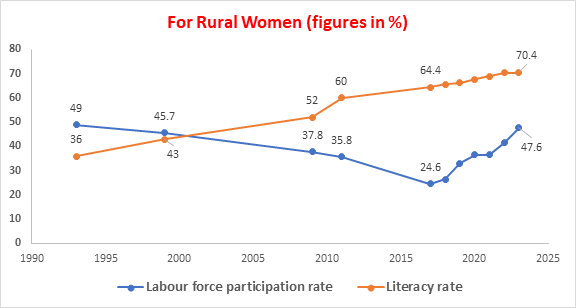
- Rural Women’s Employment:
- Over 92% rural women workers were either self-employed (73.5%) or casual labourers (18.7%), predominantly engaged in agriculture.
- Rural India offers “stronger community and family networks” that help shoulder childcare responsibilities.
- Flexible work options like self-employment and agricultural labour are more readily available, enabling women to balance work and childcare through the “It takes a village” effect (Gautham, 2022).
- However, there was a “notable decline in labour force participation among rural women between 2005 and 2019”. This is surprising given falling fertility rates, rising consumption, and urbanization, which should theoretically support greater participation.
- The post-COVID rise in rural FLFPR can be partially attributed to “crisis-driven fallback strategies, uncharacteristic of provident long-term solutions”.
- Urban Women’s Employment:
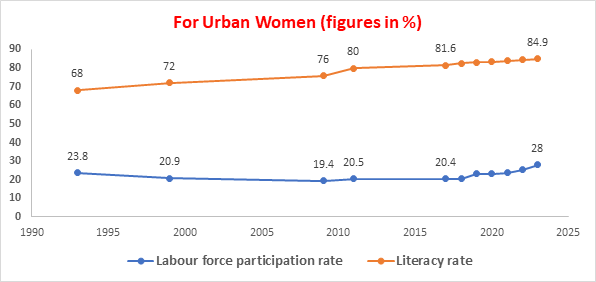
- Only 42.3% urban women were self-employed, primarily seeking jobs in the services sector.
- The urban services sector “offers women limited returns due to persistent barriers such as restricted mobility, informal work arrangements, concerns around workplace safety and prevailing social norms” (World Bank, 2024).
- Lack of Accessible Childcare: The “lack of accessible and affordable childcare infrastructure in urban India” is a pertinent factor driving FLFPR loss, especially among women with school-going children.
- Nuclear Households: Urban settings often leave women without familial support for caregiving, as 61.3% urban households are nuclear (NFHS-5).
- Rigid Urban Structure: The “rigid and demanding structure of the urban services sector” offers fewer adaptable opportunities for working mothers.
3. “Invisible Labour” and Deep-Rooted Cultural Norms:
- Time Spent on Unpaid Work: According to the Time Use Survey 2024, Indian women spend an average of 289 minutes per day on unpaid domestic work, compared to 88 minutes for men. Urban women, in particular, are burdened with juggling professional and domestic responsibilities without structural support.
- Time-Bound Underemployment: This “invisible weight leads to time-bound underemployment, where women may want to work but are unable to find opportunities that align with their caregiving obligations”.
- Cultural Norms: As household incomes rise, “deep-rooted cultural norms can take precedence, reinforcing traditional ideas that cast men as breadwinners and women as caregivers.” If the financial need for a woman’s income diminishes, her economic participation can reduce further.
4. Way Forward and Policy Implications:
- Neither Setting Working for Women: A comparison of rural and urban data shows that “neither setting is working for women, even if the reasons for this differ”.
- Redesigning Labour Market: Increasing FLFPR requires “redesigning our labour market with investments in public childcare infrastructure, promoting flexible work models and challenging the notion of caregiving as a woman’s exclusive burden”.
- Averting Low-Equilibrium Growth Story: India needs to address its low women’s labour force participation to “avert a growth story that may remain stuck in a low equilibrium”.
In conclusion, India’s path to becoming a $5 trillion economy is critically hindered by its low female labour force participation, a problem exacerbated by a complex interplay of structural barriers, social norms, and inadequate support systems, particularly for caregiving. Addressing this deep-rooted disconnect through strategic investments in childcare infrastructure, promoting flexible work, and challenging traditional gender roles is paramount for unlocking India’s full economic potential and ensuring a truly inclusive growth story.
- Sign Up on Practicemock for Updated Current Affairs, Topic Tests and Mini Mocks
- Sign Up Here to Download Free Study Material
Free Mock Tests for the Upcoming Exams
- IBPS PO Free Mock Test
- RBI Grade B Free Mock Test
- IBPS SO Free Mock Test
- NABARD Grade A Free Mock Test
- SSC CGL Free Mock Test
- IBPS Clerk Free Mock Test
- IBPS RRB PO Free Mock Test
- IBPS RRB Clerk Free Mock Test
- RRB NTPC Free Mock Test
- SSC MTS Free Mock Test
- SSC Stenographer Free Mock Test
- GATE Mechanical Free Mock Test
- GATE Civil Free Mock Test
- RRB ALP Free Mock Test
- SSC CPO Free Mock Test
- AFCAT Free Mock Test
- SEBI Grade A Free Mock Test
- IFSCA Grade A Free Mock Test
- RRB JE Free Mock Test
- Free Banking Live Test
- Free SSC Live Test