


The RBI Grade B exam is one of the most prestigious opportunities in India’s banking and financial sector. It offers managerial‑level positions in the Reserve Bank of India, attractive salary packages, and immense career growth. However, it is also one of the toughest exams, demanding months of disciplined preparation. This blog provides a comprehensive roadmap — from exam pattern to subject‑wise strategies — to help aspirants crack RBI Grade B 2026 with confidence.
RBI Grade B Exam Structure
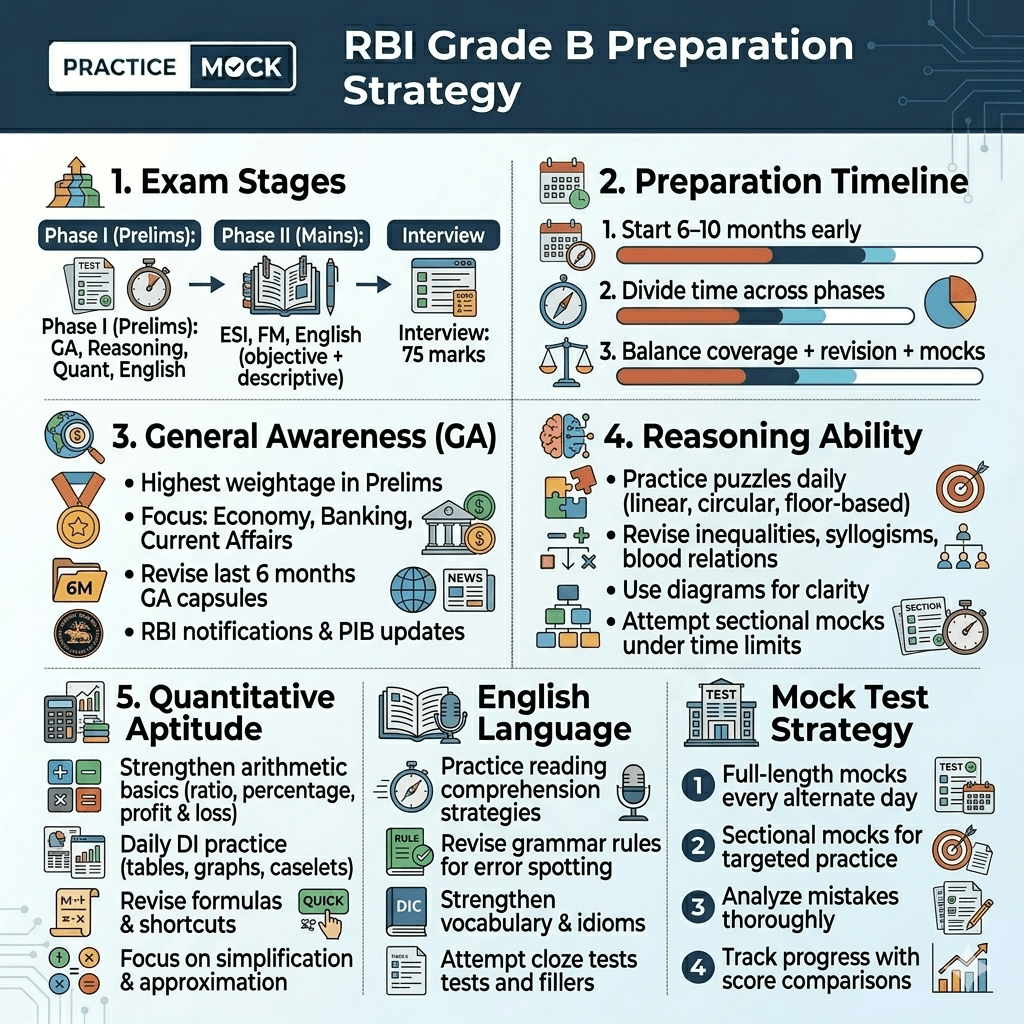
The exam is conducted in three phases:

- Phase I (Prelims) – Objective test covering General Awareness, Reasoning, English, and Quantitative Aptitude.
- Phase II (Mains) – Objective + descriptive papers in Economics & Social Issues (ESI), Finance & Management (FM), and English.
- Interview – Personal interaction carrying 75 marks.
Prelims Pattern:
| Subject | Questions | Marks | Duration |
| General Awareness | 80 | 80 | 25 min |
| Reasoning | 60 | 60 | 45 min |
| English | 30 | 30 | 25 min |
| Quant | 30 | 30 | 25 min |
Negative marking and sectional cut‑offs apply, making balanced preparation essential.
Preparation Timeline
Experts recommend 6–10 months of sustained preparation. While notification usually comes mid‑year, aspirants should begin early to avoid last‑minute stress. A structured plan ensures coverage of all subjects, regular revision, and mock practice.
General Awareness (GA) Strategy
GA is the highest weightage section in prelims (80 marks) and overlaps with mains.
- Step 1: Understand the syllabus (focus on economy, banking, current affairs).
- Step 2: Analyze previous year papers to identify trends.
- Step 3: Follow one reliable source (e.g., PIB, RBI notifications, monthly current affairs magazine).
- Step 4: Revise regularly — lack of revision is a common reason for failure.
- Step 5: Integrate GA prep for prelims, mains, and interview.
Reasoning Preparation
Reasoning carries 60 marks and is considered tough due to complex puzzles.
- Covers about 13 topics, but 5 dominate: puzzles, seating arrangement, machine input‑output, data sufficiency, critical reasoning.
- Requires daily practice of puzzles and seating arrangements.
- Start with PYQs to understand RBI’s twisted style.
- Practice at three levels:
- Concept learning
- Topic‑wise tests
- Sectional + full mocks
- Dedicate at least 6 months for mastery.
Quantitative Aptitude Preparation
Quant is often the toughest section, with low cut‑offs (e.g., 9/30 in 2025).
- Build strong basics: speed, accuracy, calculation shortcuts.
- Focus topics: number series, quadratic equations, percentages, ratios.
- Advance to: age problems, mixtures, averages, profit‑loss, SI/CI.
- Data Interpretation (DI) becomes easier once basics are clear.
- Use quality resources like PracticeMock test series for mains‑level practice.
- Gradually increase difficulty from basics to advanced.
English Language Strategy
English in RBI Grade B is unique, focusing on economic and social issues.
- Develop reading skills — vocabulary memorization alone is insufficient.
- Read editorials and newspapers daily.
- Start with simple essays, then move to complex editorials.
- Practice: sentence rearrangement, RC, error spotting, fillers, cloze tests.
- Focus on sentence structure and contextual vocabulary.
- Track progress with sectional and full mocks.
Balanced Preparation & Time Management
The RBI Grade B exam is not just about mastering one subject; it is about excelling across all four areas — General Awareness, Reasoning, Quantitative Aptitude, and English. Many aspirants make the mistake of focusing heavily on one section, often GA or Reasoning, while neglecting others. This imbalance can prove costly because the exam has sectional cut‑offs as well as an overall cut‑off. Success therefore depends on a balanced approach and disciplined time management.
Create a Long‑Term Schedule
Aspirants should design a 6–10 month study plan that allocates dedicated slots for each subject. For example, mornings can be reserved for GA and English reading practice, afternoons for Quant problem‑solving, and evenings for Reasoning puzzles. This ensures that every subject receives consistent attention. A timetable also prevents procrastination and builds a rhythm that sustains preparation over months.
Avoid Overemphasis on One Area
It is tempting to spend extra time on a favorite subject, but RBI Grade B demands uniform competence. Scoring high in GA but failing to clear Quant or English cut‑offs will disqualify a candidate. The exam rewards versatility, so aspirants must treat each subject with equal seriousness. A balanced routine ensures that weaknesses are addressed without compromising strengths.
Revise Regularly
Revision is the backbone of retention. Without it, even well‑prepared topics fade quickly. Aspirants should schedule weekly revision sessions to revisit formulas, grammar rules, and GA notes. Flashcards, short notes, and mind maps can make revision efficient. Regular revision also reduces exam anxiety, as candidates feel confident about recalling concepts under pressure.
Use Mock Tests to Simulate Exam Conditions
Mock tests are invaluable for building exam temperament. They replicate the pressure of answering 200+ questions in limited time. By attempting full‑length mocks, aspirants learn how to pace themselves, manage sectional timings, and avoid silly mistakes. Post‑mock analysis is equally important — identifying weak areas, tracking accuracy, and refining strategies. Platforms like PracticeMock provide RBI‑level mocks that mirror actual difficulty.
Consistency and Discipline are Key
Preparation is not about sporadic bursts of study but about daily discipline. Even two hours of focused study every day is more effective than irregular long sessions. Consistency builds confidence, while discipline ensures that aspirants stick to their schedule despite distractions. Over time, this steady effort compounds into mastery across all subjects.
Phase‑Wise Practical Tips
Preparing for RBI Grade B requires different approaches at each stage. By breaking it down into Prelims, Mains, and Interview, aspirants can focus on what matters most and avoid wasting time on low‑yield areas.
Prelims: Speed Drills & Sectional Mocks
Prelims is all about speed and accuracy. The paper is short, but the cut‑offs are high. To prepare effectively:
- Daily Speed Drills: Practice 20 simplification questions, 2 puzzles, and 1 reading comprehension every day. This builds reflexes and reduces hesitation.
- Sectional Mocks: Attempt sectional tests for Quant, Reasoning, and English twice a week. Analyze mistakes and maintain an error log.
- Time Management: Use a stopwatch to simulate exam conditions. Train yourself to switch sections quickly without losing focus.
- Revision Strategy: Keep formula sheets for Quant and grammar rules for English handy. Revise them daily for retention.
Mains: ESI/FM Notes & Descriptive Writing Practice
Mains is the deciding stage. It tests depth of knowledge and analytical ability.
- Structured Notes: Prepare concise notes for Economic & Social Issues (ESI) and Finance & Management (FM). Focus on RBI circulars, budget highlights, and economic survey.
- Current Affairs: Cover the last 6–8 months thoroughly. Banking awareness and RBI updates are crucial.
- Descriptive Writing: Practice essay and precis writing twice a week. Use recent economic topics like inflation, monetary policy, or digital banking.
- Mock Tests: Attempt full‑length Mains mocks weekly. Focus on Data Interpretation and logical reasoning sets.
- Revision: Create mind maps for ESI/FM topics to recall quickly during revision.
Interview: RBI Functions & Current Economy
The interview stage evaluates personality, awareness, and clarity of thought.
- Know RBI: Revise RBI’s structure, functions, and recent initiatives. Be ready to explain them in simple terms.
- Current Economy: Stay updated with economic news, GDP trends, inflation data, and RBI’s monetary policy.
- Mock Interviews: Practice with peers or mentors. Focus on clear communication and structured answers.
- Personal Profile: Be prepared to answer questions about your background, education, and motivation for joining RBI.
- Confidence Building: Read editorials daily to improve articulation and confidence in expressing opinions.
Preparation Resources
Choosing the right study resources is as important as following a solid strategy. Reliable materials ensure clarity, save time, and help aspirants practice exam‑level questions. Instead of juggling multiple sources, focus on a few trusted ones that cover the RBI Grade B syllabus comprehensively and provide consistent practice opportunities.
PracticeMock Test Series: High‑quality mock tests for prelims and mains, designed to match RBI Grade B difficulty.
PIB (Press Information Bureau): Authentic updates on government policies, schemes, and economic developments.
RBI Official Notifications: Direct source for exam updates, monetary policy changes, and regulatory guidelines.
Monthly Current Affairs Magazines: Covering sports, appointments, awards, national/international events, and economic news.
Standard Banking & Finance Books: For Economics & Social Issues (ESI) and Finance & Management (FM).
Newspapers & Editorials: Selective reading of business and economy sections to strengthen comprehension and vocabulary.
Conclusion
Cracking RBI Grade B 2026 requires discipline, smart planning, and consistent practice. By following expert strategies — mastering GA, practicing reasoning puzzles, strengthening quant basics, and improving English comprehension — aspirants can maximize their chances of success. With 6–10 months of preparation, regular mocks, and balanced revision, the RBI Grade B dream is achievable.
FAQs
Start preparation at least 6–10 months before the exam. Focus on section‑wise strategy: GA (banking & economy updates), Reasoning (puzzles, seating arrangements), Quant (DI, arithmetic basics), and English (RC, grammar). Regular mock tests and analysis are essential to build speed and accuracy.
Yes, RBI Grade B is conducted annually, and 2026 is expected to follow the same cycle. Aspirants should begin preparation early, as official notification usually comes around May–June.
No exam is “easy.” RBI Grade B is highly competitive due to limited vacancies and vast syllabus. With disciplined study, smart revision, and consistent mock practice, aspirants can crack it. Success depends on preparation strategy, not difficulty level alone.
हाँ, आरबीआई ग्रेड बी परीक्षा हर साल आयोजित होती है। 2026 में भी इसके होने की पूरी संभावना है। उम्मीदवारों को तैयारी समय से शुरू करनी चाहिए ताकि नोटिफिकेशन आने पर वे तैयार रहें।
नहीं, यह परीक्षा आसान नहीं है। इसमें सीमित सीटें और व्यापक सिलेबस होता है। लेकिन सही रणनीति, नियमित अभ्यास और मॉक टेस्ट से इसे पास करना संभव है। मेहनत और निरंतरता ही सफलता की कुंजी है।
- Sign Up on Practicemock for Updated Current Affairs, Topic Tests and Mini Mocks
- Sign Up Here to Download Free Study Material
Free Mock Tests for the Upcoming Exams
- IBPS PO Free Mock Test
- RBI Grade B Free Mock Test
- IBPS SO Free Mock Test
- NABARD Grade A Free Mock Test
- SSC CGL Free Mock Test
- IBPS Clerk Free Mock Test
- IBPS RRB PO Free Mock Test
- IBPS RRB Clerk Free Mock Test
- RRB NTPC Free Mock Test
- SSC MTS Free Mock Test
- SSC Stenographer Free Mock Test
- GATE Mechanical Free Mock Test
- GATE Civil Free Mock Test
- RRB ALP Free Mock Test
- SSC CPO Free Mock Test
- AFCAT Free Mock Test
- SEBI Grade A Free Mock Test
- IFSCA Grade A Free Mock Test
- RRB JE Free Mock Test
- Free Banking Live Test
- Free SSC Live Test