


To crack the RBI Grade B 2026 exam, aspirants must master multiple subjects in depth — and one crucial part is government schemes. These schemes play a decisive role in both Phases of the exam. If you want to cover them thoroughly, understand the importance of key schemes, and access the best resources to prepare, you’re in the right place. In this blog, we’ll provide you with exam‑relevant government schemes, trusted resources to master them, and a FREE Mock Test to reveal your AIR — helping you plan smarter and improve faster.
Also, know why RBI Grade B Phase 1 Exam: The Silent Eliminator of 99% Aspirants & What is the Finance and Management Syllabus for RBI Grade B Exam?

Are Government Schemes Important for RBI Grade B?
Yes, Government Schemes remain a key part of RBI Grade B. Past exam analysis shows their weightage clearly:
- Phase 1 (GA): Questions on schemes have dipped slightly — 10 marks in 2022, 8 marks in 2023, 7 marks in 2024, and 6 marks in 2025.
- Phase 2 (ESI + FM): Schemes carry higher weightage — 30 marks in 2022, 22 marks in 2023, 25 marks in 2024, and 24 marks in 2025.
Weightage of Government Schemes (2022–2025)
| Phase | 2022 | 2023 | 2024 | 2025 |
| Phase 1 – GA | 10 marks | 8 marks | 7 marks | 6 marks |
| Phase 2 – ESI + FM | 30 marks | 22 marks | 25 marks | 24 marks |
The trend shows that while Phase 1 has fewer scheme questions, Phase 2 consistently tests schemes in depth. So, mastering them is non‑negotiable for success in RBI Grade B 2026.
Latest Government Schemes for RBI Grade B List
Economic and Financial Schemes
- PM Vishwakarma Yojana (2023)
Aims to support traditional artisans and craftsmen.
Offers credit support, skill training, and toolkit incentives.
Budget: ₹13,000 crore - PM Gati Shakti Yojana
Infrastructure master plan to improve logistics efficiency.
Integrates 16 ministries for multi‑modal connectivity. - National Logistics Policy (2022)
Reduces logistics cost to ~8% of GDP.
Aims to make India globally competitive in logistics. - Production Linked Incentive (PLI) Schemes
Covers over 14 sectors, including electronics, pharma, and textiles.
Encourages domestic manufacturing and exports. - Digital India Programme 2.0 (2025)
Expands digital services, AI, fintech, and cybersecurity.
Focus on rural connectivity and digital literacy. - Digital Payments – E‑Mandate Framework (2026)
Streamlines recurring transactions with stronger authentication.
Active since April 2026.
Social Welfare Schemes
- PM Jan Dhan Yojana
Financial inclusion with 50+ crore beneficiaries.
Offers banking services to the unbanked population. - PM Awas Yojana (Urban & Rural)
Affordable housing for all. - PM Garib Kalyan Anna Yojana (Extended till 2025)
Free food grains for over 80 crore people under NFSA. - Agnipath Scheme
New recruitment model for Indian Armed Forces.
Short‑term contractual military service. - Sampoorna Grameen Rozgar Yojana (2025 Update)
Focus on rural employment and livelihood security.
Linked with skill development initiatives.
Environmental and Green Initiatives
- National Green Hydrogen Mission (2023)
India aims to become a hub for green hydrogen production.
Target: 5 MMT production capacity by 2030. - PM‑KUSUM Scheme
Promotes solar energy among farmers.
Provides solar pumps and grid‑connected renewable energy. - National Electric Mobility Mission (2026 Update)
Push for EV adoption and charging infrastructure.
Target: 30% EV penetration by 2030.
Other Schemes
- e‑RUPI (Digital Payment Instrument)
- One Nation, One Ration Card
- Mission Amrit Sarovar – Water conservation initiative
- SVANidhi Yojana – Loans to street vendors
- Financial Literacy Week 2026 – Focus on digital safety and inclusion
Important Government Schemes for the RBI Grade B Exam
There are some schemes that you should follow to get ready to face all types of scheme‑related questions. Here are the schemes that you need to prepare:
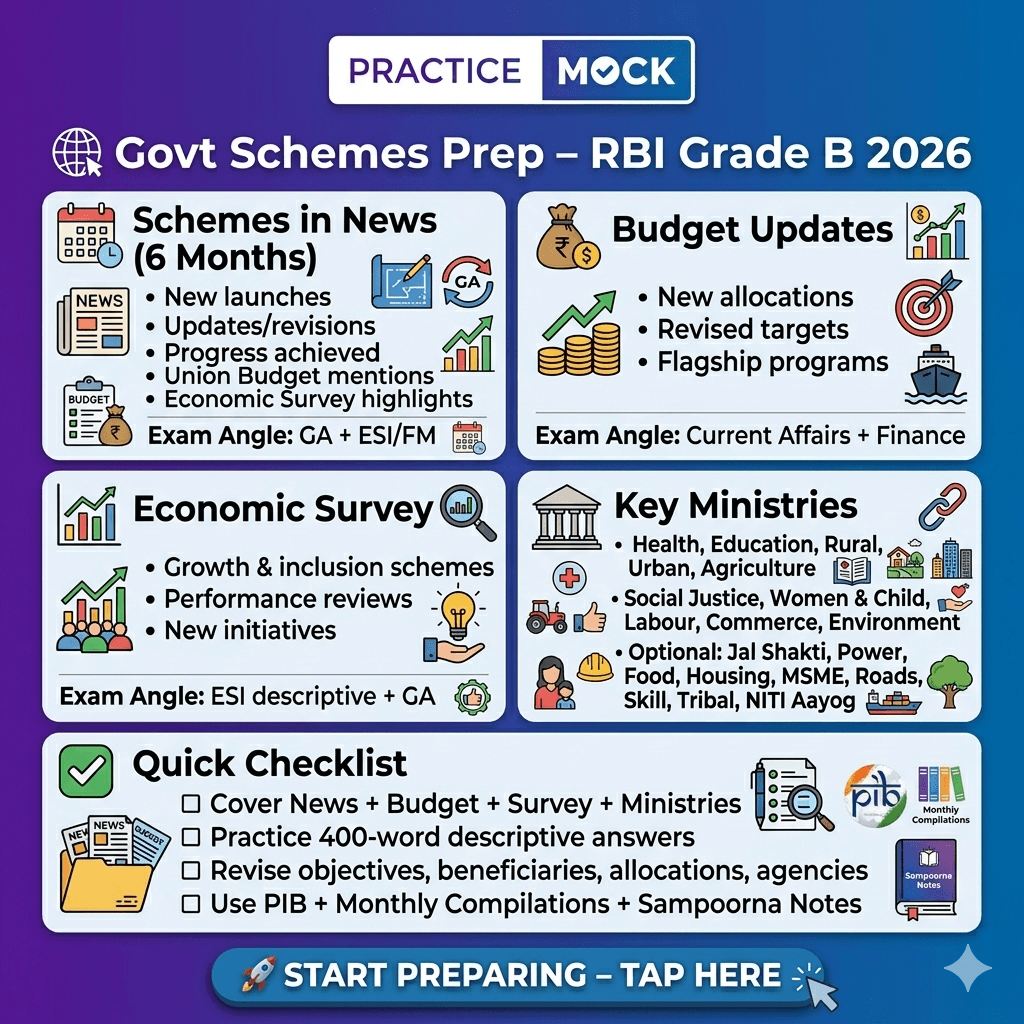
- That has been in the news for the past 6 months before the Phase 1 or Prelims exam (from PIB)
- The schemes that have been updated in the Budget
- The schemes that are relevant to the syllabus of the exam
Let’s delve more into it.
Govt. Schemes of the Last 6 Months
Cover all the government schemes that have been in the news in the past 6 months thoroughly. Start by following a good resource to complete this task. Again, carefully go through all the schemes that have made the news. The schemes that have been in the news during the past 6 months from the RBI Grade B 2025 and 2026 exam dates. Master this part by:
- Reviewing the schemes that have been recently launched
- Checking for updates or revisions of the schemes that exist
- Looking for schemes that have achieved notable progress
- Noting new schemes announced in the Union Budget
- Taking note of the schemes mentioned in the Economic Survey
You can expect questions from different angles, as discussed above. For example, here are a couple of questions related to government schemes that were asked in the RBI Grade B 2024 and 2025 exams:
- Start‑Up India Scheme
Objective Question: Which scheme is designed to encourage entrepreneurship and help start‑ups grow in India? - National Pension Scheme (NPS) Vatsalya
Objective Question: What is the goal behind the release of the NPS Vatsalya scheme, and how does it benefit families?
These questions were part of the General Awareness section in Phase 1 and Economic and Social Issues (ESI) in Phase 2. It is important to note that these schemes had been in the news in some form or the other for the past 6 months before the RBI Grade B 2024 and 2025 exams.
Important Ministries/Areas
Now, you might be wondering that in the news, there are updates about dozens of schemes every 6 months, so which scheme/s should you cover and which ones should you leave? Similarly, how much attention should you give to each scheme? The answer to this is that you should only cover those schemes which are part of the RBI Grade B syllabus. To clear this confusion, we have mentioned below the list of all the important ministries whose schemes you need to cover.
- Ministry of Health and Family Welfare
- Ministry of Education
- Ministry of Social Justice and Empowerment
- Ministry of Urban Development
- Ministry of Rural Development
- Ministry of Child and Women Development
- Ministry of Labor and Employment
- Ministry of Environment, Forest, and Climate Change
- Ministry of Agriculture and Farmers Welfare
- Ministry of Commerce and Industry
Besides these important ministries, if time permits, you should also cover the other relevant ministries, such as:
- Ministry of Jal Shakti
- Ministry of Power
- Ministry of Food and Public Distribution
- Ministry of Housing and Urban Affairs
- NITI Ayog
- Ministry of Micro, Medium, and Small Enterprises
- Ministry of Road Transport and Highways
- Ministry of Skill Development and Entrepreneurship
- Ministry of Tribal Affairs
3. Important Ministries/Areas
Now, you might be wondering that in the news, there are updates about dozens of schemes every 6 months, so which scheme/s should you cover and which ones should you leave? Similarly, how much attention should you give to each scheme? The answer to this is that you should only cover those schemes which are part of the RBI Grade B syllabus. To clear this confusion, we have mentioned below the list of all the important ministries whose schemes you need to cover.
- Ministry of Health and Family Welfare
- Ministry of Education
- Ministry of Social Justice and Empowerment
- Ministry of Urban Development
- Ministry of Rural Development
- Ministry of Child and Women Development
- Ministry of Labor and Employment
- Ministry of Environment, Forest, and Climate Change
- Ministry of Agriculture and Farmers Welfare
- Ministry of Commerce and Industry
Besides these important ministries, if time permits, you should also cover the other relevant ministries, such as:
- Ministry of Jal Shakti
- Ministry of Power
- Ministry of Food and Public Distribution
- Ministry of Housing and Urban Affairs
- NITI Ayog
- Ministry of Micro, Medium, and Small Enterprises
- Ministry of Road Transport and Highways
- Ministry of Skill Development and Entrepreneurship
- Ministry of Tribal Affairs
What to Cover in a Government Scheme
For the RBI Grade B exam, you must know every scheme in detail. Here’s what to cover:
- Launch Year
- Budget Allocation (overall + specific)
- Tagline
- Eligible Beneficiaries
- Exclusions
- Targets & Objectives
- Implementing Agency
Covering these points ensures you can handle both objective and descriptive questions confidently.
Best Resources to Prepare
- PIB + Monthly Compilation – Complete coverage of schemes with authentic updates.
- Sampoorna – Expert‑curated notes from official guidelines, highlighting exam‑relevant points.
By using these resources daily, you’ll be ready to answer even the toughest scheme‑based questions without hesitation.
Also read, How to Prepare Finance and Management for RBI Grade B?
Descriptive Questions Based on Schemes
Remember, RBI Grade B doesn’t stop at objective questions — schemes also appear in descriptive answers. To tackle them confidently, you need daily preparation and deep understanding. Writing a strong descriptive answer isn’t something you can do overnight; it comes only with consistent practice and advance preparation. That’s exactly what we aim to help you achieve.
Follow these 4 smart steps:
- Be ready for descriptive questions on government schemes.
- Practice writing 400‑word answers regularly.
- Build a clear, in‑depth understanding of each scheme.
- Go beyond memorizing facts — practice daily for accuracy and confidence.
Top Complete Course for Winners & Toppers
Want a strong start and a confident finish in your exam prep? This course is built to take you from beginner to topper. The earlier you begin, the faster you move towards success — and this course makes the journey easier.
It covers Phase 1 and Phase 2 completely, with 400 recorded lectures, E‑Books, detailed notes for ESI & FM, and full syllabus coverage. Teaching is in simple Hinglish, so every concept is easy to grasp.
Don’t wait — join now and set yourself firmly on the path to cracking the RBI Grade B 2026 exam.
RBI Schemes 2026 List
Here is the table that summarizes all the main Reserve Bank of India (RBI) schemes and directives relevant to 2026
| Scheme/Directive Name | Description | Status as of 2026 |
| Digital Banking Directions, 2026 | Consolidates internet & mobile banking rules for banks and urban co‑operative banks; introduces stricter customer consent, enhanced cybersecurity, and board‑level accountability. | Effective from Jan 1, 2026; mandatory compliance for banks and fintech partners. |
| Interest Rate on Deposits Directions, 2026 | Centralises all deposit interest rules; ensures transparency, uniformity, and depositor protection across banks, NBFCs, and HFCs. | Active since Apr 1, 2026; supersedes earlier 2016 directives. |
| Basic Savings Bank Deposit (BSBD) Account Rules, 2026 | Clarifies free services, digital payment access, and limits on incidental charges to promote financial inclusion. | Effective from Apr 1, 2026. |
| Digital Lending Directions, 2025–26 | Strengthens regulation of fintech/NBFC lending; mandates standardized consumer information, stricter reporting, and oversight of loan service providers. | Under phased implementation through 2026. |
| Payment Aggregator Guidelines, 2025–26 | Expands oversight to cover governance, merchant due diligence, settlement timelines, escrow structures, and cross‑border payments. | Compliance phased through 2026. |
| Digital Payments – E‑Mandate Framework, 2026 | Streamlines recurring digital payments with stronger authentication and consumer protection. | Active since Apr 21, 2026. |
| Risk Management & Inter‑Bank Dealings, 2026 | Updated norms for forex and inter‑bank transactions to strengthen systemic stability. | Active since Apr 20, 2026. |
| Non‑Banking Financial Companies (NBFC) – Branch Authorisation Directions, 2026 | Amended rules for NBFC branch expansion and compliance. | Active since Apr 2026. |
| Cross‑Border Inward Payment Guidelines, 2026 | Facilitates faster inward remittances with improved settlement timelines. | Active since Apr 9, 2026. |
“The secret of getting ahead is getting started. The secret of getting started is breaking your complex overwhelming tasks into small manageable tasks.” – Mark Twain
- Sign Up on Practicemock for Updated Current Affairs, Topic Tests and Mini Mocks
- Sign Up Here to Download Free Study Material
Free Mock Tests for the Upcoming Exams
- IBPS PO Free Mock Test
- RBI Grade B Free Mock Test
- IBPS SO Free Mock Test
- NABARD Grade A Free Mock Test
- SSC CGL Free Mock Test
- IBPS Clerk Free Mock Test
- IBPS RRB PO Free Mock Test
- IBPS RRB Clerk Free Mock Test
- RRB NTPC Free Mock Test
- SSC MTS Free Mock Test
- SSC Stenographer Free Mock Test
- GATE Mechanical Free Mock Test
- GATE Civil Free Mock Test
- RRB ALP Free Mock Test
- SSC CPO Free Mock Test
- AFCAT Free Mock Test
- SEBI Grade A Free Mock Test
- IFSCA Grade A Free Mock Test
- RRB JE Free Mock Test
- Free Banking Live Test
- Free SSC Live Test