



Preparing for the RBI Grade B 2026 exam while managing a full‑time job is no easy task. Working professionals often struggle with limited study hours, fatigue after office, and balancing personal commitments. Yet, every year, thousands of candidates prove that with the right roadmap, discipline, and smart strategies, success is possible. This blog provides a step‑by‑step preparation plan tailored for working professionals, ensuring clarity, efficiency, and exam‑oriented focus.
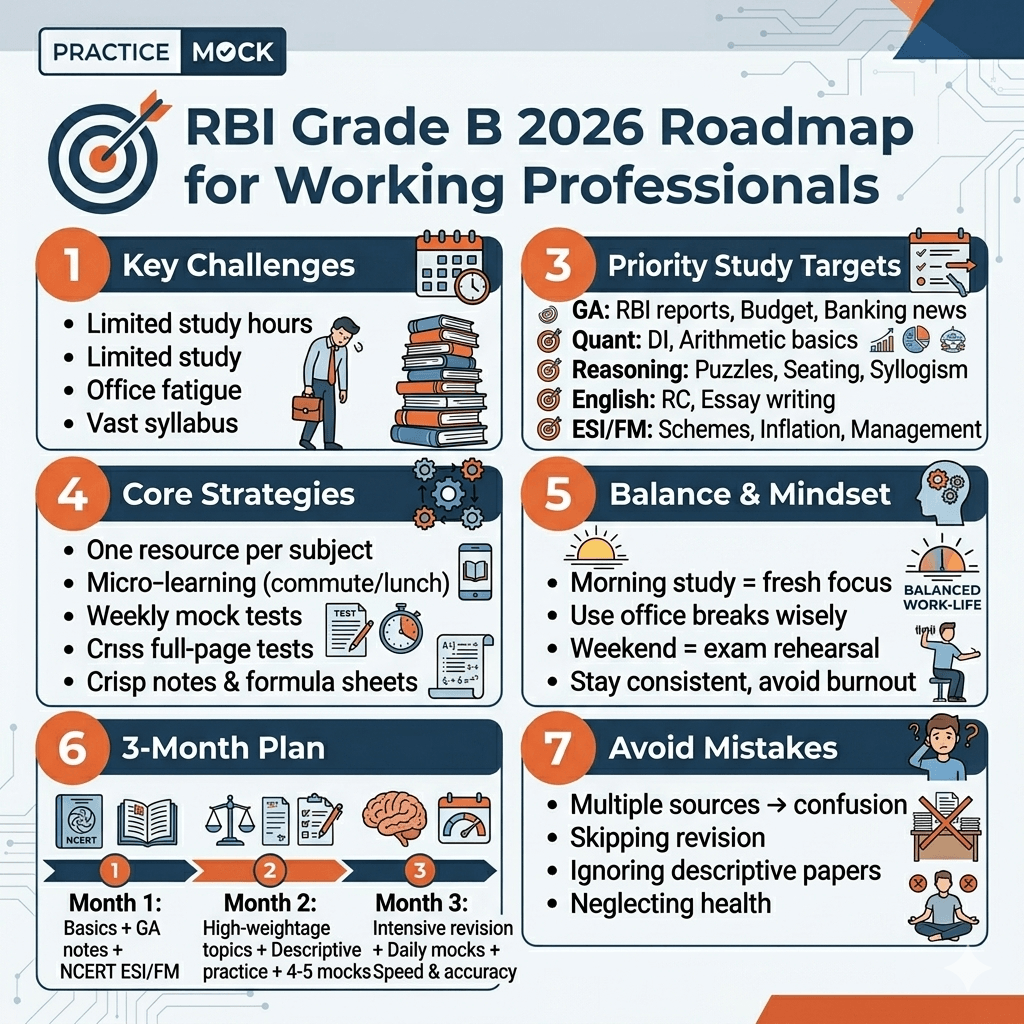
Essential Tips for Working Professionals
Working professionals face unique hurdles in exam preparation. Limited time, fluctuating energy levels, and workplace responsibilities often disrupt study consistency. The RBI Grade B syllabus is vast, demanding attention across multiple subjects. This section outlines the core challenges so aspirants can recognize them early and prepare with realistic expectations.

- Time Constraint: Most aspirants get only 2–3 hours on weekdays.
- Energy Levels: Office work drains mental stamina, making late‑night study difficult.
- Consistency Issues: Work deadlines, meetings, and travel often break study rhythm.
- Exam Pressure: RBI Grade B demands coverage of General Awareness, Quant, Reasoning, English, and Economic & Social Issues (ESI), Finance & Management (FM) — a vast syllabus.
The key is not to study more, but to study smart. Here’s what they need to do to make the most of their time and resources:
Craft a Realistic Study Schedule
A structured timetable is the backbone of preparation. For working professionals, it ensures balance between job and study. By dividing weekdays and weekends smartly, aspirants can maintain daily touch with all subjects. This section explains how to design a practical schedule that maximizes efficiency without causing burnout.
Weekdays (2–3 hours daily):
- 1 hour: General Awareness (current affairs, RBI circulars, economic news)
- 1 hour: Quant/Reasoning practice (alternate days)
- 30–45 minutes: English comprehension or descriptive writing
Weekends (6–7 hours total):
- 2 hours: ESI & FM concepts (static + current)
- 2 hours: Mock test practice & analysis
- 2–3 hours: Revision of weekly notes
This schedule ensures daily touch with all sections without overwhelming you.
Prioritize Important Topics
With limited time, aspirants must focus on topics that deliver maximum marks. High‑yield areas across Quant, Reasoning, English, GA, ESI, and FM often decide success. This section highlights the most scoring topics so working professionals can channel their preparation toward areas that matter most in the exam.
- General Awareness: RBI reports, Union Budget, Economic Survey, Banking & Finance news.
- Quantitative Aptitude: Data interpretation, arithmetic (percentage, ratio, time & work, probability).
- Reasoning: Puzzles, seating arrangement, syllogism, coding‑decoding.
- English: Reading comprehension, error spotting, essay writing.
- ESI: Inflation, poverty, unemployment, government schemes, sustainable development.
- FM: Principles of management, corporate governance, financial markets, risk management.
Smart Resource Selection
Choosing the right study material is critical for working professionals. Too many sources waste time and create confusion. This section guides aspirants to stick to one reliable resource per subject, ensuring clarity, consistency, and exam‑oriented preparation without unnecessary distractions or duplication of effort.
- GA: Monthly current affairs PDFs + RBI official website updates.
- Quant & Reasoning: PracticeMock sectional tests + previous year papers.
- English: Editorial reading + mock test practice.
- ESI & FM: RBI publications, NCERT basics, and selective reference books (e.g., Ramesh Singh for Economics, Prasanna Chandra for Finance basics).
Leverage Micro‑Learning
Micro‑learning helps aspirants utilize small pockets of time effectively. Whether during commutes, lunch breaks, or idle office hours, short bursts of study add up significantly. This section explains how working professionals can integrate flashcards, podcasts, and quick MCQs into their daily routine for continuous engagement with the syllabus.
- Use commute time for current affairs podcasts or short notes.
- Revise flashcards during lunch breaks.
- Practice 5–10 MCQs whenever you get a free slot.
Micro‑learning ensures continuous engagement without long study hours.
Make a An Effective Mock Test Strategy
Mock tests are the ultimate preparation tool. They simulate exam conditions, highlight weak areas, and build confidence. For working professionals, mocks act as both practice and revision. This section explains how to schedule, attempt, and analyze mock tests effectively without disturbing work commitments.
- Phase I: Attempt 1 full mock test every weekend.
- Phase II: Start descriptive answer practice at least 2 months before exam.
- Analysis: Spend equal time reviewing mistakes — this is where learning happens.
Build Exam‑Friendly Notes
Notes are the lifeline of last‑minute revision. For working aspirants, concise and structured notes save time and boost recall. This section explains how to prepare weekly GA notes, formula sheets, and short summaries for ESI & FM, making revision faster and more effective before the exam.
- Maintain weekly current affairs notes (bullet points).
- Create formula sheets for Quant.
- Prepare short summaries for ESI & FM topics.
- Use mnemonics & infographics for memory retention.
These notes become your last‑minute revision weapon.
Balance Work & Study
Balancing office responsibilities with exam preparation requires discipline and smart planning. This section shares practical strategies like morning study, weekend focus, and using office breaks productively. By following these tips, working professionals can maintain consistency without sacrificing health or job performance.
- Morning Study: Fresh mind, better focus. Wake up 1 hour earlier.
- Office Strategy: Avoid social media scrolling; use breaks for revision.
- Evening Routine: Light exercise + 1–2 hours of focused study.
- Weekend Discipline: Treat weekends as exam rehearsal days.
Mental Conditioning
Success in RBI Grade B is not just about knowledge — it’s about mindset. Confidence, stress management, and motivation play a huge role. This section emphasizes mental conditioning techniques that help working professionals stay consistent, avoid burnout, and approach the exam with a positive attitude.
- RBI Grade B is not just about knowledge, but consistency & confidence.
- Practice time management in mocks.
- Stay motivated with success stories of working professionals.
- Avoid burnout — take short breaks, meditate, or exercise.
3‑Month Roadmap (Ideal for Working Professionals)
A structured timeline ensures steady progress. This section provides a clear three‑month roadmap, breaking down what to study and revise each month. By following this plan, working professionals can cover the syllabus systematically and be exam‑ready by the time RBI Grade B arrives.
Month 1:
- Cover basics of Quant, Reasoning, and English.
- Start GA notes (daily + weekly).
- Begin ESI & FM with NCERT + RBI reports.
Month 2:
- Focus on high‑weightage topics in Quant & Reasoning.
- Strengthen GA with monthly compilations.
- Practice descriptive writing for Phase II.
- Attempt 4–5 full mock tests.
Month 3:
- Intensive revision of GA, ESI, FM.
- Daily mock test practice.
- Refine descriptive answers with model essays.
- Focus on speed, accuracy, and confidence.
Common Mistakes to Avoid
Even hardworking aspirants fall into traps that derail preparation. This section lists common mistakes, such as over‑reliance on multiple sources or ignoring descriptive papers. By avoiding these pitfalls, working professionals can keep their preparation exam‑oriented and efficient.
- Over‑reliance on multiple sources → Stick to one.
- Skipping revision → Notes are useless if not revised.
- Ignoring descriptive papers → Phase II decides final selection.
- Neglecting health → Fatigue reduces productivity.
Conclusion
For working professionals, cracking RBI Grade B 2026 requires discipline, smart planning, and exam‑oriented focus. With limited hours, you must prioritize high‑yield topics, rely on concise resources, and practice mocks consistently. Remember, success is not about studying 10 hours a day, but about studying the right way every day.
If you follow this roadmap with dedication, balancing work and preparation, you can turn your RBI Grade B dream into reality.
FAQs
Yes. With a smart schedule (2–3 hrs on weekdays, 6–7 hrs on weekends) and consistent practice, success is achievable.
General Awareness (RBI reports, Budget, Banking news), Quant (DI, Arithmetic), Reasoning (Puzzles, Seating), English (RC, Essay), and ESI/FM (Schemes, Inflation, Management).
At least one full mock test every weekend for Phase I, plus descriptive practice for Phase II starting two months before the exam.
Study in the morning for fresh focus, use office breaks for micro‑learning, and treat weekends as exam rehearsal days.
Relying on too many sources, skipping revision, ignoring descriptive papers, and neglecting health are the biggest pitfalls.
- Sign Up on Practicemock for Updated Current Affairs, Topic Tests and Mini Mocks
- Sign Up Here to Download Free Study Material
Free Mock Tests for the Upcoming Exams
- IBPS PO Free Mock Test
- RBI Grade B Free Mock Test
- IBPS SO Free Mock Test
- NABARD Grade A Free Mock Test
- SSC CGL Free Mock Test
- IBPS Clerk Free Mock Test
- IBPS RRB PO Free Mock Test
- IBPS RRB Clerk Free Mock Test
- RRB NTPC Free Mock Test
- SSC MTS Free Mock Test
- SSC Stenographer Free Mock Test
- GATE Mechanical Free Mock Test
- GATE Civil Free Mock Test
- RRB ALP Free Mock Test
- SSC CPO Free Mock Test
- AFCAT Free Mock Test
- SEBI Grade A Free Mock Test
- IFSCA Grade A Free Mock Test
- RRB JE Free Mock Test
- Free Banking Live Test
- Free SSC Live Test