


Among the three papers in RBI Grade B Phase 2, Economic & Social Issues (ESI) is often the toughest. It demands not just knowledge but the ability to write structured, data‑backed answers under time pressure. Half of the marks (50/100) come from descriptive writing, which decides your merit. Objective questions test memory, but descriptive answers test clarity, articulation, and analytical depth.
Mastering Descriptive Writing
Descriptive writing is the heart of ESI. It’s not enough to know concepts—you must express them clearly, logically, and persuasively. Building this skill requires daily practice and a structured approach to answer writing.

- Practice daily essays (400–600 words) for 30 days before the exam.
- Structure answers with introduction, body, conclusion.
- Use frameworks like PESTEL (Political, Economic, Social, Technological, Environmental, Legal) to organize thoughts.
- Build stamina—writing daily ensures speed and confidence in the exam hall.
Add Weight with Statistics
Numbers make your answers credible. Examiners look for evidence, not vague statements. Quoting authentic statistics and reports strengthens your arguments and shows awareness of current realities.
- India’s HDI rank (2023: 134th)
- Fiscal deficit target (2025–26: 5.1% of GDP)
- Unemployment figures from PLFS
Sources: Economic Survey, RBI Annual Report, World Bank indices. Keep a notebook of key stats for quick revision.
Connect Current Affairs with Core Theory
Static definitions alone won’t fetch marks. Linking theory with current schemes and policies demonstrates analytical depth and practical understanding. This integration is what separates average answers from top‑scoring ones.
- Poverty → MGNREGA, PM‑KISAN
- Globalization → India’s role in G20/WTO
- Education → NEP 2020
- Finance → Union Budget 2025–26 priorities
60‑Day ESI Preparation Plan
A disciplined 60‑day plan ensures complete coverage of all high‑yield topics while balancing descriptive practice and objective revision. Breaking preparation into phases keeps momentum strong, allows repeated reinforcement, and avoids last‑minute panic.
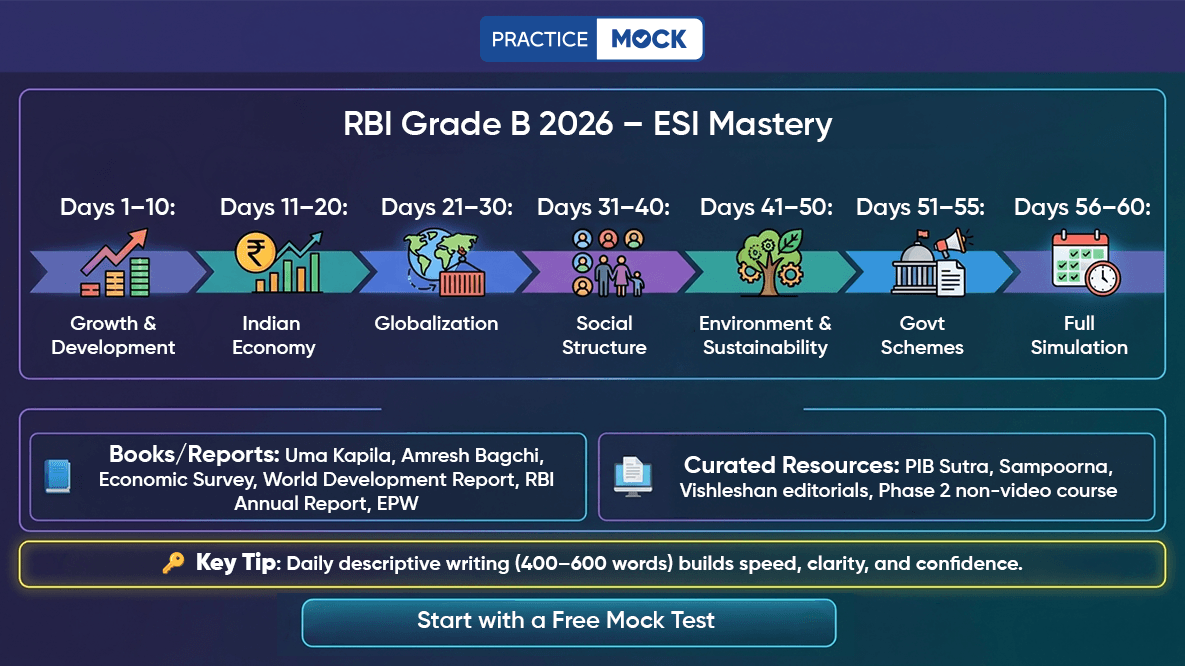
Days 1–10: Growth & Development
In the first phase, focus on the fundamentals of growth, development, and inclusive policies. This builds the foundation for descriptive writing and connects directly with SDGs and India’s development agenda.
- Daily Writing Themes: SDGs, Inclusive Growth, Poverty Alleviation
- Mock Tests: 1–3
Days 11–20: Indian Economy
Once the basics are clear, shift to the Indian economy. Cover fiscal policy, monetary policy, and the Union Budget. This section is highly scoring if you integrate current affairs with theory.
- Daily Writing Themes: Fiscal Policy, Union Budget, Inflation Control
- Mock Tests: 4–6
Days 21–30: Globalization
Globalization topics test your ability to connect India’s role with international institutions. Practice descriptive answers linking WTO, FDI, and G20 with India’s economic reforms.
- Daily Writing Themes: WTO, FDI, G20, Trade Agreements
- Mock Tests: 7–9
Days 31–40: Social Structure
This phase covers social issues like poverty, education, and healthcare. These are recurring themes in descriptive papers and require linking schemes with outcomes.
- Daily Writing Themes: Poverty Alleviation, NEP 2020, Healthcare Policies
- Mock Tests: 10–12
Days 41–50: Environment & Sustainability
Environmental issues are increasingly important in RBI Grade B. Cover climate change, urbanization, and sustainable development. Use statistics and reports to strengthen answers.
- Daily Writing Themes: Climate Change, Urbanization, Renewable Energy
- Mock Tests: 13–15
Days 51–55: Government Schemes
Focus on flagship schemes like Digital India, Atmanirbhar Bharat, and financial inclusion programs. These are directly tested in both objective and descriptive sections.
- Daily Writing Themes: Digital India, Atmanirbhar Bharat, PM‑KISAN
- Mock Tests: 16–17
Days 56–60: Full‑Length Descriptive Tests
The final phase is about simulation. Attempt full‑length descriptive tests under exam conditions. Analyze your performance, refine structure, and revise statistics.
- Daily Writing Themes: Mixed topics from all areas
- Mock Tests: 18–20
Note: This 60‑day plan balances concept-building, current-affairs integration, and descriptive practice. By following it, aspirants can cover the syllabus comprehensively, revise effectively, and walk into the exam hall with confidence.
Core Study Sources You Must Use
Books and reports are the backbone of ESI preparation. They provide depth, context, and credibility. Alongside them, curated resources simplify complex topics into exam‑ready notes.
- Indian Economy – Uma Kapila
- Public Finance – Amresh Bagchi
- Economic Survey (GoI)
- World Development Report – World Bank
- RBI Annual Report
- EPW & RBI Bulletins
These books provide theory, while PIB Sutra, Sampoorna, Vishleshan editorials, and a Phase 2 non-video Course simplify schemes, reports, and current affairs into exam‑ready notes.
Get PIB Sutra & Sampoorna here for curated resources.
Why Daily Practice Matters
Knowledge alone won’t guarantee success. Daily practice builds speed, confidence, and articulation. Writing consistently ensures you can deliver structured answers under exam pressure.
Toppers consistently report that writing one descriptive answer daily for 30 days transformed their performance. It improved articulation, time management, and confidence. Books give knowledge, but mock tests and curated resources make answers exam‑ready.
Conclusion
ESI is not about mugging up theories—it’s about connecting static concepts with current realities, supported by credible data. By following this structured plan, practicing daily, and leveraging resources like PIB Sutra, Sampoorna, Vishleshan, and RBI Grade B Mock Tests, you can walk into the exam hall with confidence and clarity.
Also Read:
Join our unique Telegram group immediately to skyrocket your preparation for Regulatory exams via expert guidance, top tips, perfect feedback, and much more!
[ Click Here to join the PracticeMock Telegram Group! ]
[ Click Here to join the PracticeMock Telegram Discussion Group Link! ]
FAQs
Descriptive writing carries 50 out of 100 marks in the ESI paper, making it the deciding factor. Practicing daily essays, structuring answers logically, and using frameworks like PESTEL ensures clarity and confidence in the exam hall.
The most critical sources include the Economic Survey, RBI Annual Report, World Development Report, Union Budget, and EPW journals. Supplement these with curated resources like PIB Sutra, Sampoorna, and Vishleshan for simplified exam‑ready notes.
Always connect static concepts with real schemes and policies. For example, link poverty with MGNREGA, globalization with India’s G20 role, and education with NEP 2020. This proves analytical depth and relevance.
Yes, if you follow a disciplined plan. Dedicate daily time to descriptive writing, revise high‑yield topics, and practice full‑length mocks. A structured 30‑day schedule ensures coverage of growth, globalization, social issues, environment, and schemes.
Mock tests simulate the exam environment, sharpen time management, and highlight weak areas. They also train you to write structured answers under pressure. Pairing books with RBI Grade B Mock Test Series 2026 ensures exam‑level readiness.
- Sign Up on Practicemock for Updated Current Affairs, Topic Tests and Mini Mocks
- Sign Up Here to Download Free Study Material
Free Mock Tests for the Upcoming Exams
- IBPS PO Free Mock Test
- RBI Grade B Free Mock Test
- IBPS SO Free Mock Test
- NABARD Grade A Free Mock Test
- SSC CGL Free Mock Test
- IBPS Clerk Free Mock Test
- IBPS RRB PO Free Mock Test
- IBPS RRB Clerk Free Mock Test
- RRB NTPC Free Mock Test
- SSC MTS Free Mock Test
- SSC Stenographer Free Mock Test
- GATE Mechanical Free Mock Test
- GATE Civil Free Mock Test
- RRB ALP Free Mock Test
- SSC CPO Free Mock Test
- AFCAT Free Mock Test
- SEBI Grade A Free Mock Test
- IFSCA Grade A Free Mock Test
- RRB JE Free Mock Test
- Free Banking Live Test
- Free SSC Live Test