


The Reasoning Ability section in RBI Assistant Prelims carries 35 questions worth 35 marks, to be solved in just 20 minutes. This section is exclusive to Prelims and does not appear in Mains. It tests logical thinking, analytical skills, and speed. Over the last 5 years, Reasoning has been moderate in difficulty, with puzzles and seating arrangements dominating. Read on to follow a 20‑day revision plan and important topics for the upcoming exam on 11th April 2026.
RBI Assistant Reasoning Ability Syllabus
The syllabus covers puzzles, seating arrangements, and logical reasoning, along with quick‑scoring topics. Each has appeared consistently in the last 5 years of RBI Assistant Prelims.

The Reasoning syllabus is wide‑ranging, covering both fundamental logic and advanced puzzles. From seating arrangements and syllogism to input‑output and data sufficiency, every topic has a role in the exam. Past papers reveal that puzzles and seating dominate, while topics like inequalities and series provide quick scoring opportunities. A balanced preparation strategy ensures aspirants can maximize marks across all areas.
| Priority Level | Topics | Reason for Importance (Past 5 Years) |
| High Priority | Seating Arrangement, Puzzles | These dominate the section. Seating and puzzles together contribute 14–18 marks. Appear every year in multiple variations (linear, circular, floor‑based, box, scheduling). |
| Medium Priority | Inequality, Syllogism, Alphanumeric Series, Direction & Blood Relation, Order & Ranking | Consistently 10–12 marks combined. Quick scoring topics solved in under 2–3 minutes each. Regularly asked in every Prelims paper. |
| Low Priority | Input‑Output, Coding‑Decoding, Data Sufficiency, Logical Reasoning, Miscellaneous | Appear occasionally (2–4 marks combined). Though limited in weightage, they are straightforward and scoring if prepared. |
NOTE:
- High Priority topics = approximately 45–50% of the section.
- Medium Priority topics = around 30–35% of the section.
- Low Priority topics = approximately15–20% of the section.
Strategy: Secure quick marks in inequalities, syllogism, and series → then tackle puzzles and seating → finally attempt occasional topics like input‑output and data sufficiency.
Seating Arrangement & Puzzles are the backbone of Reasoning in RBI Assistant Prelims.
Inequality, Syllogism, and Series are consistent quick‑scoring topics.
Input‑Output, Data Sufficiency, and Miscellaneous appear occasionally but should not be ignored.
Important Topics & Previous Years’ Analysis
This section explains each topic along with the types of questions asked in the last 5 years of RBI Assistant Prelims. Understanding past trends helps aspirants prioritize revision and maximize scoring potential.
Seating Arrangement
Seating arrangement is the most important topic, consistently carrying 8–10 marks. Past papers include linear arrangements (single/double row), circular arrangements (inside/outside facing), and complex variations. These require speed and accuracy, and often form half of the Reasoning section.
- Types asked: Linear, circular, square, rectangular seating.
- Weightage: 8–10 questions.
- Trend: Appears every year; high‑weightage.
Puzzles
Puzzles are another high‑weightage area, contributing 6–8 marks. Past papers include floor‑based puzzles, box puzzles, scheduling puzzles, and mixed logic sets. These require practice to solve quickly.
- Types asked: Floor‑based, box puzzles, scheduling, tabular puzzles.
- Weightage: 6–8 questions.
- Trend: Always present; requires daily practice.
Inequality
Inequalities are quick‑scoring, with 3–4 questions asked consistently. Past papers include direct mathematical inequalities and coded inequalities. These can be solved in under 2 minutes with practice.
- Types asked: Direct inequalities, coded inequalities.
- Weightage: 3–4 questions.
- Trend: Consistently asked; easy marks.
Syllogism
Syllogism tests logical deduction, with 3–4 questions asked every year. Past papers include traditional syllogism (All, Some, No) and new pattern with possibility cases.
- Types asked: Traditional syllogism, possibility cases.
- Weightage: 3–4 questions.
- Trend: Regularly asked; Venn diagram approach is fastest.
Alphanumeric Series
Alphanumeric series questions test pattern recognition, with 2–3 questions asked consistently. Past papers include missing terms, odd one out, and mixed series.
- Types asked: Missing terms, odd one out, mixed series.
- Weightage: 2–3 questions.
- Trend: Quick scoring; always present.
Direction & Blood Relation
Direction sense and blood relation questions are straightforward, with 2–3 questions asked every year. Past papers include coded relations and orientation problems.
- Types asked: Family tree, coded relations, distance/orientation.
- Weightage: 2–3 questions.
- Trend: Consistently asked; easy marks.
Input‑Output
Input‑Output questions appear occasionally, with 2–3 questions. Past papers include machine‑based rearrangements and coding patterns.
- Types asked: Step‑based rearrangements, coding patterns.
- Weightage: 2–3 questions.
- Trend: Occasional but scoring.
Logical Reasoning & Miscellaneous
Logical reasoning and miscellaneous questions test analytical ability, with 2–3 questions. Past papers include data sufficiency, ranking, and order‑based problems.
- Types asked: Data sufficiency, ranking, order, logical deductions.
- Weightage: 2–3 questions.
- Trend: Appears occasionally; requires clarity.
20‑Day Revision Plan
With the Prelims exam on 11th April 2026, aspirants have exactly 20 days to revise Reasoning. This plan balances topic‑wise revision with PracticeMock’s RBI Assistant Mock Tests for exam‑oriented practice.
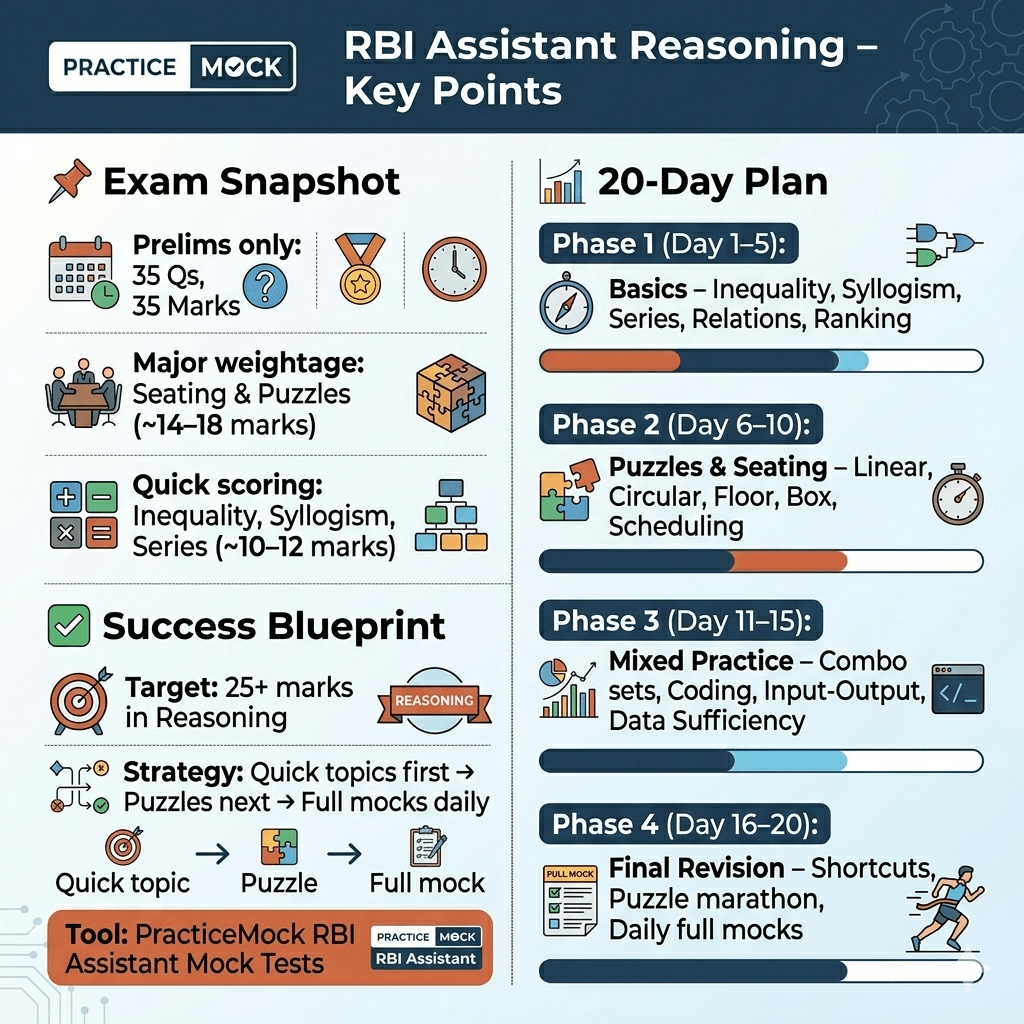
This 20‑day plan is divided into four phases of 5 days each. The first phase builds accuracy in easy topics like inequalities, syllogism, and series. The second focuses on puzzles and seating arrangements. The third emphasizes mixed practice under timed conditions. The final phase is dedicated to full mock tests and confidence building. By integrating PracticeMock’s RBI Assistant Mock Tests, aspirants can simulate exam conditions, identify weak areas, and steadily improve their speed and accuracy.
Phase 1 (Day 1–5): Basics & Accuracy
This phase focuses on quick‑scoring topics like inequalities, syllogism, and series. These are easy to master and provide 10–12 marks quickly. Daily sectional tests ensure accuracy.
- Day 1: Inequalities (50 questions)
- Day 2: Syllogism (traditional + possibility cases)
- Day 3: Alphanumeric Series (missing/wrong number)
- Day 4: Direction Sense + Blood Relations
- Day 5: Order & Ranking + Revision
- Mock Test: 1 sectional test daily (PracticeMock Reasoning sectional)
Phase 2 (Day 6–10): Puzzles & Seating Mastery
This phase builds speed in puzzles and seating arrangements, which dominate the section. Practice multiple variations daily to improve accuracy and confidence.
- Day 6: Linear arrangement (single/double row)
- Day 7: Circular arrangement (inside/outside facing)
- Day 8: Floor‑based puzzles
- Day 9: Box puzzles + scheduling puzzles
- Day 10: Mixed puzzle practice (timed sets)
- Mock Test: 1 sectional test daily + 1 full PracticeMock Prelims mock on Day 10
Phase 3 (Day 11–15): Mixed Practice & Speed Tests
This phase combines easy and tough topics under timed conditions. Sectional tests and full mocks simulate exam pressure and help aspirants refine time management.
- Day 11: Full Reasoning sectional test (20 minutes)
- Day 12: Inequalities + puzzles combo practice
- Day 13: Syllogism + seating arrangement combo
- Day 14: Coding‑Decoding + Input‑Output
- Day 15: Logical Reasoning + Data Sufficiency
- Mock Test: 1 full PracticeMock Prelims mock every alternate day
Phase 4 (Day 16–20): Final Revision & Mock Tests
The last phase consolidates learning, revises shortcuts, and builds confidence. Daily full mocks from PracticeMock ensure aspirants are exam‑ready and consistent in scoring.
- Day 16: Revise shortcuts + error log
- Day 17: Full PracticeMock Prelims mock test
- Day 18: Puzzle marathon (6–8 puzzles timed)
- Day 19: Sectional test + weak topic revision
- Day 20: Final PracticeMock Prelims mock test + confidence building
- Mock Test: Daily full mock from PracticeMock + sectional revision
Final Word
With the Prelims exam scheduled for 11th April 2026, aspirants have exactly 20 days to refine their Reasoning preparation. This plan balances accuracy in basics, mastery of puzzles, and speed in mocks. Consistent practice ensures aspirants secure high marks in Reasoning.
FAQs
35 questions worth 35 marks, to be solved in 20 minutes.
Seating arrangement and puzzles dominate, while inequalities, syllogism, and series provide quick scoring opportunities.
No, it is exclusive to Prelims.
- Sign Up on Practicemock for Updated Current Affairs, Topic Tests and Mini Mocks
- Sign Up Here to Download Free Study Material
Free Mock Tests for the Upcoming Exams
- IBPS PO Free Mock Test
- RBI Grade B Free Mock Test
- IBPS SO Free Mock Test
- NABARD Grade A Free Mock Test
- SSC CGL Free Mock Test
- IBPS Clerk Free Mock Test
- IBPS RRB PO Free Mock Test
- IBPS RRB Clerk Free Mock Test
- RRB NTPC Free Mock Test
- SSC MTS Free Mock Test
- SSC Stenographer Free Mock Test
- GATE Mechanical Free Mock Test
- GATE Civil Free Mock Test
- RRB ALP Free Mock Test
- SSC CPO Free Mock Test
- AFCAT Free Mock Test
- SEBI Grade A Free Mock Test
- IFSCA Grade A Free Mock Test
- RRB JE Free Mock Test
- Free Banking Live Test
- Free SSC Live Test