


Most RBI Grade B aspirants start preparation with confidence—but very few actually know where they stand. Reading concepts feels comfortable, but the real exam reality only appears when you sit for a mock test. That is exactly why the First 5 Mock Tests Challenge is important. It is not about scoring high; it is about discovering your real level, weak areas, and exam temperament. In this blog, we’ll break down how your first five mocks can become the strongest foundation of your RBI Grade B 2026 journey.
Why the First 5 Mock Tests Matter More Than You Think
Mock tests are often treated as practice tools, but for RBI Grade B, they are actually diagnostic tools. Your first five tests act like a mirror and don’t judge you, they reveal you.

At this stage, most aspirants:
- Overestimate preparation level
- Misjudge speed and accuracy
- Ignore exam pressure factor
But RBI Grade B is not just knowledge-based. It is a performance exam. The RBI Grade B Exam Pattern demands both accuracy and time control, especially in Phase 1.
These first five mocks tell you:
- Where you actually stand
- Which sections are holding you back
- How you behave under pressure
First 5 Mock Tests Challenge
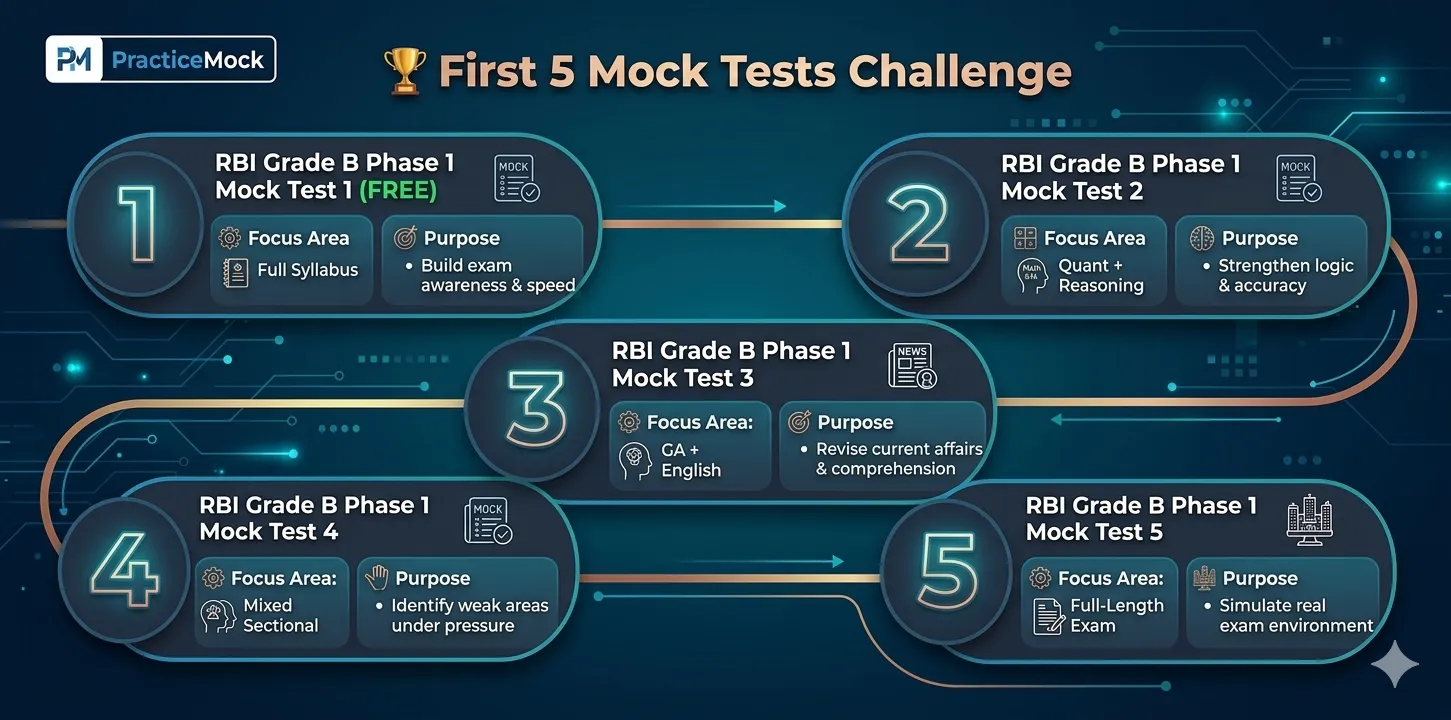
The First 5 Mock Tests Challenge: The Real Objective
Let’s be clear—this challenge is not about scoring 80+ marks. The real goal is:
- Understanding your baseline score
- Identifying weak subjects
- Learning time distribution per section
- Building exam temperament
Think of it as a benchmark phase, not a competition phase. Your preparation for RBI Grade B 2026 becomes meaningful only when you know your starting point.
Mock Test 1–2: Accept the Reality Phase
The first two mocks will likely be uncomfortable. That is normal. At this stage:
- You will feel time pressure
- You will miss easy questions
- You may struggle with accuracy
But this is exactly the purpose.
These mocks help you understand:
- How Quant behaves under time limits
- Why Reasoning puzzles consume time
- Where English traps are placed
Instead of judging yourself, treat these mocks as data collection.
Your goal is to observe, and don’t panic.
Mock Test 3–4: Adjustment Phase
Now things start changing. By the third and fourth mock, you should begin:
- Improving question selection
- Reducing silly mistakes
- Managing section timing better
This is where learning becomes visible. You start understanding:
- Which topics from RBI Grade B Syllabus give quick marks
- Which questions to skip early
- How to balance speed vs accuracy
This phase is where real improvement happens.
You should also start aligning mocks with your RBI Grade B Study Plan. Every mock must connect with revision and concept strengthening.
Mock Test 5: Benchmark Phase
The fifth mock is the most important. This is not practice anymore, but your benchmark test. At this stage, you should evaluate:
- Consistency in score
- Stability in performance
- Section-wise strength
Now compare your performance with the expected RBI Grade B Cut Off trends from previous years. This gives you a realistic idea of where you stand.
Ask yourself:
- Am I improving or just practicing?
- Which section is still weak?
- Can I clear the cutoff with this level?
This mock decides your next strategy shift.
What You Must Analyze After Every Mock Test
Mock tests without analysis are useless. After each test, focus on:
- Time spent per section
- Accuracy percentage
- Question selection strategy
- Repeated mistakes
This is where most aspirants fail. They keep giving mocks but never analyze them properly. Your RBI Grade B Preparation improves only when:
- You fix errors after every test
- You revise weak topics immediately
- You track progress consistently
Common Mistakes in First 5 Mock Tests
Most aspirants lose this challenge because they:
1. Focus only on score
Score is secondary. Improvement is primary.
2. Skip analysis
Without analysis, mocks become meaningless.
3. Compare with toppers too early
Your only comparison should be with your previous test.
4. Ignore time strategy
RBI Grade B is heavily time-dependent, especially Phase 1.
How Mock Tests Improve RBI Grade B Preparation
Mock tests are the closest replica of the real exam. They train you for:
- Time pressure
- Question selection
- Section switching
- Mental stamina
They also help refine your RBI Grade B Exam Date readiness, ensuring you are not just studying—but actually exam-ready.
Candidates who consistently take mocks generally perform better because they are already used to exam conditions.
Linking Mock Tests with Your Study Plan
Your mock test performance should directly shape your preparation.
For example:
- Weak in DI → revise Quant basics
- Weak in puzzles → practice structured sets
- Weak in RC → improve reading speed
This creates a feedback loop: Mock to Analysis to Revision to Improvement to Next Mock Test.
This loop is what builds real selection-level preparation.
Final Strategy for First 5 Mock Tests Challenge
If you treat this challenge seriously, it can change your entire preparation direction. Your focus should be:
- Not scoring high
- But understanding deeply
- Not rushing mocks
- But learning from them
Once you complete your first five mocks properly, you will know:
- Where you stand
- What to fix
- How to move forward
That clarity is more valuable than any early high score.
Final Thought
RBI Grade B preparation is not built in theory—it is built in performance. The First 5 Mock Tests Challenge is your first real step into that performance zone. So don’t ask: “How much did I score?” Instead, ask: “What did I learn about myself today?” Because that answer will decide your selection journey.
- Sign Up on Practicemock for Updated Current Affairs, Topic Tests and Mini Mocks
- Sign Up Here to Download Free Study Material
Free Mock Tests for the Upcoming Exams
- IBPS PO Free Mock Test
- RBI Grade B Free Mock Test
- IBPS SO Free Mock Test
- NABARD Grade A Free Mock Test
- SSC CGL Free Mock Test
- IBPS Clerk Free Mock Test
- IBPS RRB PO Free Mock Test
- IBPS RRB Clerk Free Mock Test
- RRB NTPC Free Mock Test
- SSC MTS Free Mock Test
- SSC Stenographer Free Mock Test
- GATE Mechanical Free Mock Test
- GATE Civil Free Mock Test
- RRB ALP Free Mock Test
- SSC CPO Free Mock Test
- AFCAT Free Mock Test
- SEBI Grade A Free Mock Test
- IFSCA Grade A Free Mock Test
- RRB JE Free Mock Test
- Free Banking Live Test
- Free SSC Live Test