


RBI stands for Reserve Bank of India and is considered the financial backbone of the Indian financial system. It regulates the flow of money in the indian economy along with the price stability and financial discipline in the market. For this, the RBI uses a monetary policy that heavily relies on different types of rates. As a banking aspirant, you must have an idea of why a particular type of rate is used and what kind of impact it has on a particular situation. In this blog, we are going to discuss different rates used in RBI, their purpose and impact.
Different Rates used in RBI
The different types of rates used in RBI are one of the important information for those who are planning to give banking exams, such as SBI PO, IBPS PO, RBI Assistant, LIC AAO and NIACL AO. The different types of rates are-

Repo Rate
Repo Rate full form is Repurchase Agreement or Repurchasing Option. Banks obtain loans from the Reserve Bank of India (RBI) by selling qualifying securities. The current Repo rate in India is 5.50%, as announced by RBI’s Governor Sanjay Malhotra on 6 August 2025 in the RBI MPC Meeting. Repo rates are usually applied to maintain liquidity and control inflation rates.
If repo rates increase, then borrowing becomes costlier and hence reduces the money supply in the market and controlling inflation. Whereas if repo rates decrease, then loans become cheaper, which boosts economic activity.
Reverse Repo Rate
The reverse repo rate is the rate at which the RBI borrows funds from the country’s commercial banks. It is to reduce the overall supply flow of money in the economy. In the reverse repo rate, the commercial banks deposit their excess funds with the Reserve Bank of India and earn interest from the deposit. When the rate is low, the money supply in the economy gets higher as banks lend more and reduce their deposits with the RBI. The current reverse repo rate in India is at 3.35%. The higher the repo rates, the banks will deposit the money with RBI instead of lending, reducing the liquidity in the market. Lower repo rates push banks to lend more, increasing liquidity.
Cash Reserve Ratio
The Cash Reserve Ratio (CRR) is a key monetary policy tool used by the Reserve Bank of India (RBI) to regulate liquidity and ensure financial stability. It refers to the portion of a bank’s total deposits that must be maintained as cash with the RBI, without earning any interest. The purpose of the cash reserve ratio is to make sure that banks always maintain a certain liquidity buffer and to control inflation. For example, if CRR is 4%, and a bank has deposits of Rs. 100 crore, it must keep Rs. 4 crore with the RBI.
Statutory Liquidity Ratio
Statutory Liquidity Ratio(SLR) is the minimum percentage of deposits that commercial banks are required to maintain in the form of liquid assets such as cash, gold or approved government securities before offering credit. Here are a few examples of approved SLR securities:
- Dated securities of the Government of India
- Treasury Bills of the Government of India
- Dated securities of the Government of India are issued from time to time under the market borrowing program and the Market Stabilisation Scheme.
- State Development Loans (SDLs) are issued from time to time under their market borrowing program.
- Any other instrument may be notified by the Reserve Bank of India.
If the SLR is higher, then it reduces the lending capacity of banks. Whereas when the SLR decreases, the lending capacity increases, boosting activity in the economy.
Marginal Standing Facility (MSF) Rate
MSF is the rate at which commercial banks can borrow overnight funds from RBI in case of emergencies when they are unable to borrow from interbank markets. Basically, MSF is a safety net for banks in times of liquidity crisis. As MSF rates are usually higher than the repo rates, banks use them only in times of need.
Bank rate
The rate at which the RBI lends to commercial banks without any collateral for long-term loans. It does not include repurchase agreements. It helps in controlling long-term credit in the economy. If the bank rate increases, it makes borrowing expensive, reducing the credit flow in the market.
Liquidity Adjustment Facility(LAF)
To manage short-term liquidity in the banking system, LAF is used as it includes both Repo and Reverse repo rates. It balances liquidity by releasing funds through repo rates and absorbing the surplus through reverse repo rates.
Marginal Cost of Funds-Based Lending Rate (MCLR)
The minimum interest rate below which the banks cannot lend, except in some special cases. It is linked to the cost of funds for banks. The rate is used to ensure fair loan pricing. When the repo rate is reduced by the RBI, MCLR also tends to fall, making loans Cheaper for customers.
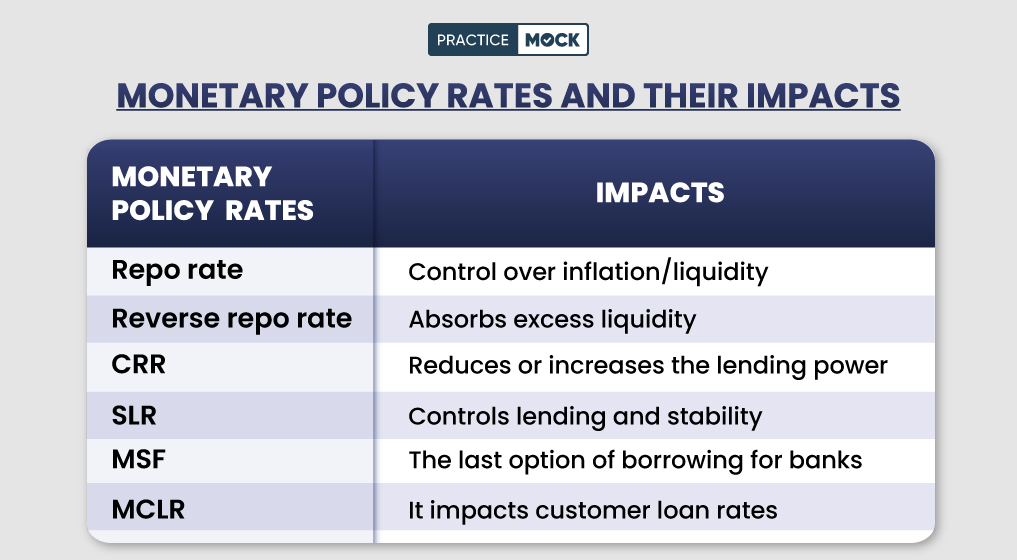
Monetary Policy Rates and Their Impacts
In this section, we are providing a list of monetary policy rates and the impact they have on the indian economy.
| Monetary policy rates | Impacts |
| Repo rate | Control over inflation/liquidity |
| Reverse repo rate | Absorbs excess liquidity |
| CRR | Reduces or increases the lending power |
| SLR | Controls lending and stability |
| MSF | The last option of borrowing for banks |
| MCLR | It impacts customer loan rates |
Conclusion
In this article, we have given all the necessary details regarding the different rates in RBI. We have also provided a table for quick revision. If you want to learn more such content and notes, you can take our banking subscription. To practice questions from other general awareness topics, you can take our mock test series.
Join our exclusive Telegram group where our experts are ready to answer all your queries, guide you in banking exam preparation, and give personalised tips to boost your success. Get access to real-time solutions, expert advice, and valuable resources to improve your study journey.

FAQs
The different types of rates in RBI are Repo rate, Reverse repo rate, Cash Reserve Ratio (CRR), Statutory Liquidity Ratio(SLR), Marginal Standing Facility (MSF) Rate, Bank rate, Marginal Cost of Funds-Based Lending Rate (MCLR).
RBI regulates repo rates and other rates based on the inflation and recession rates in the current market situation.
The current repo rate as of September 2025 is 5.50%.
- Sign Up on Practicemock for Updated Current Affairs, Topic Tests and Mini Mocks
- Sign Up Here to Download Free Study Material
Free Mock Tests for the Upcoming Exams
- IBPS PO Free Mock Test
- RBI Grade B Free Mock Test
- IBPS SO Free Mock Test
- NABARD Grade A Free Mock Test
- SSC CGL Free Mock Test
- IBPS Clerk Free Mock Test
- IBPS RRB PO Free Mock Test
- IBPS RRB Clerk Free Mock Test
- RRB NTPC Free Mock Test
- SSC MTS Free Mock Test
- SSC Stenographer Free Mock Test
- GATE Mechanical Free Mock Test
- GATE Civil Free Mock Test
- RRB ALP Free Mock Test
- SSC CPO Free Mock Test
- AFCAT Free Mock Test
- SEBI Grade A Free Mock Test
- IFSCA Grade A Free Mock Test
- RRB JE Free Mock Test
- Free Banking Live Test
- Free SSC Live Test