


SBI is India’s largest public sector bank, and since the government is the major stakeholder, the job is considered very close to a government job. Working in SBI gives you respect, job security, and stability that is rare in the corporate world.You will also get proper training and opportunities to grow in your career. The biggest advantage is the stability and timely salary. So if you seriously want to prepare for the SBI Clerk exam. You need to focus on all sections equally. When it comes to the numerical ability section of the SBI Clerk Prelims exam, Data Interpretation (DI) plays a very important role. Every year, 10-15 questions are asked on this topic. And scoring well in DI can make a big difference in your overall score. DI questions test your calculation speed, ability to analyze data, find patterns, and apply basic arithmetic concepts like percentages, ratios, and averages. Do you know that if you practice DI sets regularly, you can easily attempt these questions with accuracy in the SBI Clerk exam. In this blog, we will cover the types of DI asked in SBI Clerk, the weightage of DI in previous years, and some tips to solve DI questions quickly. We have also provided a free PDF with practice questions that you can download and solve to improve your preparation for SBI Clerk 2025.
Types of DI Asked in SBI Clerk Prelims
In the SBI Clerk Prelims exam, candidates can expect questions from different types of Data Interpretation (DI) sets. These questions are designed to check how well you can understand data and perform quick calculations. The common types of DI that usually appear are:

1. Bar Graphs: In this type, the data is shown in vertical or horizontal bars. The height or length of the bar represents the value. Questions are generally based on simple arithmetic like addition, subtraction, percentages, or ratios. For example, a bar graph is given representing the sales of a company over four years, and you are asked to calculate in what percent of years sales increased the most, and so on.

2. Table Charts: The data is presented in the form of a table with rows and columns. You may be asked to compare different values, calculate totals, or work on parameters like percentage increase or average. For example, a table showing the production of different companies in different years, and the questions will ask you to calculate things like which company’s production grew the most between 2020 and 2022?
3. Line Graphs: A line graph shows data points connected by lines. It is mostly used to represent changes or trends over a period of time, like profit growth, sales figures, or population rise. For example, you may be asked to find out which year the profit was maximum.
4. Pie Charts: A pie chart is a circle divided into slices, where each slice represents a proportion of the total. You may get questions where you have to calculate actual values from percentages or compare different slices. For Example, if a pie chart shows the market share of different companies, and the total market size is given, you need to calculate the actual revenue of each company.
5. Missing DI: In this type, some parts of the data are missing, and you have to find them by using the given conditions or relationships. It requires careful reading and logical calculation. For example, a table showing the marks of students in different subjects, but one value is missing, and you have to find it.
6. Caselets: These are paragraph-based DI questions where no table, graph, or chart is given. Instead, all the data is written in a descriptive form, and you need to understand and organize it before solving. For example, a passage may be given related to the number of students in the classroom, along with the percentage of girls and the number of boys in the classroom. You need to find the average number of girls and boys in the classroom.
Check SBI Clerk Notification 2025
Weightage of DI in SBI Clerk Prelims
The number of DI (Data Interpretation) questions in the SBI Clerk Prelims changes slightly every year, depending on the difficulty level of the exam. If we look at the past few years, around 5 to 11 DI questions have been asked regularly. Caselet DI, which comes in the form of a paragraph without charts or tables, has been asked only in some years. When caselets appear, they often take more time because you need to carefully read the entire passage before solving.
On average, you can expect around 5–10 DI questions in your paper. This means that DI alone contributes to almost 20–25% of the Quantitative Aptitude section in prelims. That’s why experts advise students to practice all types of DI – bar graphs, tables, pie charts, line graphs, and caselets. With regular practice, DI can actually become one of the most scoring parts of your paper.
Best Study Resources for SBI Clerk Exam 2025
Most Important Data Interpretation Questions for SBI Clerk 2025
Here are some important and expected questions of Data Interpretation for the SBI Clerk. Have a look:
Directions: Answer the questions based on the information given below.
A shopkeeper sold two types of laptops i.e. Ultrabooks and Netbooks. The bar graph given below shows total number of laptops sold and number of Ultrabooks sold on different days of a week.
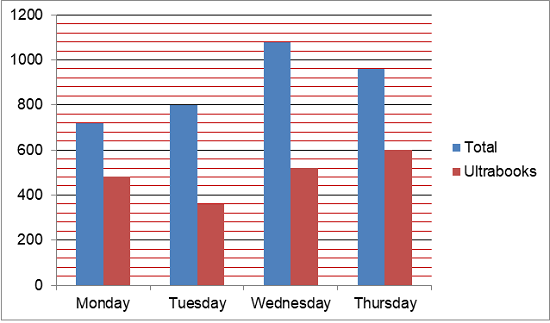
Question 1: If average number of laptops sold on Thursday and Friday is 768 and ratio of number of Ultrabooks to Netbooks sold on Friday is 5:3, then find the number of Ultrabooks sold on Friday.
A) 360
B) 216
C) 320
D) 240
E) None of these
Question 2: Average number of laptops sold on Monday and Wednesday together is:
A) 1000
B) 800
C) 900
D) 600
E) None of these
Question 3: Ratio of number of Ultrabooks to number of Netbooks sold on Tuesday is:
A) 7:11
B) 9:11
C) 9:10
D) 8:9
E) None of these
Question 4: Number of Netbooks sold on Thursday is how much percent more/less than that on Monday.
A) 50%
B) 25%
C) 30%
D) 40%
E) None of these
Question 5: If number of Netbooks sold on Saturday is 75% more than that on Wednesday, then find number of Ultrabooks sold on Saturday given that total number of laptops sold on Saturday is 1440.
A) 460
B) 320
C) 440
D) 480
E) None of these
Download the Free PDF of Data Interpretation Questions
Download the free PDF of Data Interpretation questions for SBI Clerk and practice Data Interpretation sets. These questions are based on the latest exam pattern to help you improve speed and accuracy. It helps make your preparation more productive for scoring well in the numerical ability section.
Tips to Solve DI in SBI Clerk 2025 Prelims
1. Read the given data carefully
Before you start solving the DI, take a minute to read the entire DI set carefully. What students do they directly begin calculating without understanding what the question is actually asking. First, look at the chart, table, or paragraph and note what data is given. Then, carefully read the questions to know exactly what needs to be calculated.
2. Make the Basics of Arithmetic Strong
If your arithmetic is strong, you can easily solve the DI. Topics like percentages, averages, ratios, and profit & loss are the backbone of DI. For example, if you know how to quickly calculate percentage increase or average values, solving a DI set will become much faster. So, focus on strengthening these basics during your preparation.
3. Practice Approximation & Quick Calculation
Speed matters a lot in SBI Clerk Prelims. Many times, you don’t need to calculate the exact value. For instance, if you get 19.89%, you can round it off to 20% and still arrive at the correct answer (unless the options are very close). Developing this habit of approximation will save you a lot of time, especially when options are far apart.
4. Work on Speed Maths
DI is all about calculations, and if your calculation speed is slow, you will waste too much time. To improve, revise multiplication tables at least till 25, squares till 50, and cubes till 30. Also, practice mental maths tricks like breaking numbers for faster addition or using Vedic maths shortcuts. These small things make a big difference in the exam.
5. Give Extra Attention to Caselet DI
Caselet questions are slightly trickier because no chart or graph is given. Instead, all the information is written in a paragraph. You have to carefully read the data, organize it in your mind (or on paper), and then solve. Many candidates struggle here because they skip practicing caselets. Make sure you solve at least 10–15 sets before the exam so you are comfortable handling them.
6. Solve Previous Year Papers
SBI Clerk DI sets often follow a similar pattern every year. By solving previous year DI questions, you get familiar with the type of questions asked and the level of difficulty. It also gives you the confidence that if such sets appear again, you can solve them easily. Along with this, attempt sectional mock tests to build speed and accuracy.
7. Don’t Get Stuck on One Set
In the exam, every second counts. If a DI set looks too lengthy or confusing, do not waste time on it. Skip it for the moment and move to the next set. Sometimes, one set can take 6–7 minutes, while another can be solved in just 2–3 minutes. Smart selection of questions will maximize your score. You can always come back to the difficult set later if time is left.
Here is what successful students say about practice mock. Have a look

Related Blog’s on SBI Clerk 2025 Exam
| SBI Clerk Notification | SBI Clerk Exam Pattern |
| SBI Clerk Syllabus | SBI Clerk Salary |
| SBI Clerk Cut Off | SBI Clerk Previous Year Question Paper |
- Sign Up on Practicemock for Updated Current Affairs, Topic Tests and Mini Mocks
- Sign Up Here to Download Free Study Material
Free Mock Tests for the Upcoming Exams
- IBPS PO Free Mock Test
- RBI Grade B Free Mock Test
- IBPS SO Free Mock Test
- NABARD Grade A Free Mock Test
- SSC CGL Free Mock Test
- IBPS Clerk Free Mock Test
- IBPS RRB PO Free Mock Test
- IBPS RRB Clerk Free Mock Test
- RRB NTPC Free Mock Test
- SSC MTS Free Mock Test
- SSC Stenographer Free Mock Test
- GATE Mechanical Free Mock Test
- GATE Civil Free Mock Test
- RRB ALP Free Mock Test
- SSC CPO Free Mock Test
- AFCAT Free Mock Test
- SEBI Grade A Free Mock Test
- IFSCA Grade A Free Mock Test
- RRB JE Free Mock Test
- Free Banking Live Test
- Free SSC Live Test