


When you start preparing for RBI Grade B, one question always comes up: How important are current affairs? The truth is — they’re not just important, they’re game-changers. In Phase 1, they help you clear the cutoff. In Phase 2, they form the backbone of General Awareness and Economic & Social Issues. And in interviews, they test whether you truly understand the RBI, the economy, and national policy. Without strong current affairs preparation, even the most talented aspirants struggle. Along with daily current affairs study, solving RBI Grade B Previous Year Questions helps candidates understand the type of GA questions asked in the exam and the level of preparation required. This blog will show you how to cover current affairs strategically, which sources to trust, and how to integrate them into your RBI Grade B 2026 study plan. Read on to build a preparation strategy that gives you a real competitive edge.
Why Current Affairs Matter in RBI Grade B
Current affairs are woven directly into the RBI Grade B exam pattern. In Phase 1, General Awareness carries the highest weightage. In Phase 2, questions in Economic & Social Issues and Finance often stem from recent developments. Aspirants must remember: RBI is a regulator, so its exam naturally tests awareness of financial markets, monetary policy, and global economic trends.

Exam Relevance
Current affairs are tightly linked to the RBI Grade B exam pattern. In Phase 1, General Awareness carries the highest weightage. In Phase 2, questions in Economic & Social Issues and Finance often draw directly from recent developments. Remember, RBI is a regulator — so the exam naturally tests your awareness of financial markets, monetary policy, government schemes, and global economic trends.
Covering RBI Notifications and Circulars
The Reserve Bank of India regularly issues circulars and notifications that directly shape the financial system. These updates are not just important — they are primary sources for exam questions. Smart aspirants make it a habit to check the RBI’s official website every week, ensuring they stay ahead with authentic, exam‑relevant information.
Why RBI Sources Are Crucial
Unlike secondary compilations, RBI’s own circulars are the most authentic source. For example, the recent notification mandating a Unique Transaction Identifier (UTI) for OTC derivatives is a regulatory change aimed at enhancing transparency. Updates like these are directly exam‑relevant and must be tracked carefully by every aspirant.
Understanding Financial Market Developments
RBI Grade B aspirants should not stop at just reading headlines. The exam tests your deep understanding of financial market changes — like updates in derivative reporting, monetary policy decisions, and inflation trends. To succeed, you need to grasp the details and impact behind these developments.
Example: OTC Derivatives and UTI
OTC derivatives are custom contracts traded outside exchanges. To improve transparency, the RBI now requires a Unique Transaction Identifier (UTI) for every deal — like an Aadhaar number for each transaction. This kind of regulatory change is a perfect example of current affairs that overlap with core concepts, making it highly exam‑relevant.
Sources for Current Affairs Preparation
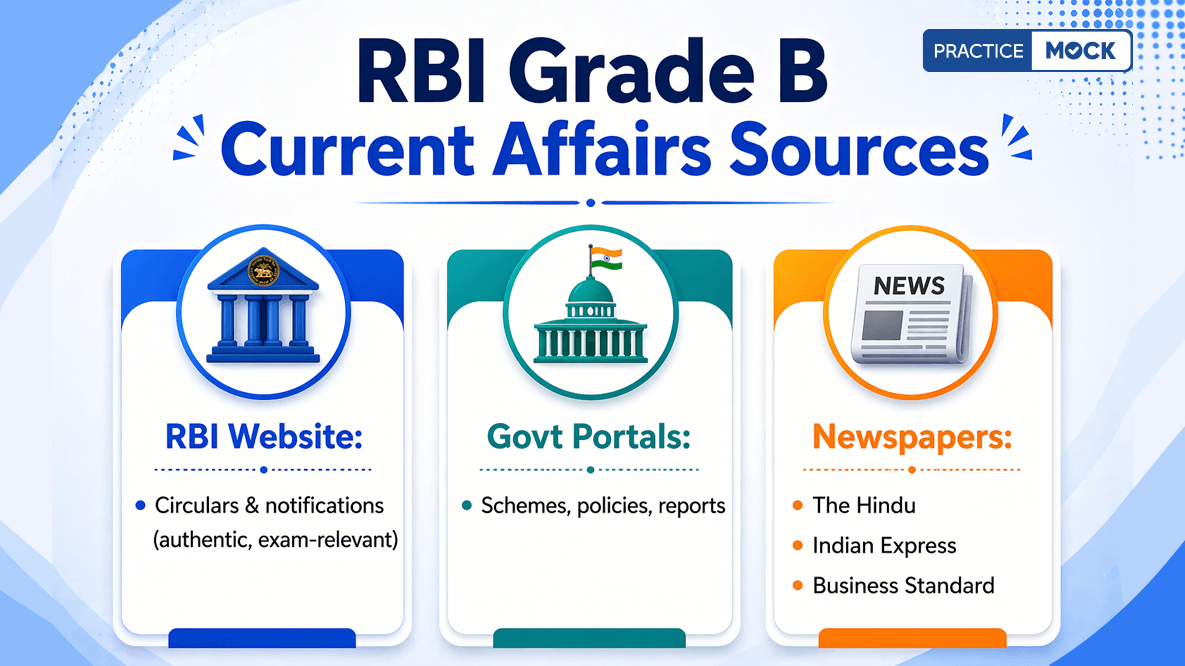
Choosing the right sources is critical. Aspirants should rely on:
- RBI official website for circulars and press releases.
- Government portals for schemes and policy updates.
- Newspapers like The Hindu or Indian Express for daily coverage.
- Magazines like Yojana and Kurukshetra for socio‑economic issues.
Best Resources for Current Affairs
Preparing Current Affairs strategically is far more powerful than just scanning newspapers. Focused resources help you cover high‑weightage topics and recall them quickly in the exam.
Top Resources You Can’t Miss
Bazooka (Monthly Current Affairs 2025): Your ready‑made solution for complete monthly coverage — national & international news, awards, sports, finance, economy, schemes, and obituaries. Curated for banking & government exams, Bazooka’s Free PDFs let you revise anytime and boost memory retention.
PIB Sutra: A highly effective, affordable resource built around PIB updates. Covers schemes, economics, finance, social issues, agriculture, rural development, and reports. Each edition includes descriptive questions and quizzes to sharpen recall and exam readiness.
GA Topic‑Specific Tests: The smartest way to master Current Affairs is practice. These exam‑like tests help you apply knowledge, analyze strengths and weaknesses, and build speed & accuracy. Attempting 7 topic‑wise tests ensures complete coverage.
Newspapers: The Hindu, Business Standard, Mint, Economic Times — daily updates on policies, economy, and financial developments. Focus on editorials, budget highlights, and RBI‑related news for deeper insight.
By combining Bazooka, PIB Sutra, GA Tests, and newspapers, you prepare Current Affairs deeply and strategically — ensuring you’re exam‑ready without missing a single scoring topic.
Avoid Overload
Do not chase multiple compilations. Stick to authentic sources and revise consistently. Quality matters more than quantity.
Strengths and Weaknesses Before Making a Plan
Before diving into current affairs, aspirants must assess their strengths and weaknesses. Some may already be strong in economics but weak in static GK. Others may follow newspapers but struggle with retention.
Self‑Check with Mock Tests
A diagnostic mock test helps identify which areas of current affairs you are comfortable with and which require more focus. This ensures your plan is tailored to your needs.
Building a Realistic Study Plan
A study plan must balance daily reading, weekly revision, and monthly consolidation. Current affairs are vast, so consistency is key.
Plan with Flexibility
Allocate one hour daily for current affairs. Use weekends for revision and practice quizzes. Adjust the plan based on your progress and exam timeline.
Integrating Current Affairs with Syllabus
Current affairs are not standalone—they integrate with the syllabus. For example, RBI’s UTI mandate links to Financial Markets, while government schemes link to Economic & Social Issues.
Smart Integration
Whenever you read a current affair, ask: Which syllabus topic does this relate to? This approach ensures relevance and better recall in exams.
Monthly and Quarterly Revision
Retention is the biggest challenge in current affairs. Without revision, information fades quickly.
Revise Monthly
Use monthly compilations to consolidate. At the end of each quarter, revise again to strengthen memory. This layered revision ensures long‑term retention.
Practice Through Mock Tests
Reading alone is not enough. Aspirants must test themselves regularly. Mock tests simulate exam conditions and help measure how well you recall current affairs under pressure. PracticeMock gives you all of this in one place. Free mock tests, sectional quizzes, monthly PDFs, and complete Phase 2 Video & Non-Video courses. It’s a complete package.
Why Mock Tests Work
They highlight gaps in knowledge, improve speed, and build confidence. Regular practice ensures you are exam‑ready.
Example of Exam‑Relevant Current Affairs: UTI for OTC Derivatives
Let’s take a closer look at the UTI mandate, as it is highly exam‑relevant.
- UTI Definition: A unique 52‑character identifier for OTC derivative transactions.
- Purpose: Transparency, risk monitoring, and global standardization.
- Structure: Includes Legal Entity Identifier (LEI) and additional characters.
- Waterfall Responsibility: CCP → ETP → Counterparties → CCIL.
- Timeline: Applicable for contracts entered on or after January 1, 2027.
This example shows how current affairs overlap with conceptual clarity, making them vital for RBI Grade B preparation.
Handling International Reports and Indices
RBI Grade B often asks about international reports like World Bank’s Ease of Doing Business or IMF’s World Economic Outlook. Aspirants must track these reports and note India’s ranking or key highlights.
Focused Reading
Do not memorize entire reports. Focus on India‑specific data, global trends, and recommendations relevant to RBI’s role.
Linking Current Affairs with Descriptive Papers
In Phase 2, descriptive answers often require current affairs integration. For example, an essay on financial inclusion must include recent government schemes and RBI initiatives.
Practice Writing
Write short notes linking current affairs with syllabus topics. This builds confidence for descriptive papers.
Take a Free Mock Test
This is a job worth pursuing, but remember it comes through a competitive exam. To secure it, you need to prepare with a clear plan. The first step is to know your strengths and weaknesses early. A Free Mock Test is the best way to find gaps before buying paid test series. It shows you where you stand and helps you plan your preparation for the RBI Grade B Exam.
Takeaway
This is a job worth chasing, but remember it comes through a competitive exam. To secure it, you need smart preparation. The first step is to know your strengths and weaknesses early. A Free Mock Test is the best way to spot gaps before spending on paid test series. It shows you where you stand and how to plan your preparation for the RBI Assistant Exam 2026.
[ Click Here to join the PracticeMock Telegram Discussion Group! ]
FAQs
Current affairs are decisive. They dominate Phase 1 GA and form the backbone of Phase 2 papers like Economic & Social Issues and Finance.
Rely on RBI’s official website, government portals, newspapers like The Hindu or Indian Express, and magazines like Yojana and Kurukshetra.
At least 6–8 months before the exam. For Phase 2, focus on one year’s coverage, especially RBI updates and government schemes.
Yes. Mock tests simulate exam conditions, test recall under pressure, and highlight gaps in your preparation.
- Sign Up on Practicemock for Updated Current Affairs, Topic Tests and Mini Mocks
- Sign Up Here to Download Free Study Material
Free Mock Tests for the Upcoming Exams
- IBPS PO Free Mock Test
- RBI Grade B Free Mock Test
- IBPS SO Free Mock Test
- NABARD Grade A Free Mock Test
- SSC CGL Free Mock Test
- IBPS Clerk Free Mock Test
- IBPS RRB PO Free Mock Test
- IBPS RRB Clerk Free Mock Test
- RRB NTPC Free Mock Test
- SSC MTS Free Mock Test
- SSC Stenographer Free Mock Test
- GATE Mechanical Free Mock Test
- GATE Civil Free Mock Test
- RRB ALP Free Mock Test
- SSC CPO Free Mock Test
- AFCAT Free Mock Test
- SEBI Grade A Free Mock Test
- IFSCA Grade A Free Mock Test
- RRB JE Free Mock Test
- Free Banking Live Test
- Free SSC Live Test