


Digital payments are central to India’s financial inclusion and consumer protection agenda. On April 21, 2026, the Reserve Bank of India issued consolidated directions on the Digital Payments – E‑Mandate Framework, replacing earlier fragmented guidelines. For RBI Grade B 2026 aspirants, this reform is highly relevant across General Awareness, ESI, and Finance sections, as it reflects RBI’s regulatory role under the Payment and Settlement Systems Act, 2007 (PSS Act, 2007).
What is the E‑Mandate Framework?
An e‑mandate is a digital authorization for recurring payments such as EMIs, insurance premiums, and subscriptions. It allows customers to set up, modify, or cancel recurring transactions securely, without paper‑based processes.

- Scope: Applies to recurring transactions via cards, UPI, and PPIs (Prepaid Payment Instruments).
- Objective: Simplify recurring payments, enhance security, and strengthen consumer rights.
Key Features of the 2026 Framework
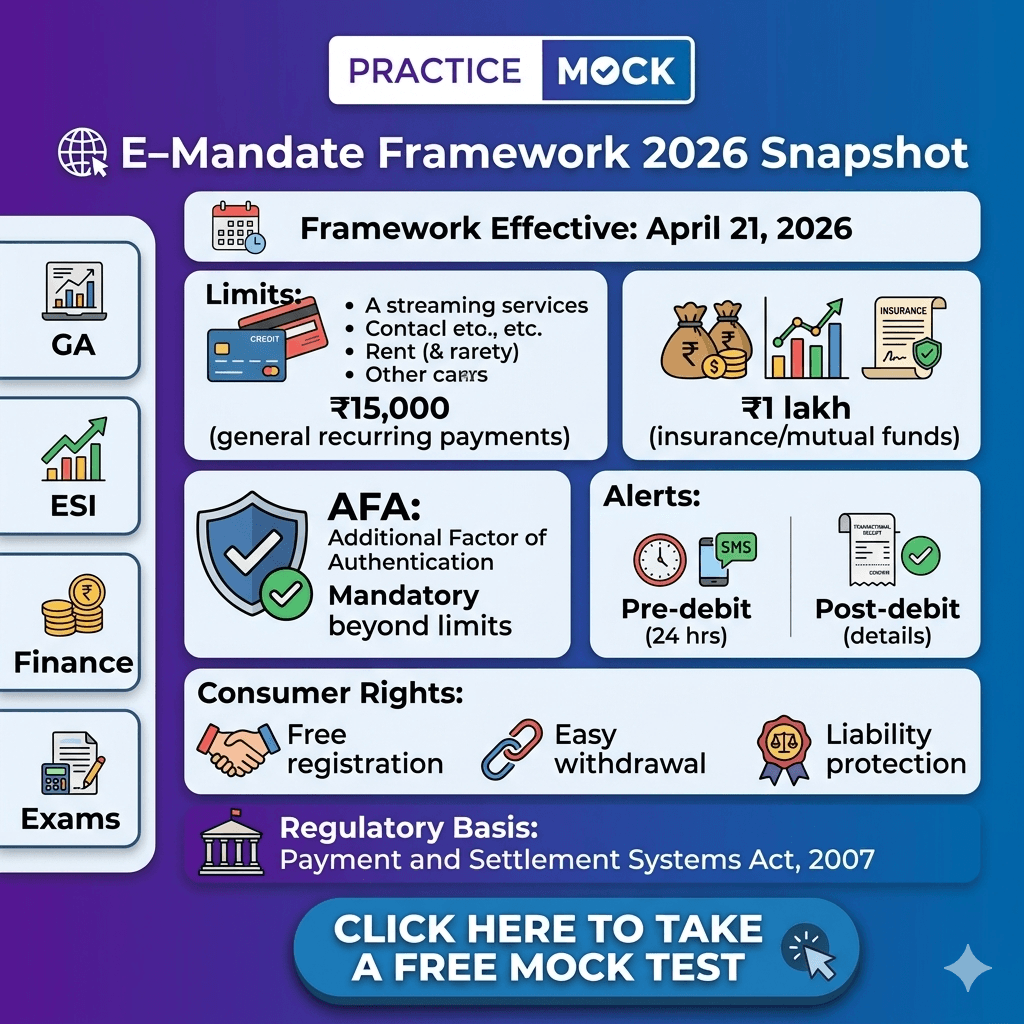
- One‑Time Registration: Customers register mandates with Additional Factor Authentication (AFA).
- Modification/Withdrawal: Mandates can be changed or cancelled anytime.
- Transaction Limits:
- Up to ₹15,000 recurring payments allowed without AFA.
- Enhanced limit of ₹1 lakh for insurance premiums and mutual fund SIPs.
- Beyond these limits, AFA is mandatory.
- Notifications:
- Pre‑debit alerts at least 24 hours before debit.
- Post‑debit alerts with transaction details.
- Consumer Protection: Free registration, grievance redressal mechanisms, and liability safeguards.
- Unified Framework: Consolidates earlier circulars into one master direction.
RBI Grade B 2026 Relevance
- Exam Relevance:
- General Awareness (GA): Questions on RBI’s latest digital payment reforms.
- ESI (Economic & Social Issues): Link to financial inclusion and consumer protection.
- Finance & Management: RBI’s regulatory powers under the PSS Act, 2007.
- Policy Significance:
- Builds trust in digital payments.
- Reduces transaction costs and delays.
- Strengthens India’s digital economy.
Section‑Wise Strategy for Aspirants
Let’s dive into its section-wise preparation:
General Awareness
- Memorize key facts: effective date (April 21, 2026), transaction limits, AFA rules.
- Practice MCQs like: “What is the maximum limit for recurring insurance payments under RBI’s 2026 E‑Mandate?”
ESI (Economic & Social Issues)
- Connect reforms to financial inclusion and digital literacy.
- Prepare short notes linking e‑mandates to rural adoption of UPI and PPIs.
Finance & Management
- Study RBI’s regulatory powers under the Payment and Settlement Systems Act, 2007.
- Understand how grievance redressal and liability protection enhance consumer confidence.
RBI Grade B 2026: Sample Questions on Digital Payments & E‑Mandate Rules
These practice questions highlight RBI’s April 21, 2026 e‑mandate reforms, testing GA, ESI, and Finance exam readiness.
General Awareness (GA)
- What is the effective date of RBI’s consolidated Digital Payments – E‑Mandate Framework, 2026?
- Under the new framework, what is the maximum limit for recurring transactions without Additional Factor Authentication (AFA)?
- For insurance premiums and mutual fund SIPs, what enhanced recurring transaction limit has RBI permitted?
- Which Act empowers RBI to issue directions on payment systems, including e‑mandates?
- How many hours before debit must a pre‑transaction alert be sent to customers under the new rules?
Economic & Social Issues (ESI)
- How does the e‑mandate framework promote financial inclusion in rural areas using UPI and PPIs?
- Which consumer protection features in the 2026 framework strengthen trust in digital payments?
- Explain how grievance redressal mechanisms under the new rules contribute to consumer confidence in financial services.
Finance & Management
- Under the 2026 framework, what is the role of Additional Factor Authentication (AFA) beyond transaction limits?
- How does the Payment and Settlement Systems Act, 2007 provide RBI authority to regulate recurring digital transactions?
Conclusion
The Digital Payments – E‑Mandate Framework, 2026 is a landmark reform ensuring secure, transparent, and consumer‑friendly recurring transactions. For RBI Grade B 2026 aspirants, mastering this topic is crucial—not just for GA but also for ESI and Finance papers. By linking reforms to broader themes of financial inclusion and regulatory oversight under the PSS Act, 2007, aspirants can score high in both objective and descriptive sections.
FAQs
To unify fragmented guidelines and incorporate stakeholder feedback.
Recurring domestic payments via cards, UPI, and PPIs.
Focus on dates, limits, consumer protection measures, and RBI’s regulatory role.
- Sign Up on Practicemock for Updated Current Affairs, Topic Tests and Mini Mocks
- Sign Up Here to Download Free Study Material
Free Mock Tests for the Upcoming Exams
- IBPS PO Free Mock Test
- RBI Grade B Free Mock Test
- IBPS SO Free Mock Test
- NABARD Grade A Free Mock Test
- SSC CGL Free Mock Test
- IBPS Clerk Free Mock Test
- IBPS RRB PO Free Mock Test
- IBPS RRB Clerk Free Mock Test
- RRB NTPC Free Mock Test
- SSC MTS Free Mock Test
- SSC Stenographer Free Mock Test
- GATE Mechanical Free Mock Test
- GATE Civil Free Mock Test
- RRB ALP Free Mock Test
- SSC CPO Free Mock Test
- AFCAT Free Mock Test
- SEBI Grade A Free Mock Test
- IFSCA Grade A Free Mock Test
- RRB JE Free Mock Test
- Free Banking Live Test
- Free SSC Live Test